

Using the James Webb Space Telescope (JWST), astronomers from the Southwest Research Institute have discovered a new moon of Uranus. Thanks to this discovery, the number of known moons of the planet has increased to 29.
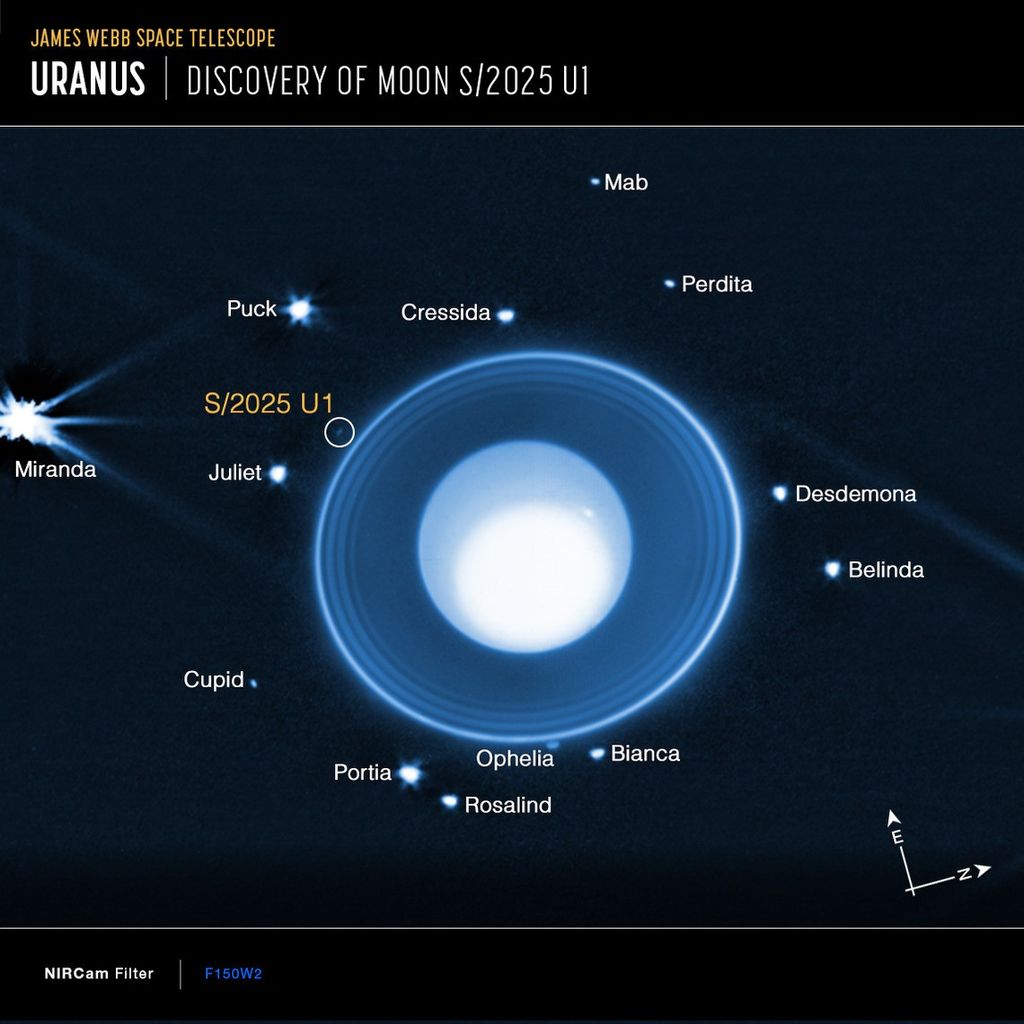
Uranus has the third largest moon system in the Solar System. Until recently, astronomers knew of 28 moons orbiting the seventh planet. The five largest of them were discovered before the middle of the 20th century. Another ten moons were discovered by the Voyager 2 probe, which flew past the icy giant in 1986. The rest were found during follow-up observations carried out by ground-based telescopes and the Hubble Space Observatory.
Now that number has increased to 29. The newly discovered moon was found during observations made by the JWST telescope on February 2, 2025. After studying a series of ten images in the near-infrared range, taken with a 40-minute exposure, astronomers found evidence pointing to the existence of a previously unknown moon, provisionally designated S/2025 U 1.
S/2025 U 1 is a relatively small object. According to preliminary estimates based on the characteristics of other inner moons of Uranus, its diameter is only 10 km. Its small size explains the reason for S/2025 U 1 not being detected by Voyager 2.
The discovered moon belongs to the so-called inner moons. This is the name given to objects located in orbits close to the planet, lying within the region of larger moons. All of Uranus’ inner moons are closely associated with its rings and are thought to have formed as a result of the breakup of a larger body.
“No other planet has as many small inner moons as Uranus, and their complex interactions with the rings hint at a chaotic history that blurs the boundary between the ring system and the moon system,” commented Matthew Tiscareno of the SETI Institute in Mountain View, California, a member of the research team. “In addition, the new moon is smaller and much dimmer than the smallest of the previously known inner moons, making the discovery even more difficult.”
S/2025 U 1 is the 14th member of a complex system of small moons orbiting within the orbits of the largest moons Miranda, Ariel, Umbriel, Titania, and Oberon (all named after characters from English literature). Its orbit lies at a distance of 56,000 km from the ice giant and is close to the planet’s equatorial plane between the orbits of Ophelia and Bianca. Based on the orbital characteristics of S/2025 U 1, astronomers suggest that it may have formed not far from its current location.
It should be noted that the article about the discovery has not yet passed the review stage — however, it is unlikely that there will be any problems with this. In the future, S/2025 U 1 will receive an official name. It has to be approved by the International Astronomical Union.
According to NASA

