
Astronomers have announced the discovery of one of the most massive black holes. This cosmic giant is close to the theoretical limit and is almost 10,000 times more massive than the black hole at the center of our Milky Way.
It is believed that every galaxy in the Universe has a supermassive black hole at its center. The best way to determine their masses is to measure the speeds of the stars orbiting around them. However, this method only works with nearby galaxies. For more distant galaxies, measuring the mass of a black hole is usually only possible when it is active. At the same time, estimates based on the rate of accretion of matter often have a very significant margin of error.
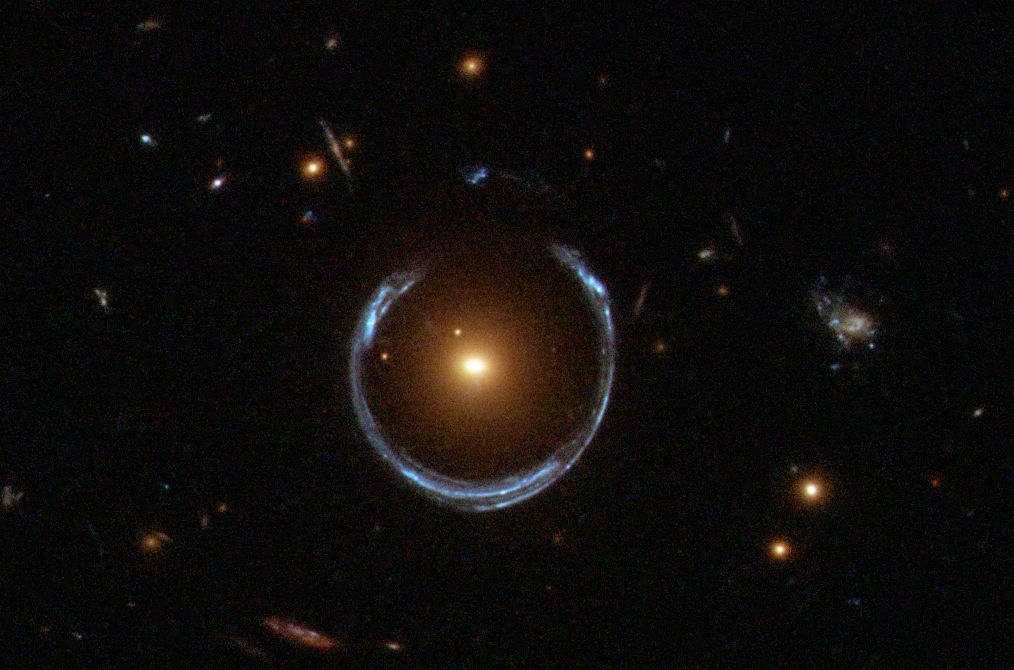
An international team of researchers managed to circumvent this limitation thanks to gravity. They focused on the Horseshoe Galaxy, located 5 billion light-years from Earth. It is one of the most massive galaxies known to us. Its gravity is so strong that it distorts space-time and refracts light from a more distant background galaxy into a giant Einstein ring in the shape of a horseshoe.
Using a combination of gravitational lensing and stellar kinematics, scientists were able to determine the mass of the inactive black hole hidden at the center of the Horseshoe Galaxy. It is 36 billion times greater than the mass of the Sun. By comparison, the mass of Sagittarius A*, the black hole at the center of the Milky Way, is “only” 4.2 million times the mass of the Sun.
According to scientists, the black hole at the center of the Horseshoe Galaxy is one of the 10 most massive black holes ever discovered. And considering that the masses of the others are determined with very significant errors, it may well be the most massive, since its mass is close to the theoretically possible limit.
This discovery is significant because it will help astronomers understand the relationship between supermassive black holes and their host galaxies. It is also important to note that the Horseshoe Galaxy is a so-called fossil group. This is the name given to the final stage of development of the most massive gravitationally bound structures in the Universe, which occurs when they collapse into a single extremely massive galaxy without bright satellites. It is quite possible that all the supermassive black holes that were originally located in neighboring galaxies merged together, giving rise to a gravitational monster lurking at the center of the Horseshoe Galaxy.
According to Phys.org

