

Astronomers witnessed a cosmic explosion that released energy equivalent to 400 billion suns. It was caused by a supermassive star being torn apart by a black hole.
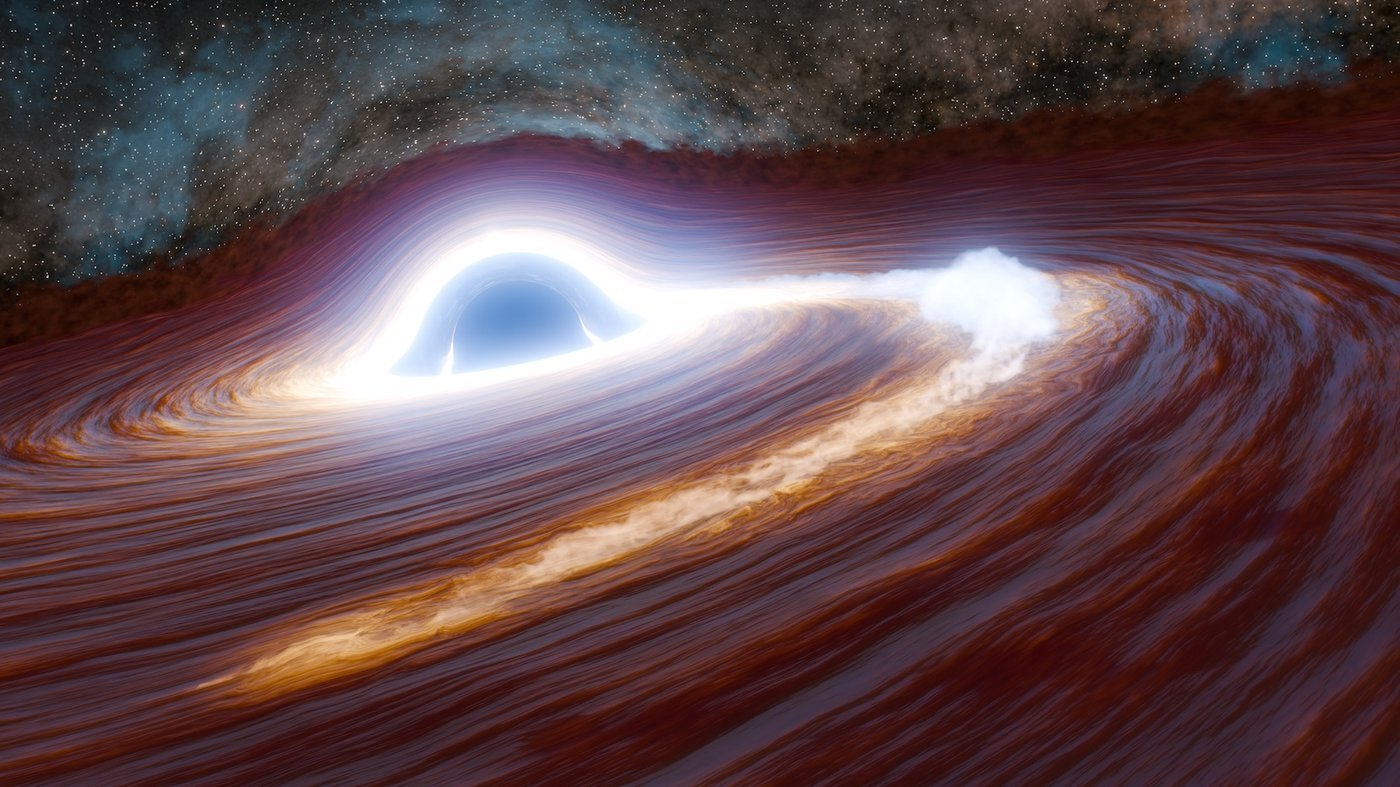
The event, officially designated AT2024wpp (and informally named Whippet), was first discovered by astronomers as part of the Zwicky Transient Facility sky survey. It immediately attracted attention due to its similarity to the cosmic explosion AT 2018cow, which was 10–100 times brighter than an average supernova.
Whippet also resembled another class of objects called “Luminous Fast Blue Optical Transient” (LFBOT). This is an incredibly bright burst of light visible at distances of up to billions of light-years, which usually lasts for several days and emits high-energy radiation ranging from the blue end of the spectrum to ultraviolet and X-rays. Although several dozen such phenomena have been detected, LFBOTs remain poorly understood, although scientists associate them with the destruction of stars.
To solve the mystery of Whippet, researchers observed it using the Liverpool Telescope in the Canary Islands and the Swift spacecraft. They confirmed that its spectrum was shifted toward the blue end of the spectrum and that the object emitted X-rays, as expected from an LFBOT. This, combined with the fact that Whippet had an extremely high temperature, led to the conclusion that the event was caused by a black hole tearing apart a star with its gravity.
Further investigation by Whippet revealed a powerful shock wave propagating from the central source at about 20% of the speed of light, colliding with the surrounding gas. These shock waves dissipated in about six months when they reached the outer gas bubble left over from the destroyed star.
However, scientists have not yet fully understood all the circumstances surrounding Whippet. The team discovered helium moving away from the source at a speed of about 21 million km/h. This suggests that some densely bound structure survived tidal disruption and is moving at a speed of about 2% of the speed of light.
The team believes that this could be a stream of material ejected by the core of a doomed star when it was “spaghettified” by the black hole at the center of Whippet. Another possibility is that this stream of helium was generated by a third body in the system when it was exposed to particles and X-rays ejected by the black hole that had just “devoured” the star.
Earlier, we talked about how the black hole at the center of the Milky Way keeps its explosive past hidden.
According to Space.com

