

An international team of astronomers has discovered a unique star system that has set a new record for compactness. The four stars in it are so close together that this entire “cosmic apartment” could easily fit inside Jupiter’s orbit. The discovery, published in the journal Nature, offers a glimpse into the complex dance of gravity that determines the fate of celestial bodies.
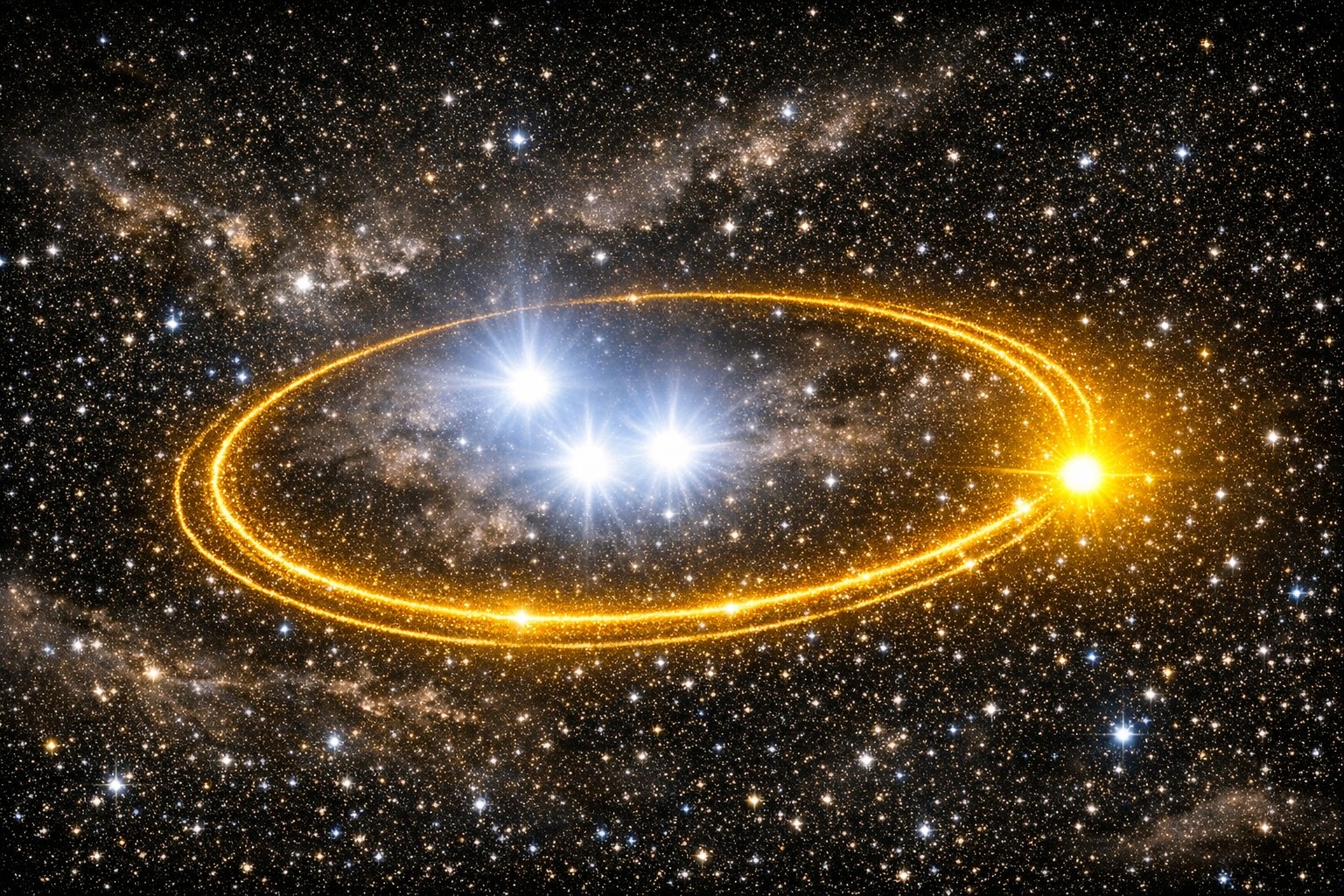
The object, designated TIC 120362137, is a rare example of a hierarchical multiple system. In it, three stars form an extremely close core, while the fourth orbits them at a relatively small distance. The main feature is that it is the most compact system of all known quadruplets: the outer star completes a full revolution around the three inner ones in just 1045 days – the shortest period ever recorded for such configurations.
Transit method
The discovery was made possible by NASA’s TESS space telescope, designed to search for exoplanets. The transit method used by planet hunters worked here, too, but in a different way. Astronomers were looking for triple systems, but encountered an anomaly.
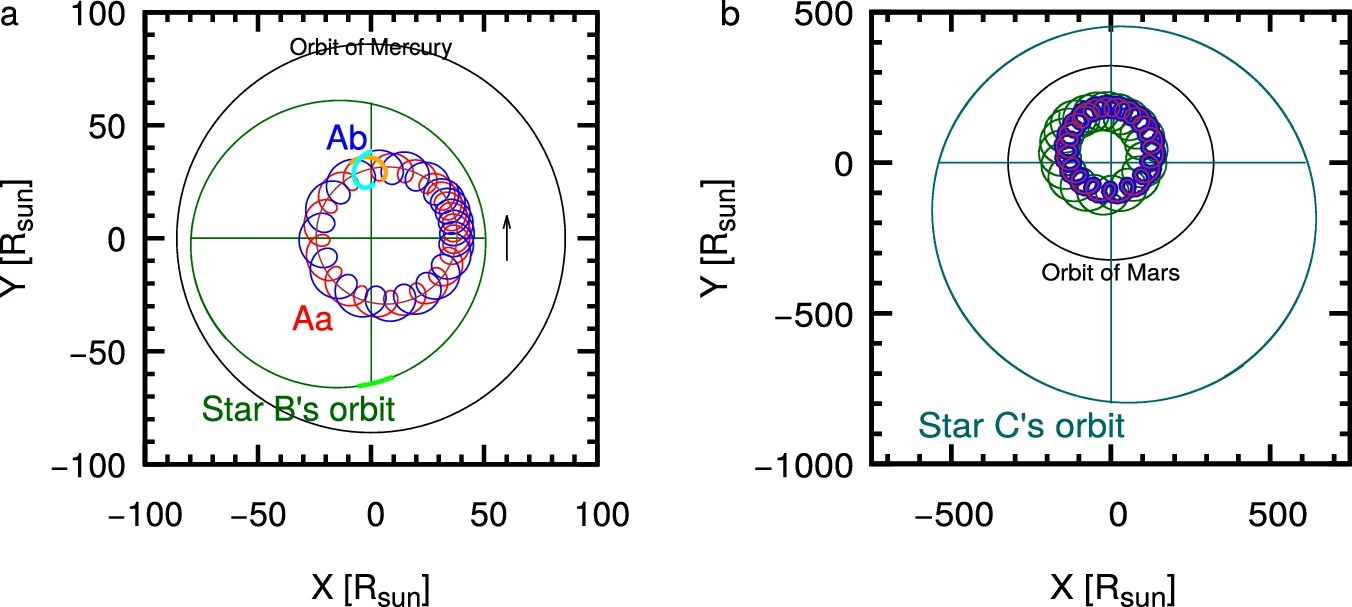
Initially, they recorded eclipses every 1.5 days, which indicated a close binary star system where one component periodically eclipses the other. Then it turned out that every 26 days, the overall brightness of the system drops again, which was caused by a third star. However, even this was not enough to explain all the subtleties of the brightness changes. Careful analysis of data collected from 2019 to 2024 showed that the gravity of a fourth invisible component shifts the timing of the eclipses, revealing its presence.
Portrait of the system: from Mercury to Jupiter
The three inner stars of the system are hotter and more massive than our Sun. They are crowded into a space comparable to the size of Mercury’s orbit. This is an extremely close neighborhood, where gravitational interactions are crucial. The fourth star, on the other hand, is more like the Sun and extends further into an area comparable to Jupiter’s orbit.
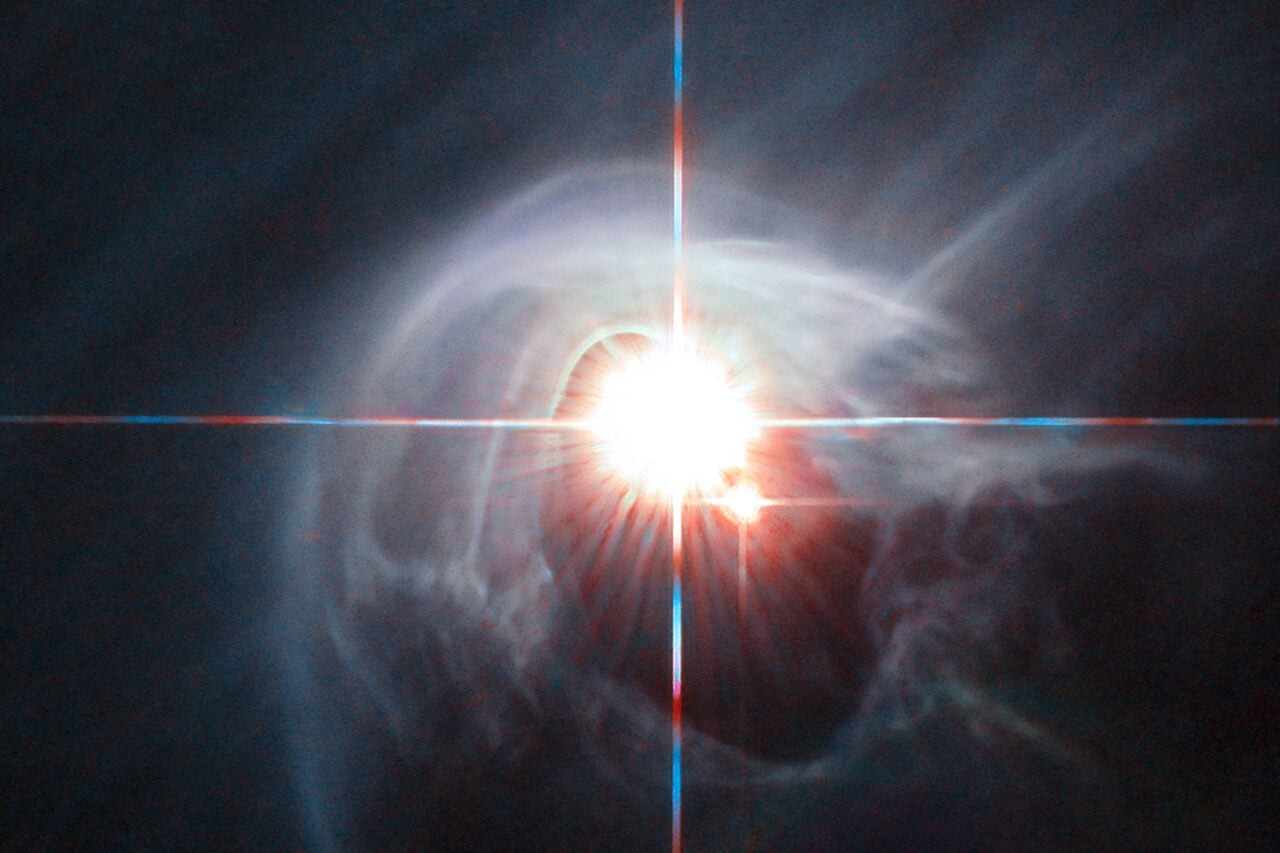
Source: ESA / Hubble & NASA
“Stars are usually born in groups in giant clouds of gas and dust,” explains study co-author Tibor Mitnyan of the University of Szeged. “However, the formation of such compact and orderly hierarchical systems is one of the greatest mysteries of astrophysics, which still raises many questions.”
The future of the system
The unique dynamics of the system allowed scientists to simulate its fate millions of years into the future. In approximately 300 million years, the three inner stars will lose their stability. Two of them will merge into one, and later the third will join this giant core. The result of this double cataclysm will be the birth of a white dwarf – a superdense star core the size of Earth.
The fourth, distant star, evolving independently, will also turn into a white dwarf. Thus, the once close quartet will turn into a pair of white dwarfs orbiting each other with a period of 44 days.
“It’s an amazing conclusion,” adds Mitnyan. “If, billions of years from now, astronomers discover this binary system of white dwarfs, they won’t even guess that it was once such an exotic and close-knit quartet of stars.”
Previously, the “3-Body Problem” was explained.
Provided by Gizmodo

