

Astrophysicist Cosimo Bambi from Fudan University has unveiled an ambitious plan: use terrestrial lasers to accelerate a 1-gram nano-box to one-third the speed of light and deliver it to the nearest black hole, 20–25 light-years away, in 70 years. It will take another two decades for the data to return to Earth, bringing the total duration of the mission to almost a century!
The proposed vehicle is a microchip with a thin-film sail; a stream of photons from multi-petawatt lasers on Earth will give it the necessary momentum. The key condition is to find a sufficiently close dormant black hole, which currently remains a problem for observations.
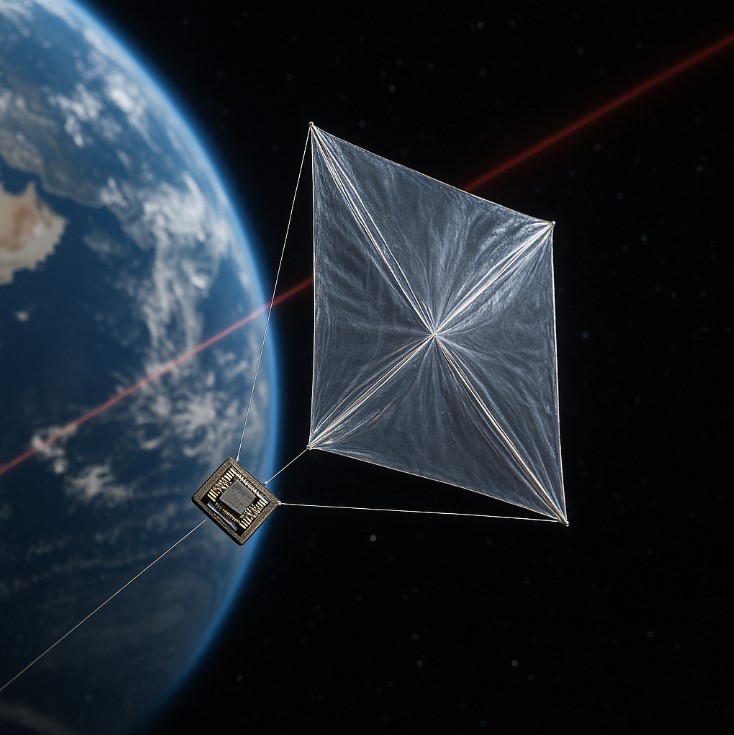
Light is a stream of tiny “balls” called photons. Each of them has a microscopic impulse, so when trillions of photons from a super-powerful multi-petawatt laser simultaneously strike the thin sail of a nanoprobe, they transfer their “momentum” to it and push it forward. The higher the laser power, the denser the light wind and the faster the device accelerates. It’s like a sailboat, only instead of wind, it’s powered by a powerful beam of light.
The technological and financial barriers are still enormous: powerful laser arrays would cost approximately €1 trillion today. However, the author estimates that in 20–30 years, the price could fall to approximately €1 billion — comparable to the budgets of modern scientific missions — while the technology of nanoprobes is being actively developed within projects such as Breakthrough Starshot.
Studying an isolated black hole without environmental noise will allow us to verify the existence of the event horizon and the ultimate validity of general relativity with unprecedented accuracy. The measurements obtained may shed light on the nature of singularities and Hawking radiation, and help distinguish black holes from alternative compact objects such as quasars, dark stars, etc., deepening our understanding of gravity and the evolution of the Universe.
If you are fascinated by the idea of a nanoprobe hurtling toward a black hole, be sure to read our article “The final step before a black hole: everything you wanted to know about neutron stars” — the final stage of evolution before the gravitational abyss. There you will learn how stellar matter is compressed to the density of atomic nuclei, why a magnetar shines brighter than a billion Suns, and how such objects help researchers decipher gravitational wave signals.
According to interestingengineering. eurekalert


.jpg)