

The supermassive black hole at the center of the Circinus galaxy feeds on gaseous material through two spiral arms. This is the conclusion reached by a group of researchers from Leiden University.
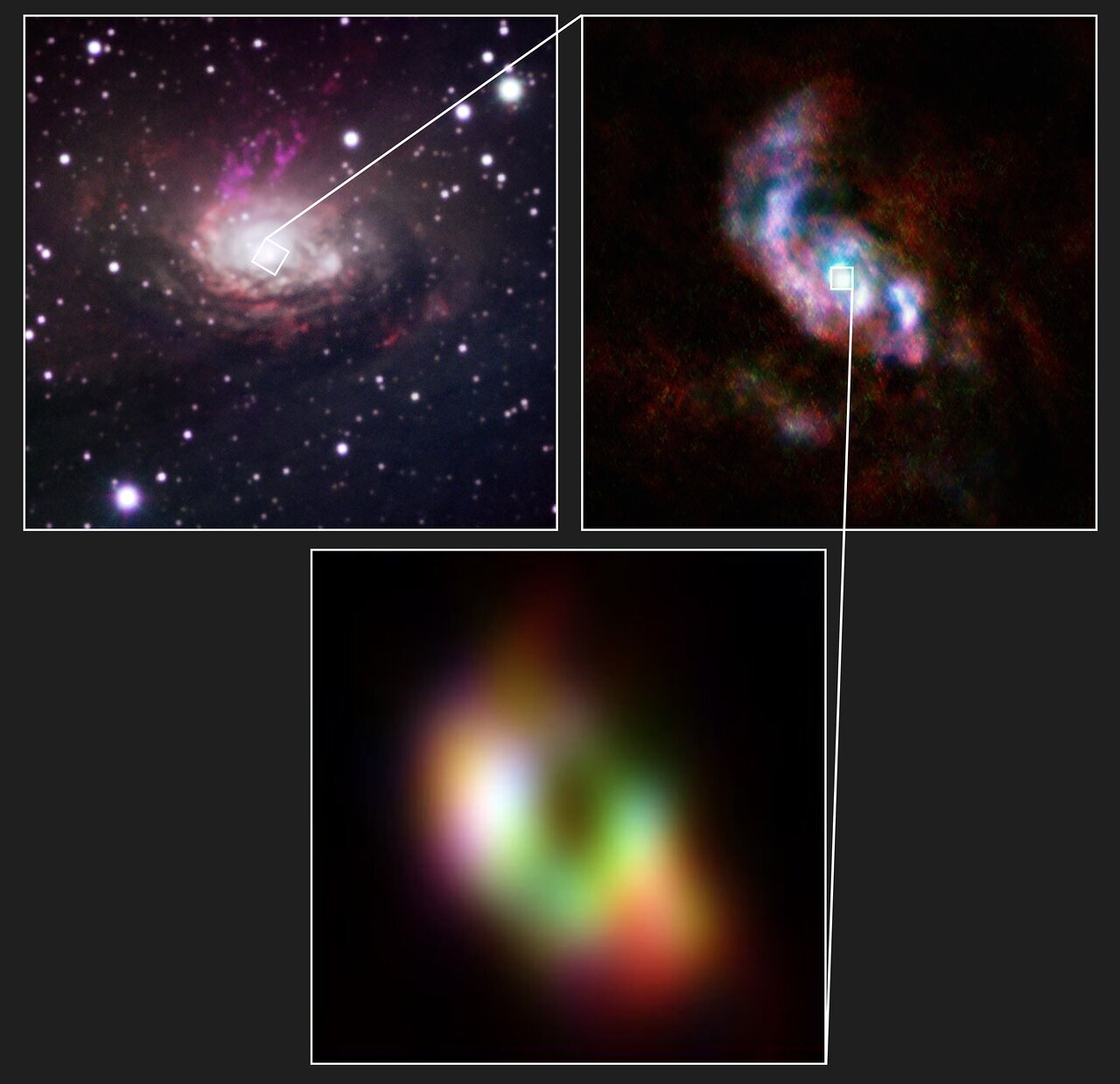
Black holes are often depicted in illustrations as a kind of cosmic whirlpool in which the surrounding gas disk disappears. However, in reality, this is not the case. In order to absorb matter from the accretion disk, a black hole needs some kind of feed channel — otherwise, it will forever spin at a great distance from it.
To better understand the feeding habits of black holes, astronomers used the ALMA radio telescope complex. Its target was the Circulus galaxy, located just 13 million light-years from Earth. Although it is one of the closest large galaxies, it was only discovered in 1977, as it is hidden behind the disk of the Milky Way.
Observations made by ALMA, combined with modeling, revealed the presence of two spiral arms around the supermassive black hole at the center of the galaxy. They serve as a “food pipe,” supplying gas to it. Calculations show that the gas in the arms moves at speeds reaching 150,000 km/h. That’s half the speed of light. Furthermore, it appears that the black hole feeds rather sloppily. A maximum of 12% of the incoming substance is actually absorbed by it, while the rest is ejected back without ever reaching the event horizon.
The discovery raises a number of logical questions about whether all black holes have spiral arms, why they absorb such a small percentage of matter, and what happens to the material they eject. Researchers hope to find answers to these questions with the help of the Event Horizon Telescope, which took landmark photographs of the silhouette of supermassive black holes, and the Extremely Large Telescope, which is being built in Chile.
Earlier, we reported on how James Webb examined the structure of a black hole jet.
According to Phys.org

