

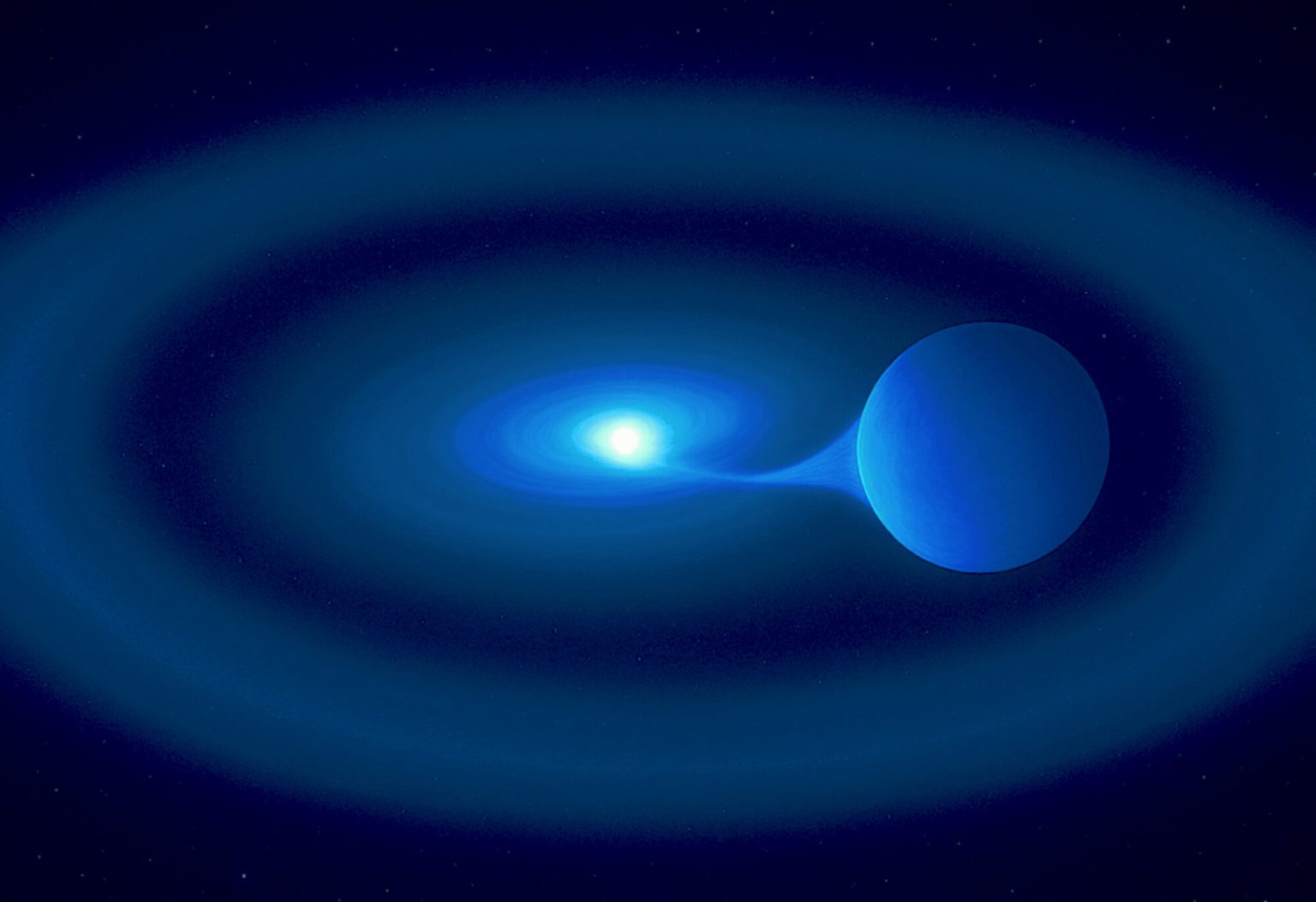
Scientists are observing the V Sagittae system. It consists of a normal star and a white dwarf. The latter tears its companion to pieces with the force of gravity and actively absorbs matter from it.
Space feast
Scientists have published a study of an interesting system in which cosmic cannibalism occurs. Their research showed that the double star, named V Sagittae, burns unusually brightly because an ultra-dense white dwarf is devouring its larger companion in a feeding frenzy.
Experts believe that the stars are very close to each other. They only roll once when they are 12.3 hours old, gradually approaching each other. They say it could cause a huge explosion, so bright that it could be seen with the naked eye from Earth at a distance of about 10,000 light-years.
The conclusions were drawn by an international team of astronomers, including Professor Phil Charles from the University of Southampton, led by Dr. Pasi Hakala from the University of Turku in Finland, together with Dr. Pablo Rodríguez Gil from the Spanish Institute of Astronomy of the Canary Islands and the University of La Laguna.
Bright cosmic ring around V Sagittae
V Sagittae, one of the brightest star systems, has stumped experts since its discovery in 1902. However, new research by scientists shows that this extreme brightness is caused by a white dwarf sucking the life out of its companion star, using the accumulated matter to turn it into a burning hell. This process is so intense that a thermonuclear reaction occurs on the surface of the white dwarf, shining like a beacon in the night sky.
Researchers also discovered a ring of gas, resembling a giant aura, enveloping both stars, which is a consequence of the enormous amounts of energy generated by the insatiable white dwarf.
Dr. Pasi Hakala from the University of Turku noted: “The white dwarf cannot consume all the mass being transferred from its hot star twin, so it creates this bright cosmic ring. The speed at which this doomed stellar system is lurching wildly, likely due to the extreme brightness, is a frantic sign of its imminent, violent end.”
Astronomers believe that the matter accumulating on the white dwarf will likely lead to a new flare in the coming years, during which V Sagittae will become visible to the naked eye. But when the two stars finally collide and explode, it will be a supernova explosion so bright that it will be visible from Earth even during the day.
According to phys.org

