

Spectroscopic studies conducted using the ALMA radio telescope have revealed that the interstellar comet 3I/ATLAS contains a surprising amount of alcohol. However, it will not be possible to organize celebrations because it is methanol that is contained in burning vodka.
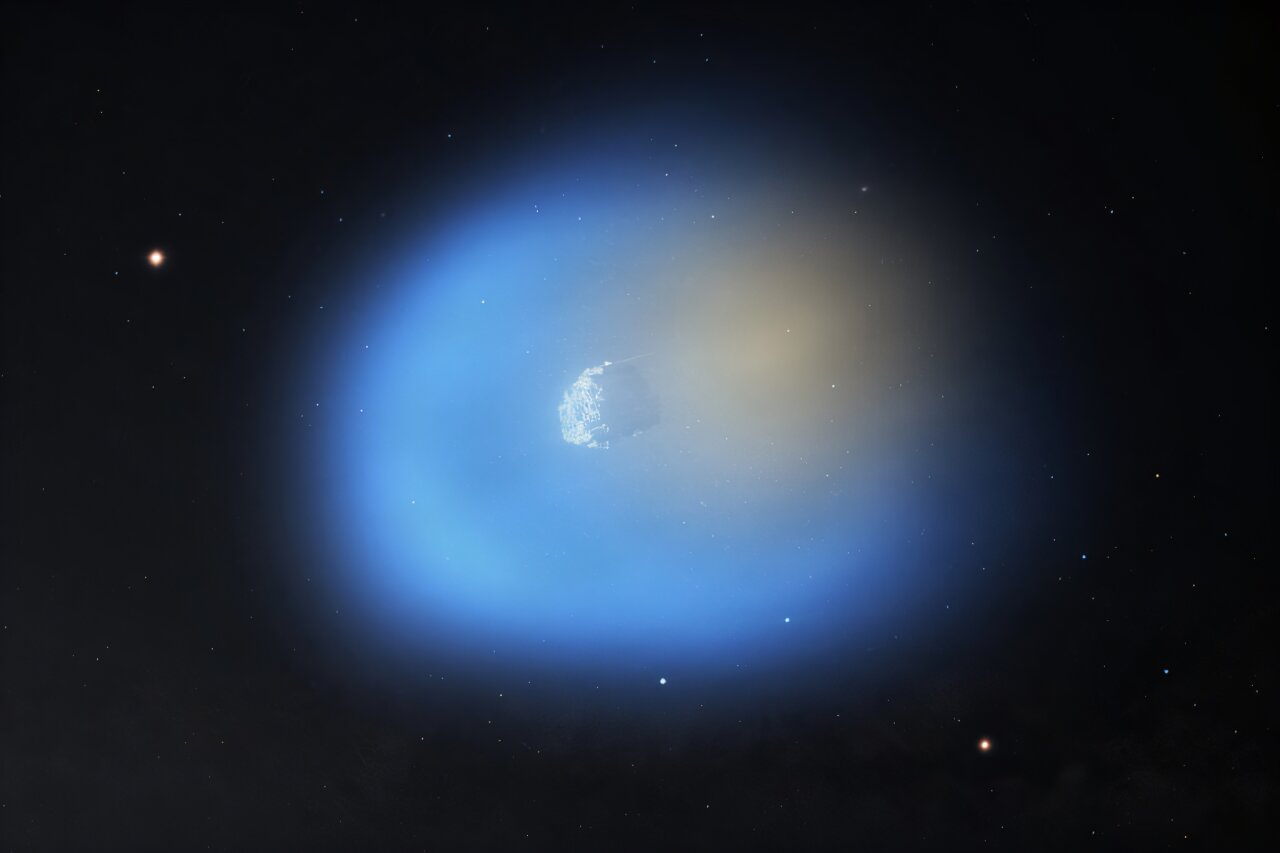
Comet 3I/ATLAS
The interstellar comet 3I/ATLAS is gradually leaving the Solar System. However, publications devoted to it continue to appear from scientists to this day. For example, a study recently appeared on the arXiv preprint server in which the authors found a lot of alcohol on the comet.
In fact, the data that made it possible to determine this was obtained back in the autumn of 2025. Then the comet approached the Sun at its closest distance, and scientists pointed all kinds of astronomical instruments at it. Among them was the large American ALMA radio antenna array.
ALMA is typically used to obtain images of objects in different wavelength ranges beyond the perception of the human eye. But it can also operate in spectrograph mode, i.e., searching for characteristic absorption bands in radiation broken down into different wavelengths, which are characteristic of certain chemical substances.
A lot of alcohol
This technique enabled scientists to determine the chemical composition of the interstellar comet. They did not discover anything particularly unusual on it, roughly the same substances as on the “tailed stars” of our Solar System. However, it also became clear that they were formed under several other conditions.
This makes the current study all the more interesting. ALMA data have enabled the detection of substances such as hydrocyanic acid and methanol on 3I/ATLAS. The latter belongs to alcohol, but it cannot be consumed even in small doses.
However, scientists were still very interested in the presence of these substances, because they are organic and can be transformed into something more complex, which can be considered the building blocks of life. At the same time, the process of evaporation of hydrocyanic acid and methanol from the surface of the interstellar comet turned out to be completely different.
The molecules of the first simply break away from the surface under the influence of solar wind, much like most other substances. Methanol, on the other hand, clings to tiny solid grains and flies away with them.
According to phys.org

