

For the first time in history, scientists were able to measure the polarization of X-rays during a powerful flare on a magnetar. This unique observation, made by the IXPE observatory, reveals details about the behavior of the most magnetic objects in the Universe during their most active phase.
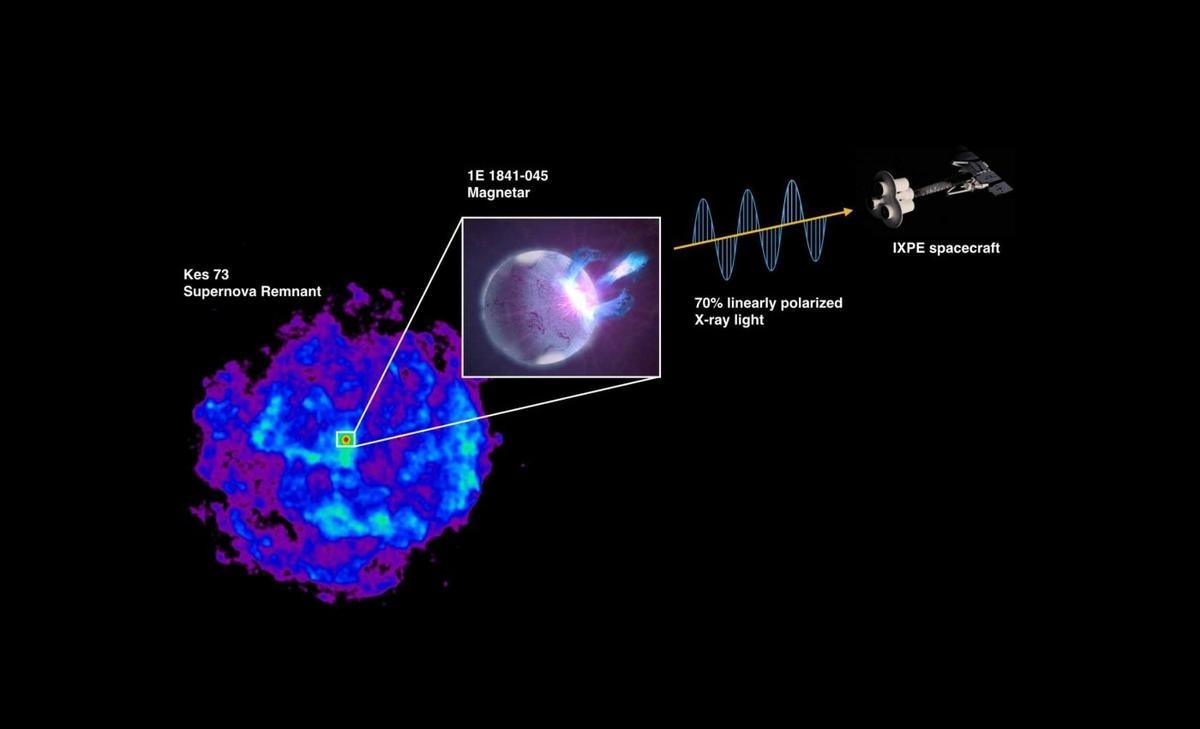
We are talking about magnetar 1E 1841-045. The object is located inside the remnant of supernova Kes 73 at a distance of 8.5 to 9.8 kiloparsecs from Earth, which is approximately equivalent to 28,000 light years. The results of the study are published in The Astrophysical Journal Letters. This object is an extremely dense neutron star with the strongest magnetic fields in the Universe, hundreds of trillions of times stronger than Earth’s magnetic field. It is precisely these objects that are subject to sudden and powerful bursts of radiation.
On August 21, 2024, this magnetar woke up. The Swift, Fermi, and NICER observatories recorded the start of its activity. And after about six weeks, the specialized IXPE observatory joined the observations and carried out revolutionary measurements.
Why is polarization measurement so important?
Light, like waves on the surface of water, has the property of polarization — oscillations in a certain plane. Measuring this characteristic for X-rays reveals the physical processes that generated them and details of the environment through which they passed.
By analyzing how polarization changes with energy, scientists can distinguish between radiation coming from the hot surface of a star and radiation originating high up in its magnetic atmosphere (magnetosphere). The polarization angle indicates the geometry of the magnetic field, and its degree indicates the specific physical mechanism of photon generation.
Revolutionary results and their significance
IXPE measurements revealed an impressive effect. In the 2–3 keV energy range, polarization was about 20%. However, in the harder X-ray range (6–8 keV), this figure rose sharply to 55–70%, indicating the highly ordered, “synchronized” nature of high-energy radiation. At the same time, the polarization angle remained unchanged.

These data are direct evidence that powerful X-ray radiation is generated high in the magnetosphere of the magnetar, rather than on its surface. Two main theories explain its origin: either it is the result of a “natural Compton laser” when electrons accelerate photons, or synchrotron radiation from electrons and positrons heated to millions of degrees and spinning in a magnetic field.
The data obtained, in particular the strong polarization increasing with energy, are best consistent with the synchrotron mechanism. As Rachael Stewart of George Washington University noted, this observation will force scientists to refine existing models, forcing them to take extreme polarization into account.
Future research
This first measurement became an important benchmark. It provides a way to compare the behavior of a magnetar in a flare state and in a quiescent state. Michela Rigoselli from the Italian National Institute for Astrophysics is already planning further observations once the star has calmed down, in order to track the evolution of its properties.
If the polarization angle remains stable, this indicates a simple and unchanging magnetic field configuration. If it changes, this will indicate the presence of several complex radiation zones. Launched in 2021, the IXPE mission continues to transform theoretical debates about neutron stars into questions that can be answered with precision, opening a new chapter in astrophysics.
Earlier, we reported on how magnetars “gifted” Earth with gold and platinum.
According to earth.com

