

Scientists used the South African MeerKAT telescope array to explore the depths of space and caught a record-breaking signal from the early Universe, similar to a laser pulse. Explore the depths of space and detected something resembling a laser pulse. They believe it could be a so-called hydroxyl megamaser—a region of space filled with gas and subjected to shock waves from colliding galaxies.
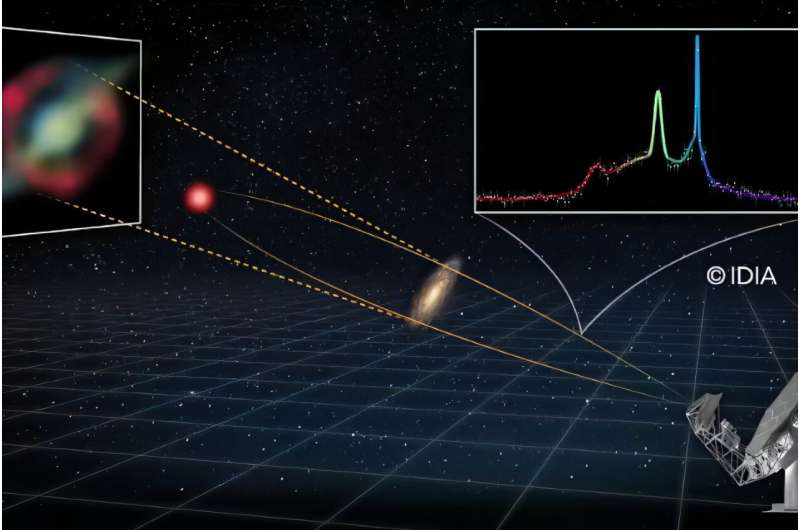
Hydroxyl megamaser
A team of researchers working with the South African MeerKAT radio telescope has reported a strange signal originating from a region of the universe 8 billion light-years away. The signal resembles a laser beam—that is, coherent radiation.
However, scientists are far from believing that they are seeing evidence of some kind of cosmic battle. After all, they know they are dealing with what is known as a hydroxyl megamaser—that is, a natural source of coherent radio emissions. But that doesn’t make the signal any less interesting.
A maser is essentially the same thing as a laser, except that it operates outside the visible spectrum. Such devices have been built on Earth, but in space there are giant versions of them, more powerful than anything humans can imagine. They consist of vast gas clouds that begin to emit radiation when exposed to external factors.
Galactic collisions
Interestingly, scientists simply cannot see with ordinary telescopes what caused the hydroxyl cloud to emit powerful laser radiation. However, they have observed many similar objects much closer to us, leading them to conclude with confidence that this must be a collision of galaxies.
Normally, signals from a distance of 8 billion light-years are barely detectable. This time, the beam was amplified by gravitational lensing. But even that wouldn’t have been enough. More precisely, MeerKAT is powerful enough to pick up this signal. The problem lies elsewhere: among the vast amount of radio emissions that the telescope registers every second, this signal is almost indistinguishable from the rest. So the main challenge is not in detecting it, but in finding it among the multitude of other sources.
What’s next?
Researchers said that this time they were able to detect a signal from the hydroxyl megamaser thanks to a new data processing algorithm. They also noted that there should actually be many more such signals, but our observational techniques are not yet sophisticated enough to detect them.
Perhaps a new generation of radio telescopes, consisting of many antennas, will be more successful in detecting such signals. In addition, it is worth checking the region from which this cosmic laser beam originated for the presence of gravitational waves. Because the collision of galaxies means that the supermassive black holes at their centers have drawn closer together and will soon begin to merge.
According to phys.org

