

Back in 2019, the global gravitational observatories LIGO and Virgo recorded powerful fluctuations in space-time, an event that science designated as GW190521. The prevailing scientific opinion saw this as the result of the merger of two supermassive black holes. However, a new hypothesis from a group of researchers at the Chinese Academy of Sciences offers a much more fantastic explanation. Scientists suggested that we witnessed not just a cosmic cataclysm, but the echo of a collision between black holes in a parallel Universe.
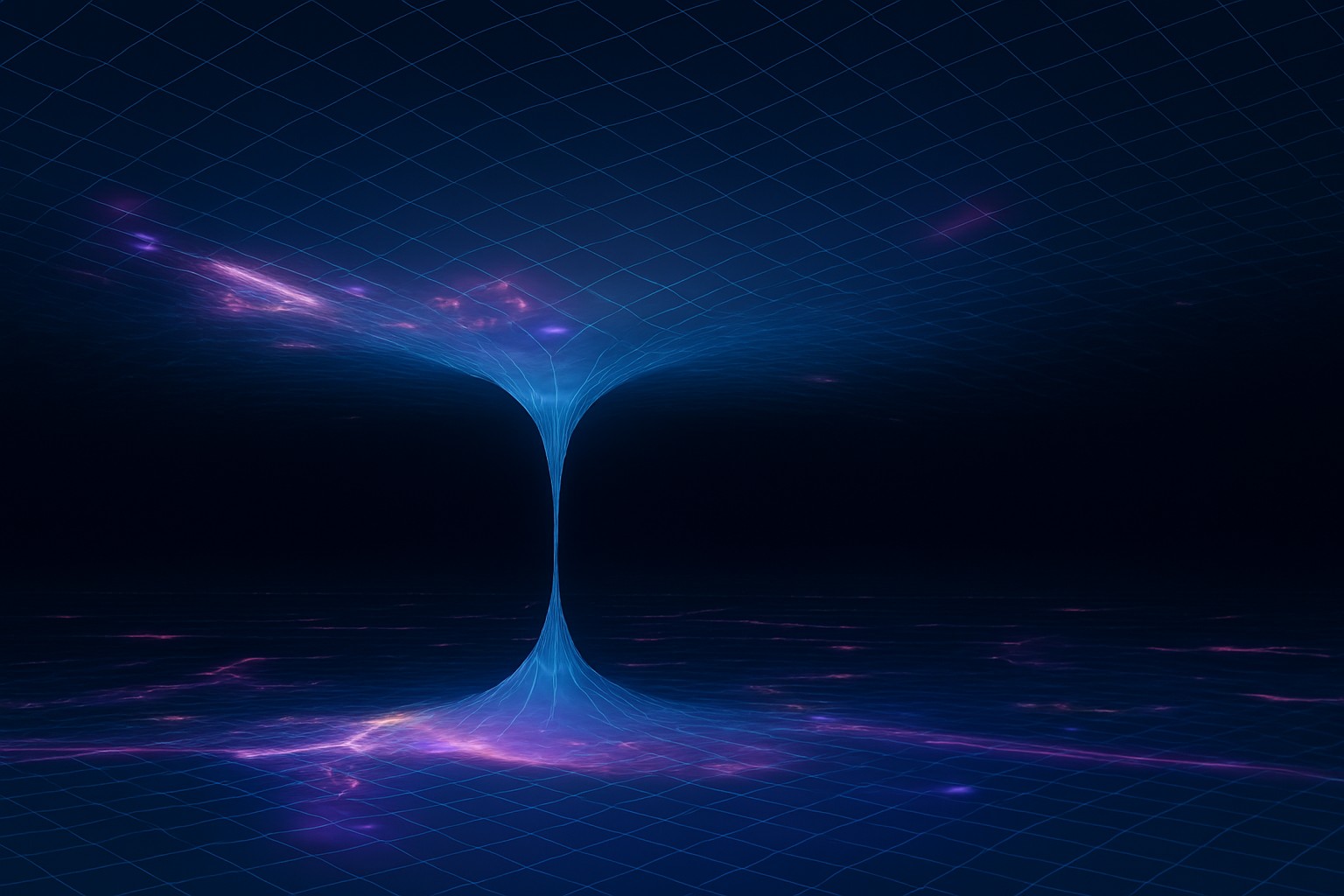
Interdimensional wormhole hypothesis
In their paper, which is still awaiting peer review, the scientists have put forward an incredible hypothesis. They believe that the recorded signal could have been generated by the formation of a wormhole — a kind of tunnel in space-time. This wormhole, in their opinion, was the result of the merger of binary black holes not in our Universe, but in another Universe, temporarily connecting it to ours. In other words, the detectors could have picked up not direct evidence of the catastrophe, but its reflection, its echo, passing through an exotic spatial tunnel.
Anomalies of the mysterious signal
What prompted scientists to propose such a bold theory? The key factor is the unusual nature of the GW190521 signal itself. It turned out to be extremely short. Usually, when black holes spiral closer together, this generates a characteristic “chirping” sound — a gradual amplification of gravitational waves. However, in this case, the approach phase is practically absent. This is difficult to explain within the standard model, given that the mass of the merger was estimated at a colossal 142 solar masses. Such an event should have left a much more detailed trace.
A model that opens up new horizons
To support their hypothesis, the researchers developed a special model. It describes what the waveform would have been like if the signal from a collision in another Universe had been reflected from a rapidly collapsing wormhole. According to their calculations, this scenario could explain the short duration and unusual structure of GW190521. Scientists note that their model only slightly better fits the data than traditional explanations, leaving ample room for future discussion and research. This story may have a sequel: the 2023 event, the most massive black hole merger since then, exhibits similar short-term characteristics, which may be the key to unraveling this cosmic mystery.
Earlier, we reported on how dark matter represents a reflection of a parallel Universe.
According to sciencealert.com

