

The clustering algorithm detected an area of increased density in the Kuiper belt. Scientists do not know why there are more objects concentrated in this area than elsewhere. In addition, the objects here have orbits closer to a circle.
New regions of the Kuiper belt
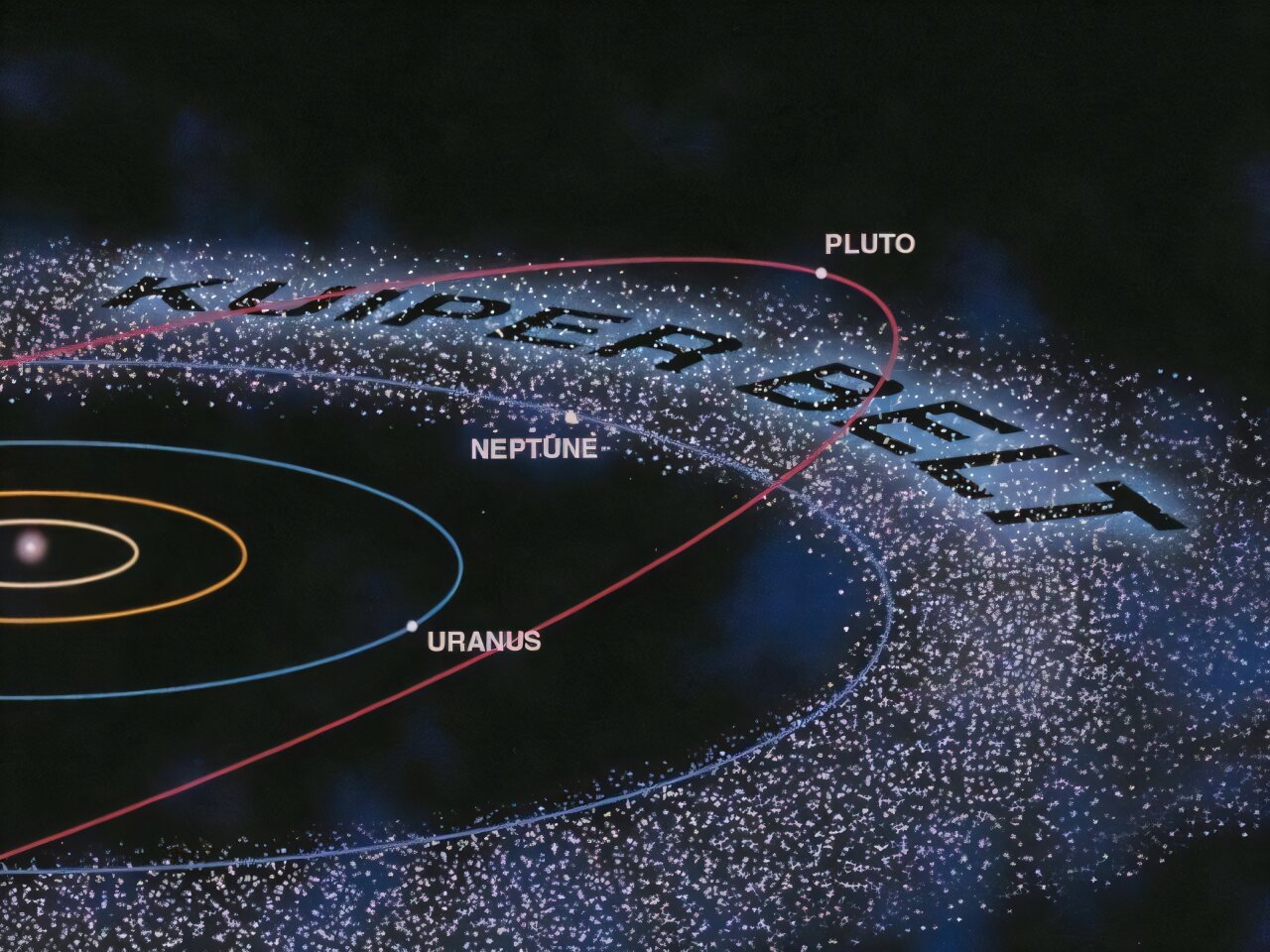
A large region of our solar system called the Kuiper belt extends from Neptune’s orbit to approximately 50 astronomical units. This region consists mainly of icy objects and small rocky bodies such as Pluto. Scientists believe that Kuiper belt objects (KBOs) are remnants left over from the formation of the solar system.
Now, a new paper describes a recently discovered region that appears to be completely different from other parts of the Kuiper belt, but some uncertainty remains.
Core of the Kuiper Belt
Back in 2011, a group of astronomers noticed a denser region of objects located in the Kuiper belt at a distance of about 44 AU. The group named this region the “core” and found that the objects in it have a low inclination to the ecliptic and eccentricity compared to other KPOs.
In other words, their orbits were more circular and lay closer to the plane of the Solar System rather than at an angle. The core itself lies within another distinct population of KPO, called the “dynamically cold” population, in which all objects tend to have lower eccentricities and inclinations.
Since the initial observation of the nucleus was visual in nature, it may not have captured some fine details. Some researchers have wondered whether a more in-depth study of the data on these objects might reveal new features in the nucleus or other parts of the Kuiper belt.
Clustering algorithm and new questions
To find individual structures in the Kuiper belt, the authors of a new preprint article decided to test a clustering algorithm called Density-Based Spatial Clustering of Applications with Noise (DBSCAN). This algorithm has already been used for other astronomical datasets, but not for the Kuiper belt. First, the team calculated the barycentric free orbital elements, such as the semi-major axis, eccentricity, and inclination, for 1,650 classical KPOs and applied DBSCAN to them to search for other clusters of similar objects.
Their algorithm detected not only the core, but also another separate structure next to it, approximately 43 AU away, which they simply call the inner core. The inner core stands out as potentially separate because its eccentricity distribution is narrower than that of the core, indicating a separate population. They claim that the inner core contains 7-10% of classical KPOs.
However, the team notes that the distinction between the core and the inner core depends on the clustering parameters. This leaves some doubt as to whether the inner core is truly separate.
Theories about the structure of the Kuiper belt
At present, the existence of the inner belt as a separate structure remains unclear. However, new data from the Vera Rubin Observatory will soon be published, which should shed more light on this issue. These and other studies may clarify the nature of these structures and provide more information about their origin.
However, for the authors of the study, the inner belt remains important. Scientists note that there are two alternative explanations, between which it is impossible to choose: either the core is much larger than previously thought, or there is an additional separate structure in the cold classical Kuiper belt. In any case, the inner core, as described here, is an additional component.
Provided by phys.org

