

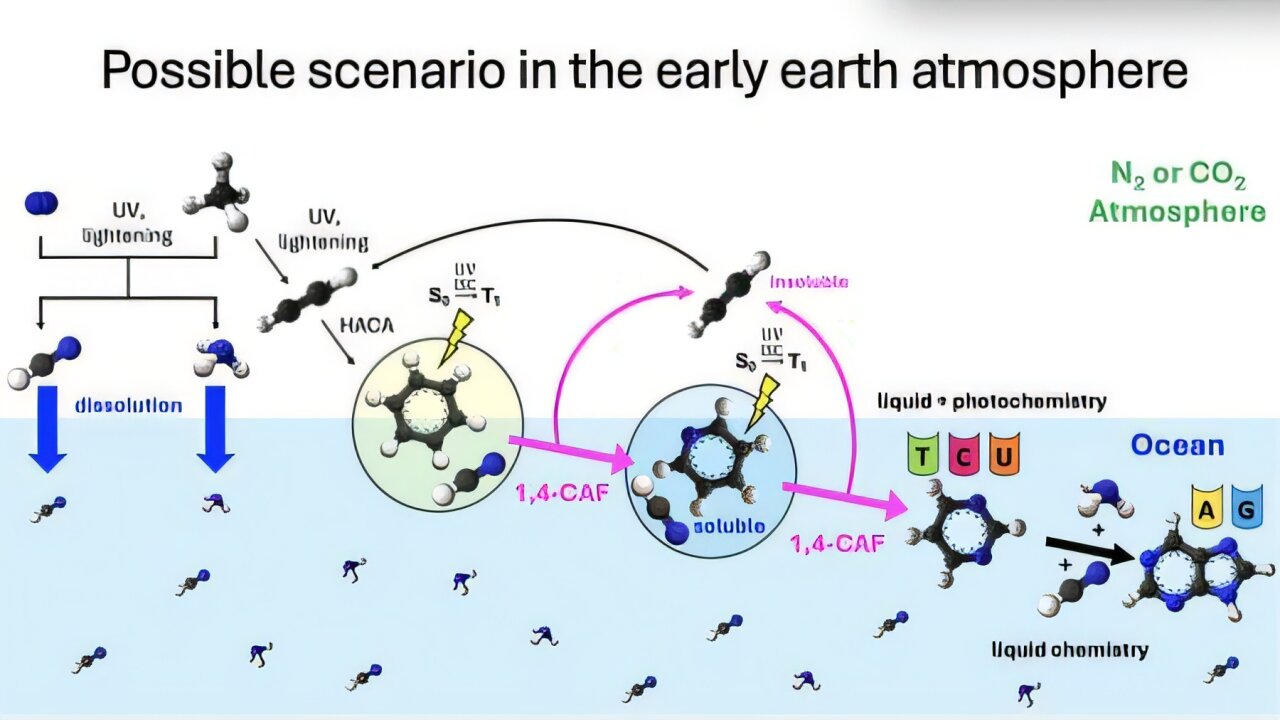
Scientists have discovered a new chemical reaction based on benzene and hydrogen cyanide. And they have proposed a new possible mechanism for the formation of precursors of the nitrogenous bases of DNA and RNA from benzene and hydrogen cyanide under the conditions of the early Earth. They are the basis of organic life on our planet. However, for now this is a theoretical model that needs experimental verification.
Building blocks of life
Researchers at the California Institute of Technology have discovered a new reaction involving benzene that could potentially explain how life originated on our planet. Specifically, it involves the formation of the building blocks of deoxyribonucleic acid (DNA) and ribonucleic acid (RNA).
They serve as carriers of genetic information—a kind of instruction manual that guides the construction of proteins, cells, and the entire organism as a whole. At the same time, it has long been common knowledge that DNA and RNA are easily assembled from individual building blocks. The only problem is that these building blocks—adenine, guanine, cytosine, uracil, and thymine—had to have originated somehow as well.
Overall, scientists are already aware of dozens of processes that could potentially have led to the formation of RNA—the simplest form of matter capable of reproduction and evolution—from very simple organic compounds. However, every time they discover a new pathway, it becomes an important building block in the growing confidence that life could indeed have arisen naturally.
A new path
The new study began when researchers became curious about what organic compounds are actually contained within nucleotides. It turns out that these are mostly very simple molecules, such as nitrogen and methane. But the most complex common structure was benzene (С6H6) — a simple and fairly stable organic compound consisting of a ring of six carbon atoms and six hydrogen atoms.
Benzene is stable in atmospheres dominated by nitrogen or carbon dioxide, and Earth’s current atmosphere is mostly nitrogen. The researchers decided to test whether the molecule could have remained stable on Earth in ancient times, and the answer was yes. This led to a search for substances with which it could react to form more complex organic compounds.
One promising candidate was hydrogen cyanide (HCN), which is thought to have been common in the atmosphere of early Earth. Computer simulations have shown that it can react with benzene under ultraviolet light to form nitrogen-containing organic compounds—potential precursors to the nitrogenous bases of DNA and RNA.
Many of these compounds are highly soluble in water, and could have accumulated in the oceans and been used in subsequent chemical reactions. The main advantage of the newly discovered pathway is that it uses simple molecules that were probably widespread on early Earth, and the reactions themselves do not require exotic conditions.
The study did not show the formation of DNA or RNA, nor did it even demonstrate the synthesis of ready-made nucleotides. It only suggests a new possible route to the formation of precursors to nitrogenous bases. There are many more chemical transformations between such precursors and true RNA.
According to phys.org

