

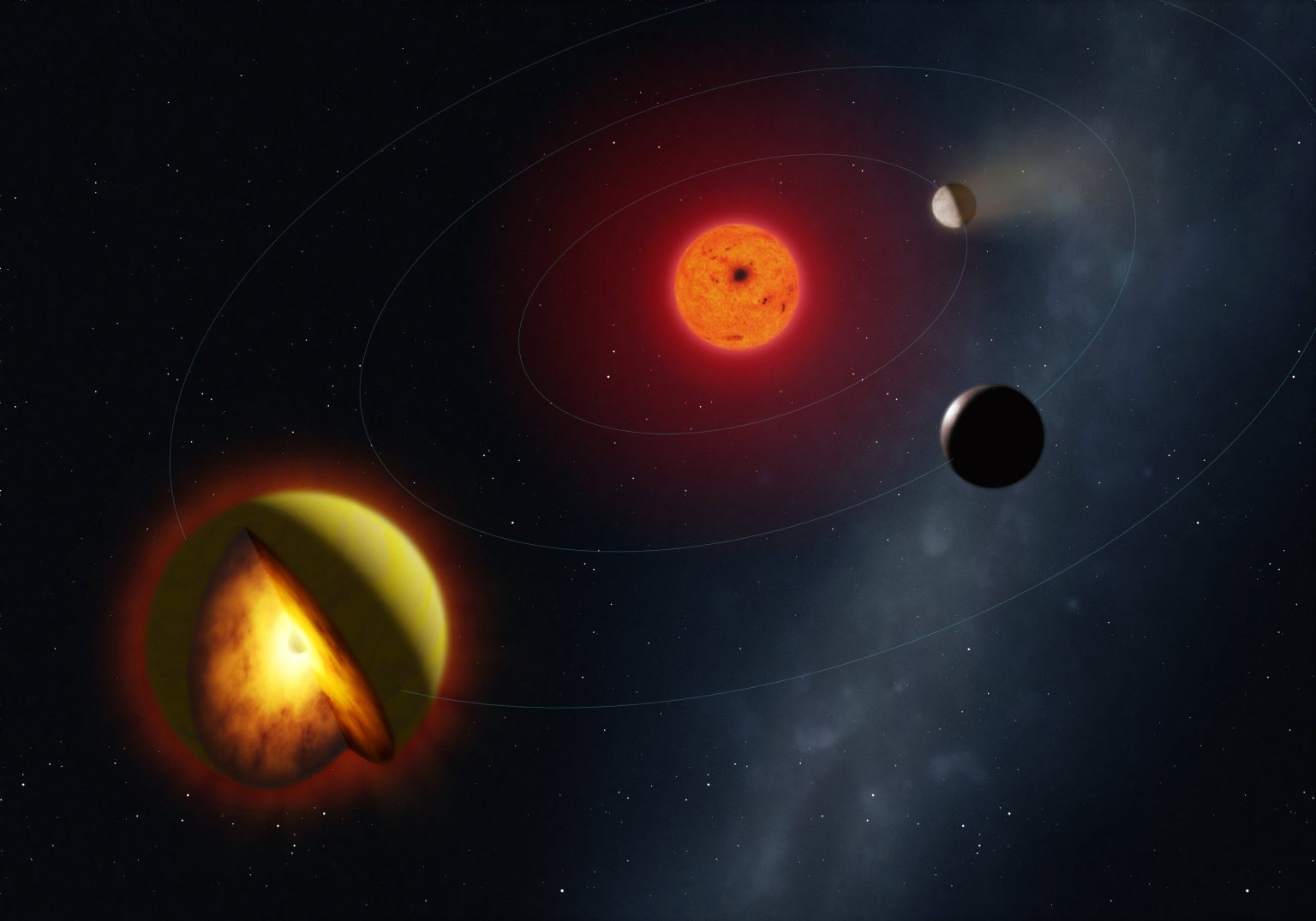
Scientists speculate that there may be a previously unknown class of molten planets in the Universe, featuring oceans of molten sulfur. The recently discovered world L 98-59 d may be one of them.
A new type of planet
Researchers from the University of Oxford recently published an article in the journal Nature Astronomy in which they proposed the existence of a completely new type of planet in the Universe. And they already have evidence that some of the known worlds fall into this very category.
Planets are generally divided into two broad categories: gas giants, which are large and consist mainly of relatively low-density material, and the rocky planets of the terrestrial group. Beyond the Solar System, there are also oceanids and mini-Neptunes, which occupy an intermediate position between these two types but do not constitute a separate third type.
This situation can be explained by the fact that the composition of all protoplanetary disks in the Milky Way is believed to be roughly the same. The new hypothesis is that this may not be the case in some instances.
We’re talking about planets with high sulfur content, which can indeed vary from planet to planet. Usually this goes unnoticed, but the case is different when a relatively small planet orbits very close to its star. In this case, it melts completely. A layer of silicates remains on the surface, and beneath it lies a vast ocean of liquid sulfur.
Planet L 98-59 d
Although the scientists’ research is primarily theoretical, it is based on a real-world example. The planet L 98-59 d orbits very close to its star — a red dwarf. Observations by the James Webb Space Telescope have shown that it has an atmosphere composed primarily of hydrogen but containing a trace amount of hydrogen sulfide.
And that’s very strange, considering that this gas usually dissipates very quickly in outer space. However, L98-59d has existed for 5 billion years, and it has been present on the planet all this time. This means there has to be some source for it.
And scientists believe that it is precisely the ocean of molten sulfur beneath the surface. They believe that L 98-59 d once formed as a small “Neptune-like” planet and contained a large amount of volatile substances. But over time, they evaporated due to the star’s radiation, leaving only a core containing a large amount of sulfur.
According to phys.org

