

Spanish astronomers have published the results of their research into the evolution of the near-Earth asteroid 2022 RD2. In the future, it may become a temporary moon of Earth and then collide with our planet.
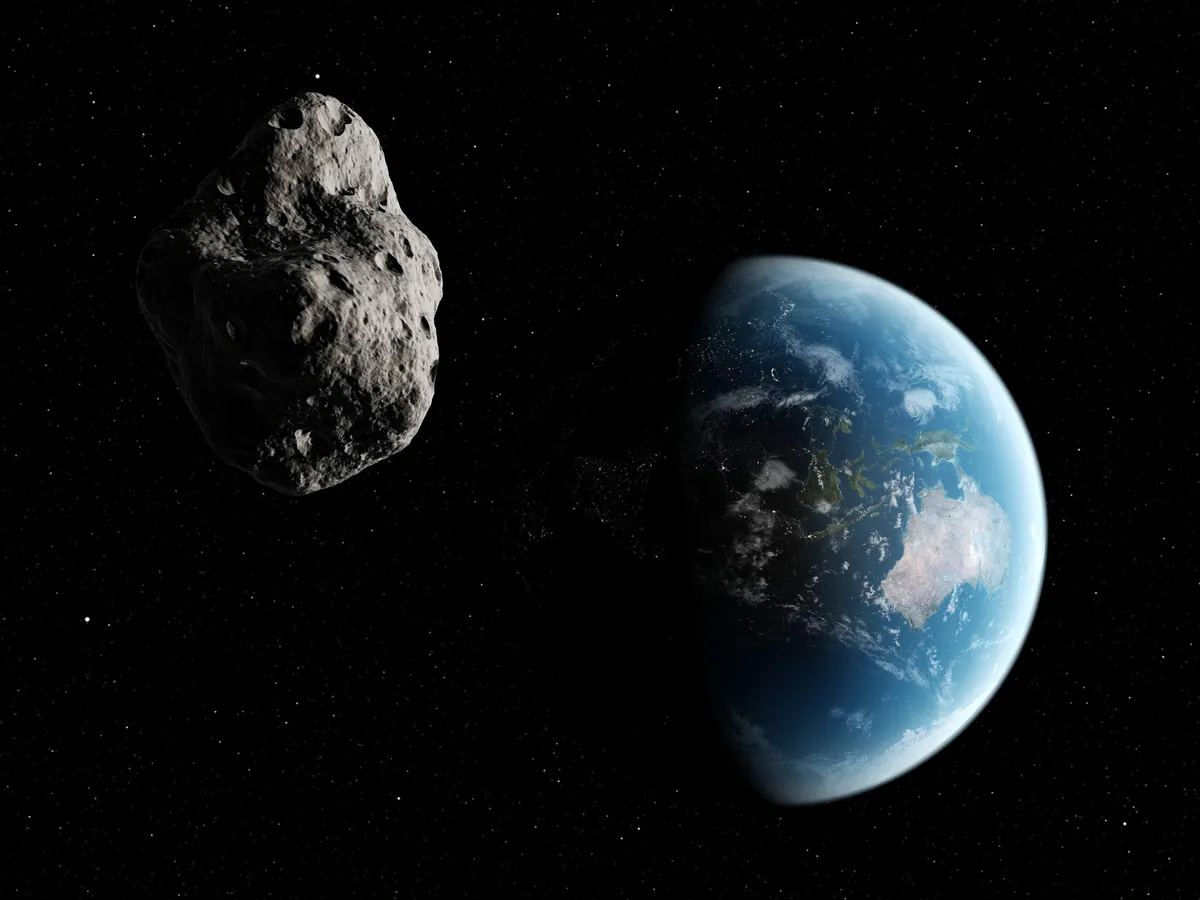
Asteroid 2022 RD2 was discovered in 2022 by the Pan-STARRS telescopes. Its diameter is estimated at 5–11 meters, and it is part of the Arjuna asteroid family—a group of asteroids that move close to our planet in orbits with characteristics similar to Earth’s orbit.
Researchers from the University of Madrid simulated the evolution of the orbit of 2022 RD2. It showed that in the future, the asteroid will become a mini-moon.
Mini-moons are near-Earth objects that move in horseshoe-shaped trajectories and approach Earth at low relative speeds. As a result, their geocentric energy becomes negative for a short time. Quite often, such objects do not manage to complete a single orbit around Earth before leaving its vicinity.
This is precisely the fate that awaits 2022 RD2. It will become Earth’s mini-moon three times: between November 12 and December 12, 2043, then between February 29 and May 21, 2044, and finally between July 10 and 29, 2044. In the future, it may move into an orbit where it has a small chance of colliding with Earth. Scientists’ calculations have shown that the probability of 2022 RD2 colliding with our planet between 2080 and 2124 is 0.097%.
However, even if this unlikely scenario does occur, 2022 RD2 does not pose a significant threat. Given its small size, the asteroid is unlikely to reach the Earth’s surface and will most likely disintegrate in the upper layers of the atmosphere.

