

The Andromeda Galaxy, or M31, is our closest large neighbor. Scientists recently discovered a new satellite galaxy orbiting it—the 34th such discovery. It is tiny, very dark, and ancient.
Local group
On April 30, a study conducted by a group of European astronomers using the Pan-Andromeda Archaeological Survey (PandAS) project to observe the Andromeda Galaxy was posted on the arXiv preprint server. It states that they have discovered a new, previously unknown satellite.
Andromeda, or M31, is the largest galaxy nearest to us. It is a spiral galaxy similar to our own, located approximately 2 million light-years from the Milky Way, and together they form a gravitationally bound structure known as the Local Group.
In addition to the two large galaxies, it includes several dozen smaller ones, the smallest of which are not much different in size from globular clusters. Most of them are satellites of the Milky Way. And it was precisely one of these dwarf galaxies that scientists discovered.
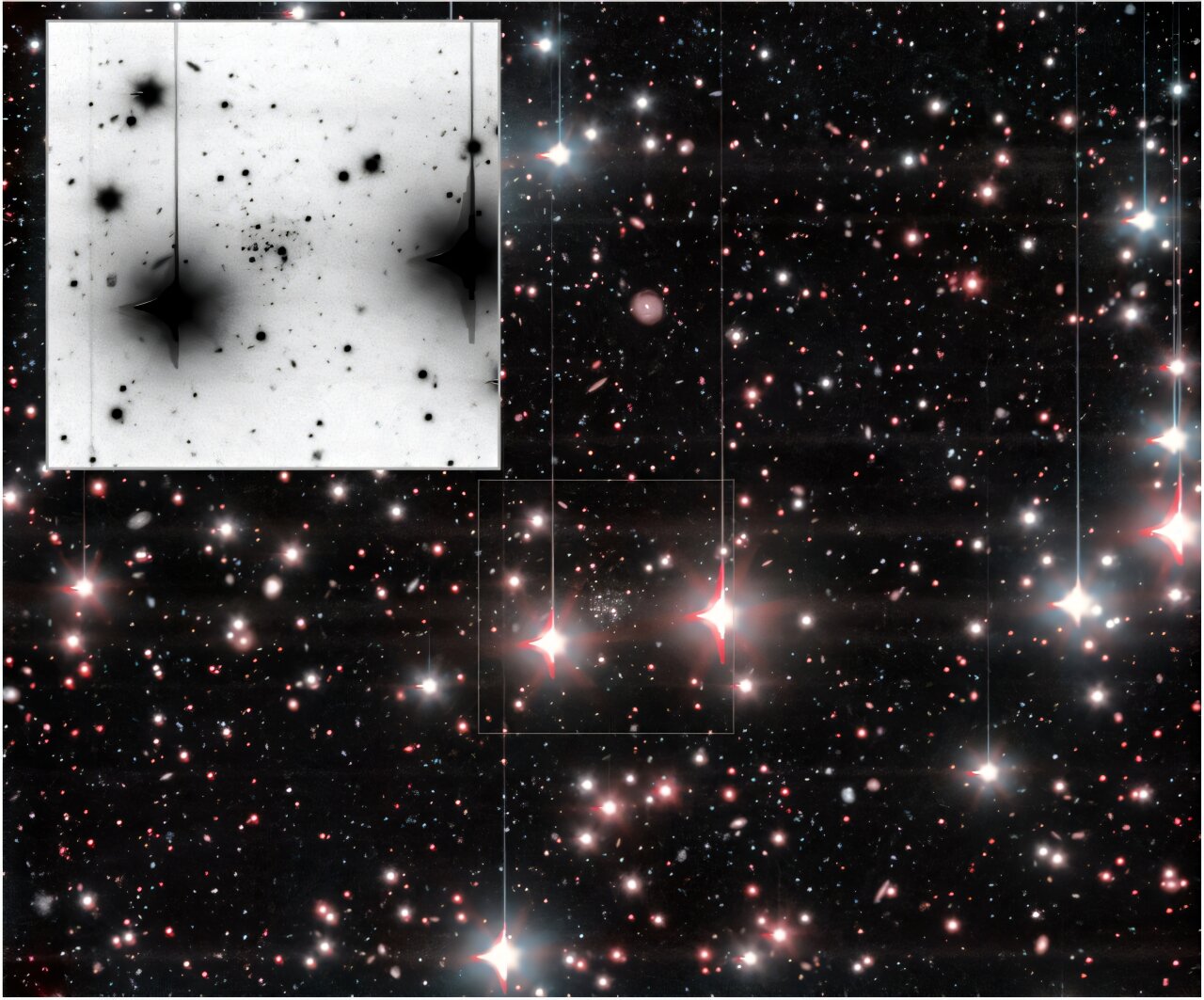
Andromeda XXXVI
The new galaxy has been named Andromeda XXXVI. It was discovered by amateur astronomer Giuseppe Donatiello. He was the one who noticed something unusual in one of the images, and other scientists later joined him in confirming that it was indeed a galaxy.
Andromeda XXXVI is located 2.53 million light-years away from us and 388,000 light-years away from the Andromeda Galaxy. And since the radius of the sphere of gravitational influence is 850,000 light-years, it must certainly be orbiting it.
However, the new galaxy is small. Its radius is only 208 light-years. Furthermore, it is very faint. Scientists believe it is surrounded by a massive halo of dark matter. Moreover, it is very old; its age is estimated at 12.5 billion years.
Andromeda XXXVI—an artifact from the dawn of time. It shows us what typical galaxies were like in the early days of the Universe. Scientists believe that there must be quite a few other objects similar to it in the local group.
According to phys.org

