

Scientists studied the gravitational wave burst GW200208_222617, the trail left by the merger of a pair of black holes. Astronomers discovered that before this happened, they were in an eccentric orbit. And this leads to some very interesting conclusions.
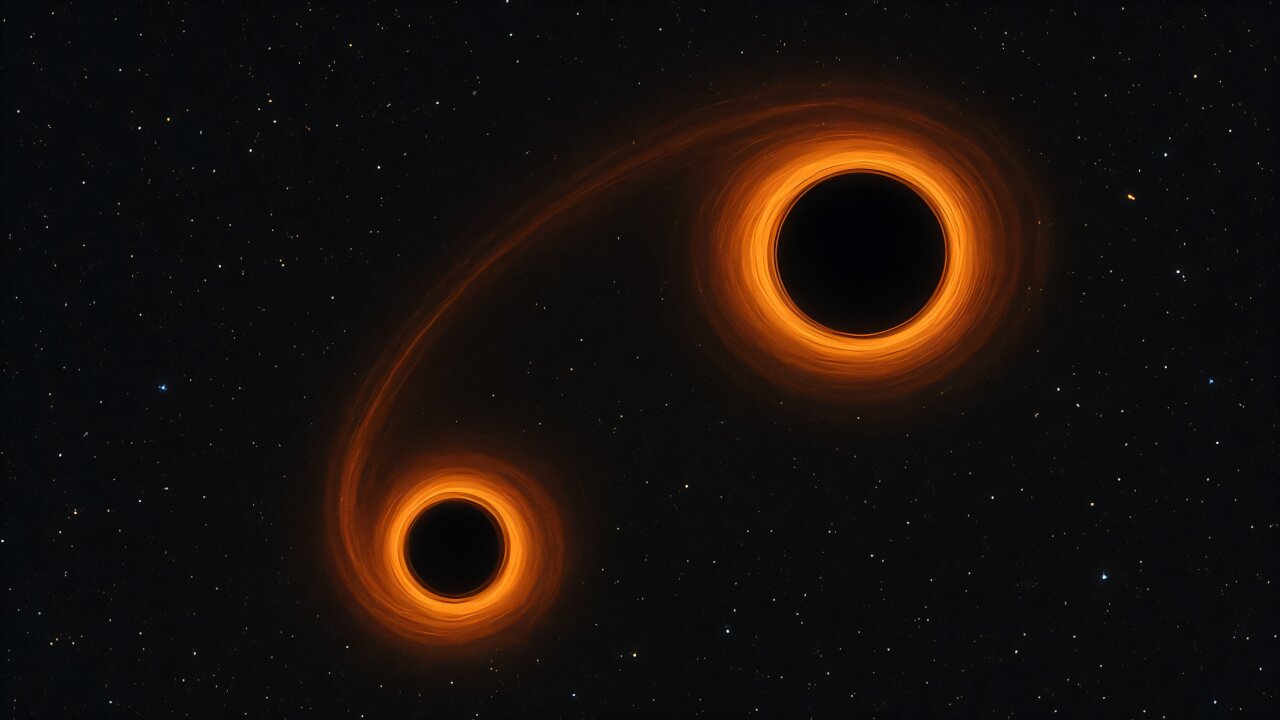
Black hole merger trail
Gravitational waves are vibrations in space-time itself, which are detected by special laser detectors. They are generated by the movement of massive bodies at speeds close to the speed of light. An example of this is the GW200208_222617 event.
It was recorded by all three of our planet’s main interferometers: LIGO, Virgo, and KAGRA. Thanks to this comprehensive data set, scientists were able to learn a lot about the behavior of black holes before merging. These holes were a pair, but they orbited a common center of mass with significant eccentricity.
Meaning they hadn’t been close to each other for a long time before that. After all, when such a partnership lasts for hundreds of millions of years, orbits usually become circular or close to circular. Hence, the two black holes likely collided shortly before this. But how exactly did this occur?
Mystery of origin
In fact, scientists cannot say for sure how this pair of black holes formed, because all they have are fluctuations in space recorded at several different points. There are several possible scenarios, but it is unclear which one is correct.
Scientists are certain of one thing: this pair did not form on its own. This is part of a triple system or large cluster. They are also convinced that such an event cannot be a single occurrence, and that mergers of black holes originating from multiple systems have to occur very frequently.
According to phys.org

