

The galaxy OJ 287 has been known for over a century for its variable brightness. Scientists have long known that this is caused by a blazar — an active black hole at its center. Recently, astronomers were fortunate enough to observe a stream of plasma emanating from it.
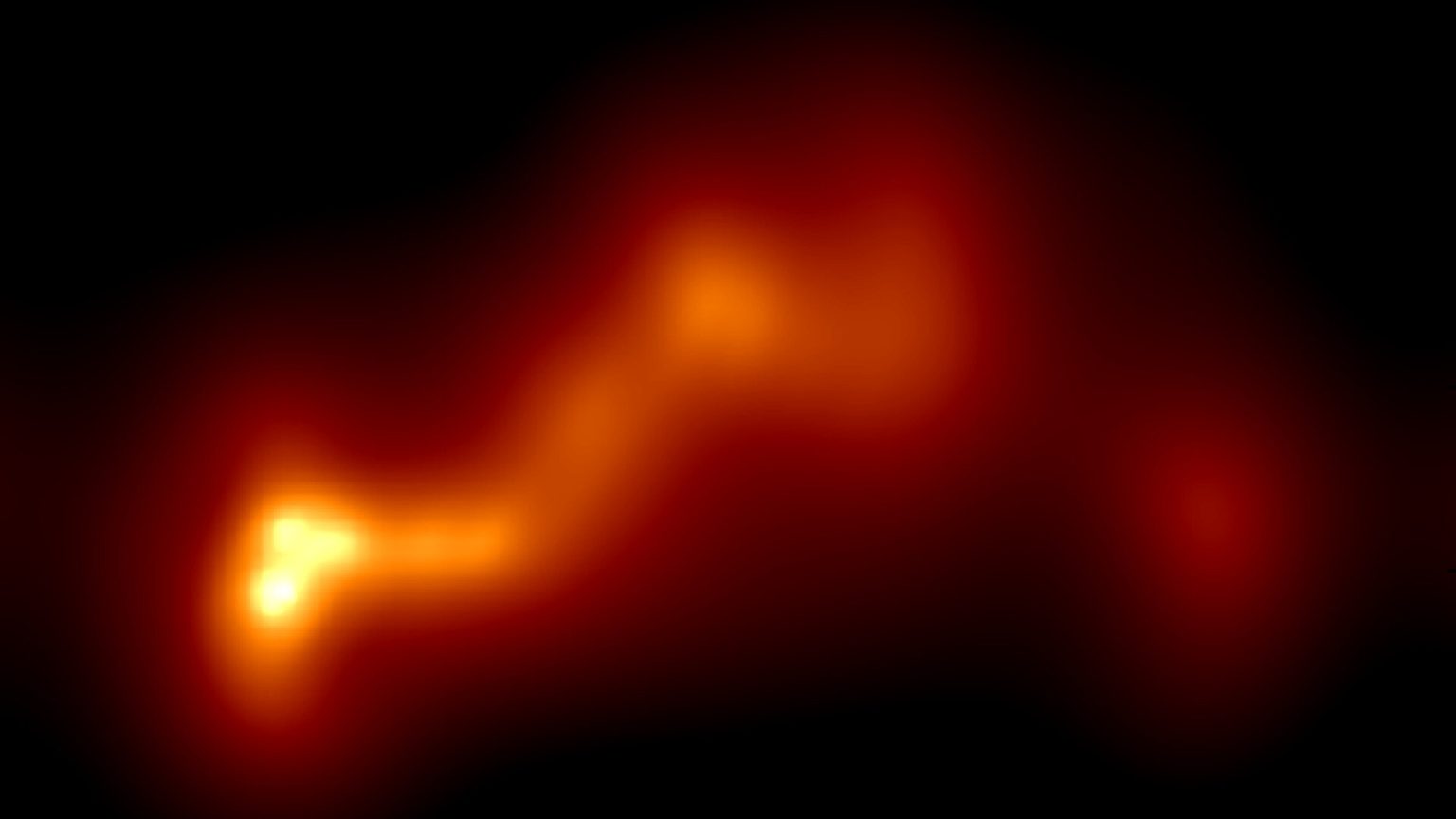
Incredible image of galaxy OJ 287
For more than 150 years, the galaxy OJ 287 and its brightness variations, located five billion light-years away, have puzzled and fascinated astronomers, as they suspect that two supermassive black holes are merging at its core.
An international research team led by Dr. Efthalia Traianou from Heidelberg University recently succeeded in capturing a highly detailed image of the heart of a galaxy. This revolutionary image, taken with a space radio telescope, shows an unknown, highly curved segment of a plasma jet circling around the center of the galaxy. The image provides new insight into the extreme conditions surrounding supermassive black holes.
Giant plasma jet
The core of galaxy OJ 287 belongs to the class of blazars, which are characterized by high activity and impressive luminosity. Black holes are the driving force behind these active galactic nuclei. They absorb matter from their surroundings and can eject it in the form of giant plasma jets consisting of cosmic radiation, heat, heavy atoms, and magnetic fields.
The image, which penetrates deep into the center of the galaxy, shows a sharply curved ribbon-like structure of the jet; it also points to new insights into its composition and behavior. In some areas, the temperature exceeds ten trillion degrees Kelvin, indicating the release of extraordinary energy and movement near the black hole.
Researchers also observed the formation, propagation, and collision of a new shock wave along the jet and attributed this to energy in the trillions of electron volts range, obtained from unusual gamma-ray measurements taken in 2017.
How was the image obtained?
The radio image was made using a ground-space radio interferometer consisting of a radio telescope in Earth orbit — the ten-meter antenna of the RadioAstron mission aboard the Spektr-R satellite — and a network of 27 ground-based observatories located around the globe.
In this way, researchers were able to create a virtual space telescope with a diameter five times greater than that of Earth; its high resolution is due to the distance between individual radio observatories. The image is based on a measurement method that utilizes the wave nature of light and the associated overlapping waves.
Interferometric imaging confirms the assumption that there is a binary supermassive black hole inside the galaxy OJ 287. It also provides important information about how the movements of such black holes affect the shape and orientation of the emitted plasma jets.
“Its special properties make the galaxy an ideal object for further research into black hole mergers and the associated gravitational waves,” notes Efthalia Traianou.
Research institutions from Germany, Italy, Russia, Spain, South Korea, and the United States participated in the study.
According to phys.org

