

For nearly twenty years, astronomers have been searching for gamma rays from supernovae, and they have finally found an answer. It turns out that the Fermi telescope detected such a signal back in 2017, but it has only now been confirmed. A new study suggests that the source of the explosion’s energy was most likely a magnetar.
An unusual explosion
The researchers focused on a specific class of explosions. Super-luminous supernovae emit at least ten times more energy in visible light than typical events of this type.
Over the past few decades, scientists have identified about 400 such objects, but the source of their excess energy has remained a subject of debate. One of the leading hypotheses pointed to a magnetar.
What is a magnetar?
A magnetar is a type of neutron star with the strongest magnetic field in the known Universe. It can be a thousand times stronger than that of a typical neutron star, and ten trillion times stronger than the field of a permanent magnet on a refrigerator.
A newly formed magnetar rotates several hundred times per second. This rotation generates a powerful stream of particles—electrons and positrons—that form a cloud containing gamma rays.
How do they get out?
Gamma rays are absorbed and re-emitted, gradually transforming into visible light. It is this light that gives the supernova its extraordinary brightness.
About three months after the explosion, the debris cloud expands and cools enough for some of the gamma rays to finally penetrate it. This is exactly the signal that was detected in the Fermi data collected in 2017.
Closest of the known ones
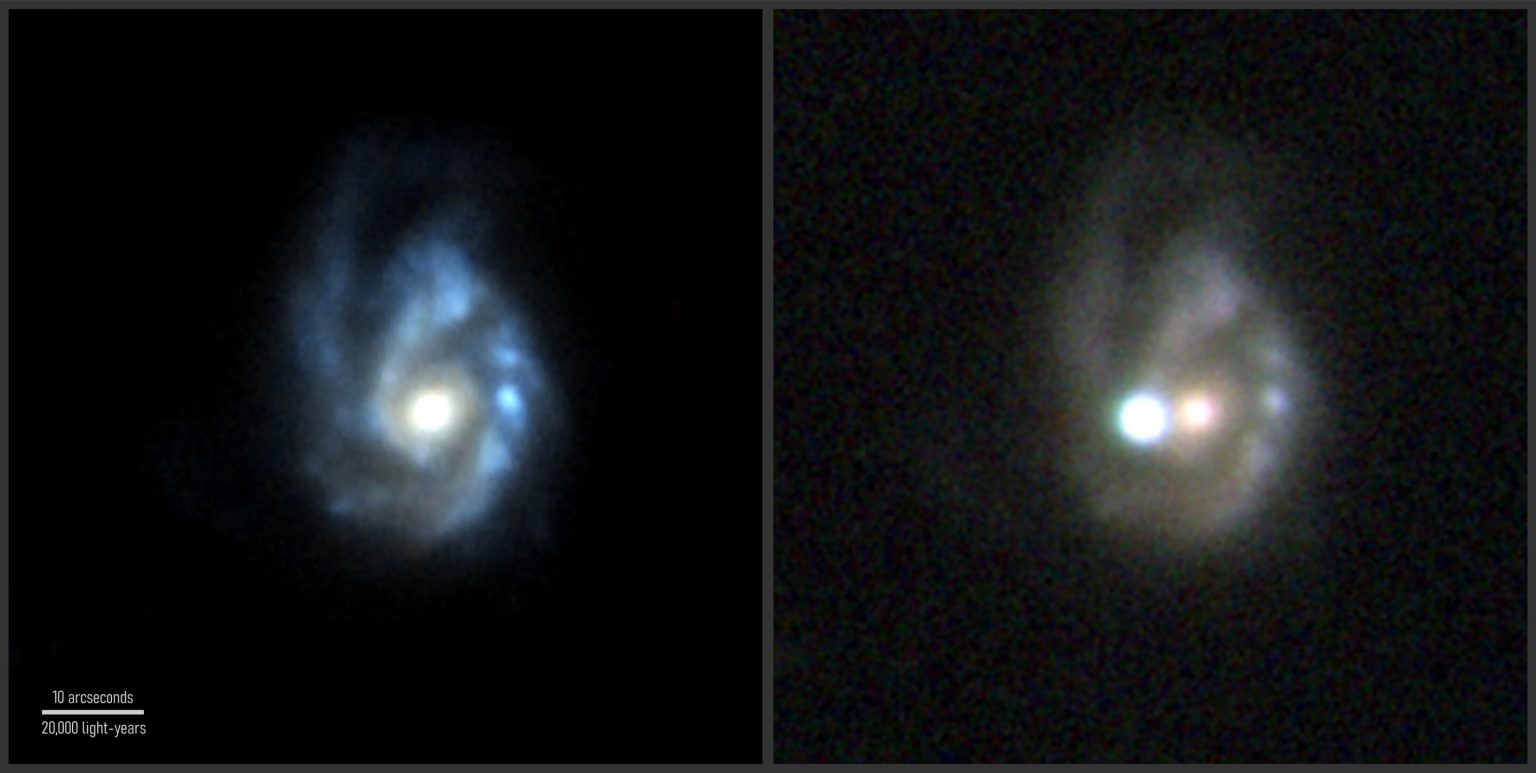
The explosion occurred in the galaxy NGC 3191 in the constellation Ursa Major. The light from it traveled about 440 million light-years before reaching Earth, making it one of the closest supernovae ever observed.
An international team analyzed the six closest super-luminous supernovae observed during the first 16 years of Fermi’s operation.Signs of gamma-ray emission were detected only in SN 2017egm, confirming previous theories about the nature of such explosions. The findings were published in the journal Astronomy & Astrophysics.
What’s next?
According to the researchers’ calculations, the new ground-based Cherenkov Telescope Array Observatory will be able to detect such objects at distances of up to 500 million light-years in approximately 50 hours of observation.
Combining these ground-based instruments with space telescopes will provide a better understanding of the mechanism behind the most powerful stellar explosions in the Universe.
According to phys.org

