

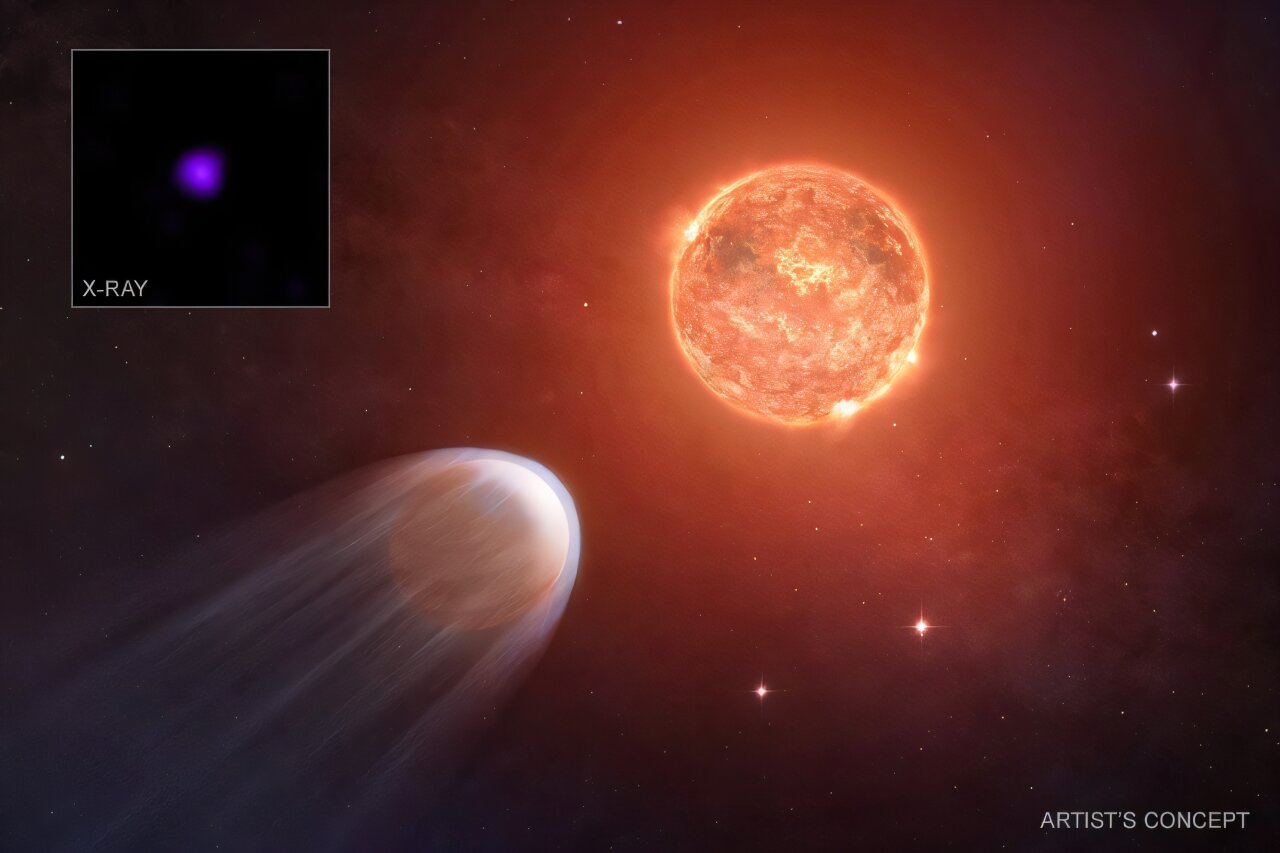
Scientists have discovered the planet TOI-1227b. It is a gas giant located very close to its star. Because of this, the radiation of the latter literally dissolves this world into space.
A baby planet the size of Jupiter
The discovery of exoplanets (around 6,000, and their number is growing) has shown that the Solar System is not typical. Other star systems contain planets that are completely unlike ours, with orbits that do not exist in the Solar System. One such planet is TOI-1227b.
TOI-1227b is a planet approximately the size of Jupiter, with about 20% of its mass. It orbits an M-class dwarf star, or red dwarf, located about 330 light-years away. It was discovered in 2022 based on data obtained by NASA’s Transiting Exoplanet Survey Satellite (TESS).
TOI-1227b is experiencing an existential crisis. It orbits very close to its star, at a distance of only about 1/5 of the distance from Mercury to the Sun. New research shows that this planet is still very young — only about 8 million years old. Compared to Earth, it is a baby in diapers. But instead of growing, TOI-1227b is gradually losing its mass.
Study of the star TOI-1227
This exoplanet is the second youngest planet that astronomers have ever found transiting in front of its star. Researchers conducted new X-ray imaging and optical spectroscopic observations of TOI 1227 to determine its age and the effect of high-energy radiation on the exoplanet TOI-1227b.
The star around which it orbits, TOI-1227, is much smaller and dimmer than the Sun. As an M-class dwarf, it is much less massive than the Sun and much dimmer in visible light. However, this dimness does not describe the entire spectrum of the star’s radiation.
M-dwarfs are known for their extreme flares, which produce powerful X-ray radiation. Unlike the Sun, M dwarfs are completely convective. Convection occurs throughout the entire interior of the star, creating powerful magnetic fields that are responsible for flares. In the case of TOI-1227 b, the unfortunate young gas giant is right at the epicenter of this destructive flare.
Loss of planetary mass
“Our models show that TOI 1227b is currently rapidly losing atmospheric mass at a rate of about 1012 g/s,” the authors of the study write. This means that every second, the planet loses about a million tons of its atmosphere. Astronomers have calculated that in just 1 billion years, the planet will lose its entire atmosphere.
Powerful X-rays from stars such as TOI-1227 tear away the atmospheres of exoplanets through several different but related mechanisms.
Mechanism of atmospheric loss by a planet
When X-rays hit molecules in the atmosphere, they ionize and heat them up. This can raise the temperature of the atmosphere to several thousand degrees Kelvin, causing it to expand. As the atmosphere expands, the planet’s gravitational pull on it becomes weaker and weaker. In some cases, the heating is so intense that light molecules, such as molecular hydrogen, can evaporate from the atmosphere.
Photodissociation also plays a role. X-rays have sufficient energy to split water molecules into hydrogen and oxygen atoms. Since hydrogen is very light, it can easily escape into space. In addition, X-rays can increase the temperature of stellar wind, giving it more energy and making it more effective in stripping away atmospheres.
Researchers believe that the planet loses a mass equivalent to two Earth atmospheres every two centuries. Although many discoveries made by astronomers take a long time to manifest themselves, this happens much faster. Most phenomena in astronomy are measured in millions or billions of years, not centuries.
Accurate measurement of the planet’s mass
Scientists find it difficult to say when the planet will finally dissolve into the star TOI-1227, as much depends on understanding the planet’s mass. In this case, it is difficult to determine the mass accurately. To obtain these figures, the team conducted several simulations and chose the most likely results.
There is a gap in the sizes of known exoplanets: planets with a radius of 1.5 to 2 Earth radii are particularly rare. It is believed that this gap is related to mass loss due to photoevaporation. Astronomers are eager to study planets like TOI-1227b to better understand this process.
“The nearby young transiting exoplanetary system TOI-1227 is an important reference point for studying the earliest stages of exoplanet evolution around low-mass stars,” the researchers note. They point out that to really figure out what’s going on with TOI-1227, we need more photometric and spectroscopic observations to get a better idea of the planet’s mass and estimate the extent of its atmospheric loss.
According to phys.org

