

Scientists are studying eruptions from the supermassive black hole at the center of the galaxy IC 3599. The enormous ejection of matter has now been observed for the third time in the past 35 years. Researchers have determined what causes it.
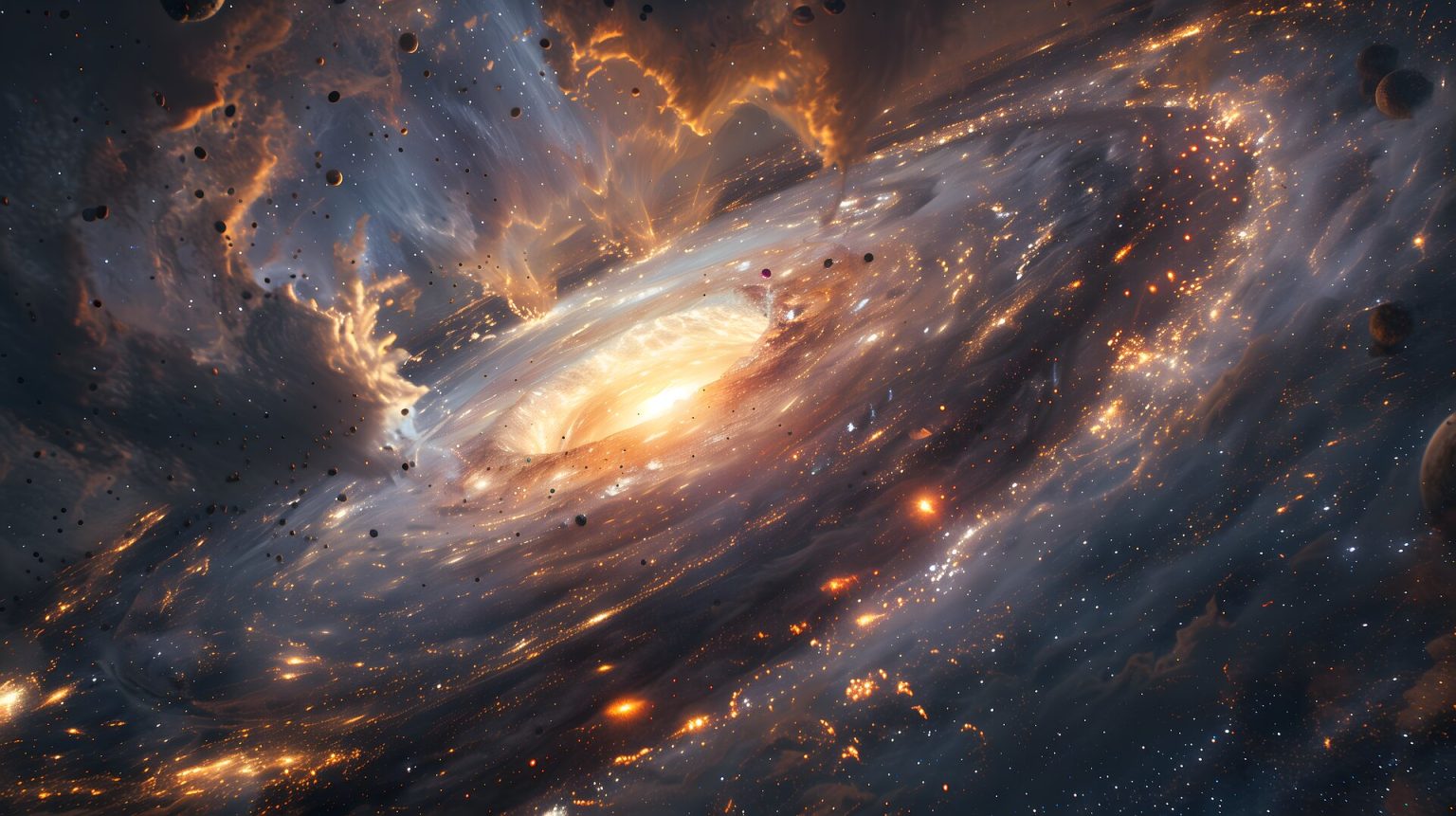
The Galaxy IC 3599
A study of events occurring in the galaxy IC 3599 was recently published on the arXiv preprint server. According to phys.org, the galaxy is located approximately 280 million light-years away. In 2025, a powerful flare occurred at its center, accompanied by a large ejection of matter into space.
Because a supermassive black hole is undoubtedly located at the center of IC 3599, the phenomenon must be associated with processes occurring around it. What is most remarkable, however, is that astronomers have now recorded a similar flare at the center of the galaxy three times over the past 35 years. The previous events were detected in 1990 and 2010.
It should also be noted that IC 3599 belongs to the class of active galaxies. Large quantities of matter constantly fall toward the black hole at its center, producing powerful radiation that can be detected even from Earth. During the eruptions, however, its intensity increased by a factor of 50.
What Is Happening There
The latest study, which helps explain what is occurring at the center of this galaxy, is based on data from the Swift and XMM-Newton space telescopes, as well as several ground-based observatories operating at different wavelengths. In particular, an observing session with XMM-Newton lasted 120,000 seconds and enabled scientists to determine what is happening to the black hole at the center of IC 3599.
The fact that eruptions near the supermassive black hole at the center of IC 3599 occur at irregular intervals—19.5 and 15.7 years—significantly limits the range of possible explanations. Scientists had suggested that the system might contain a pair of black holes or a large star that is gradually being torn apart.
However, coronal emission lines and characteristic brightness fluctuations with a period of 7.4 hours have helped to understand what exactly is happening near the supermassive black hole IC 3599. The material that enters it does not fall in immediately. It first accumulates in the inner part of the accretion disk, where the density, temperature and radiation pressure gradually increase.
When the disk reaches a critical state, it becomes unstable. Much of the accumulated gas rapidly accretes onto the black hole, causing its brightness to increase sharply. At the same time, some of the matter is ejected outward by powerful radiation in the form of a rapid stream of gas. After this, the inner disk is depleted, the system returns to a quiescent state, and the cycle begins again.

