

Scientists have studied the young star Iota Horologii, which is very similar in its parameters to the Sun. At the same time, it has a significantly more powerful magnetic field, and now it turns out that its activity cycle lasts only 2 years (our sun’s is 22).
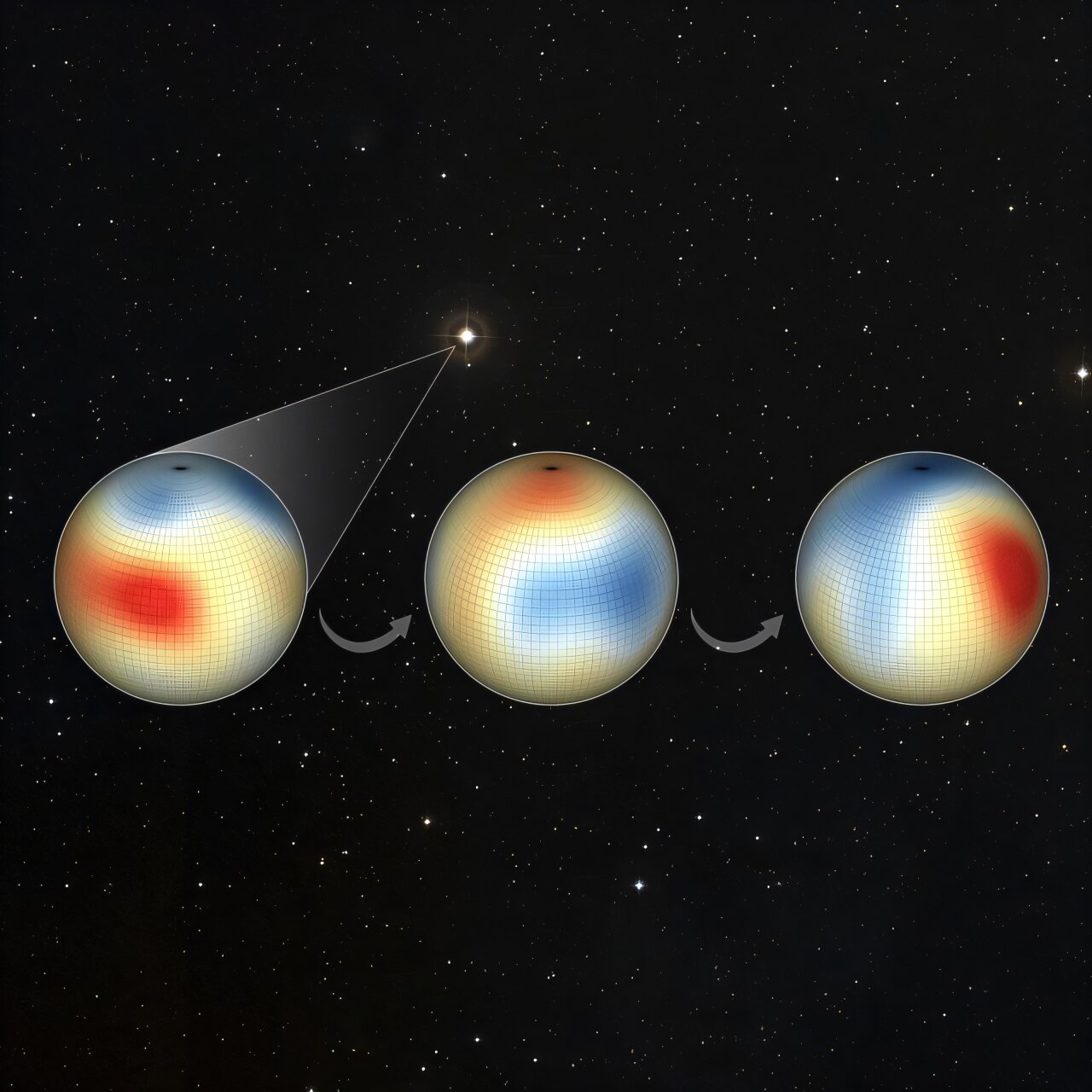
Iota Horologii
Scientists from the Leibniz Institute for Astrophysics Potsdam (AIP) have discovered that the rhythm of the young star Iota Horologii is much faster than that of the Sun. This is indeed a very important observation, since this star is very similar to ours in terms of mass.
Iota Horologii is located 56 light-years away from us. It is a young system, only 600 million years old. That is, if there is a planet similar to Earth, then it should only have primitive single-celled organisms.
It has long been known that this star is significantly more active than the Sun and has a powerful magnetic field. Scientists were very interested in finding out what its activity cycle looked like and how similar it was to the one that determined the number of spots and, consequently, the number of flares on our own star.
Research results
To study Iota Horologii, scientists used the HARPS polarimeter installed on the 3.6-meter telescope of the European Southern Observatory in La Silla, Chile. Researchers from AIP collected spectropolarimetric data on this star over six seasons of observation — a total of 199 nights.
Using an advanced technique known as Zeeman Doppler Imaging (ZDI), the team converted these measurements into 18 separate “maps” of the large-scale magnetic field of ι Hor, distributed over approximately 140 complete revolutions of the star. These maps reflect how magnetic features arise, disappear, and even change polarity — phenomena that trace deep-rooted dynamo processes in the turbulent inner layers of the star.
The main result of the study is that the complete cycle of magnetic field change on Iota Horologii is 773 days, or about two years. During this time, the magnetic poles manage to exchange places and then return to their original state. It takes the Sun 22 years to do this.
According to phys.org

