

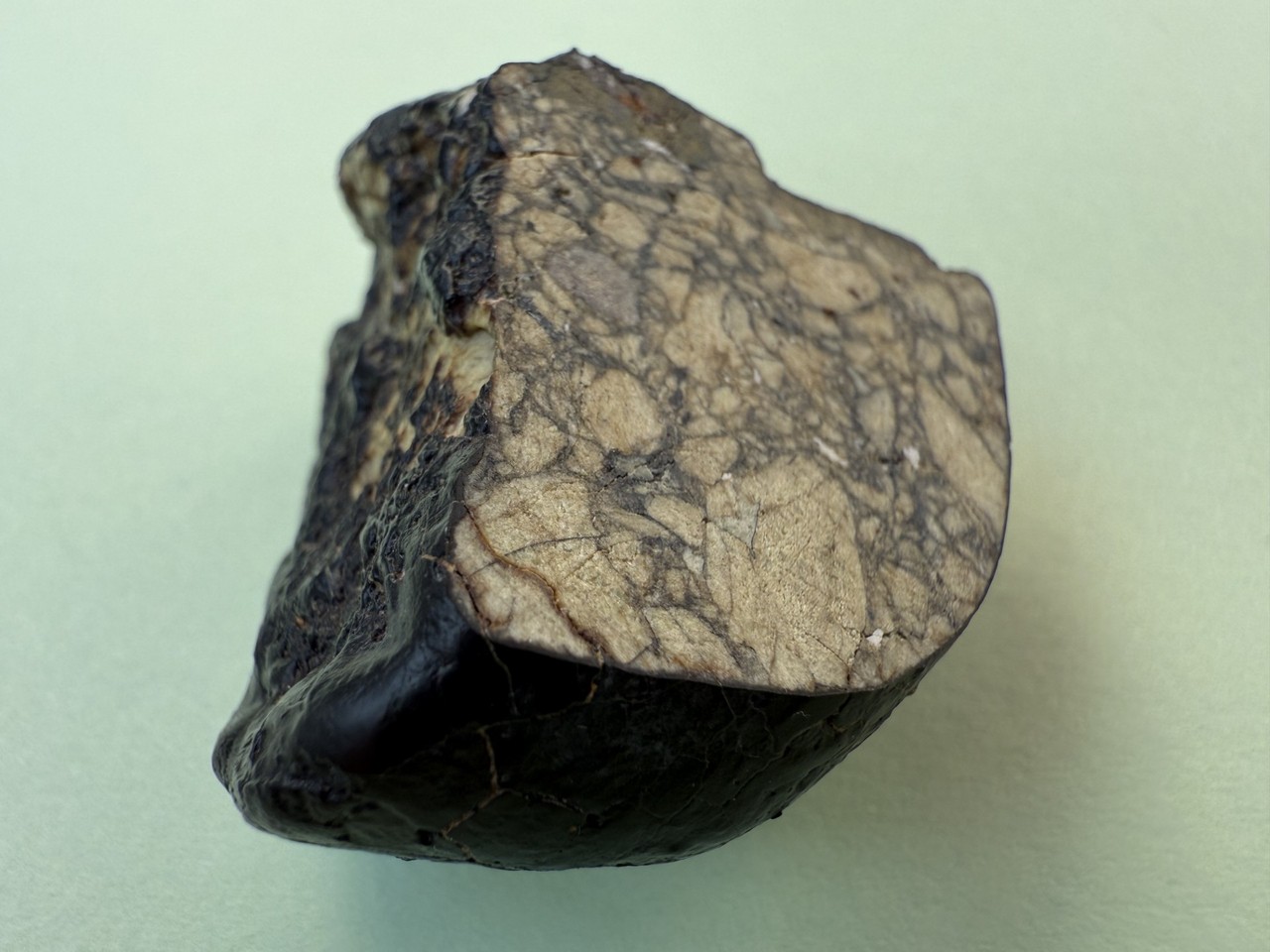
The small African meteorite Northwest Africa 12264, which scientists gained access to in 2018, casts doubt on the order in which the inner and outer regions of the Solar System were formed.
New insights into the chronology of the Solar System
A small, inconspicuous meteorite could change our understanding of the formation of our Solar System. Tiny fragments of the Northwest Africa 12264 meteorite call into question the longtime belief that planets closer to the Sun formed earlier than those beyond the asteroid belt, between Mars and Jupiter.
A study by Dr. Ben Rider-Stokes of the Open University in Milton Keynes, UK, published in the journal Communications Earth & Environment, suggests that rocky planets in the inner and outer parts of the Solar System formed simultaneously.
Modern ideas about the formation of planets
According to current knowledge, planets form when the swirling gas ring around a young star begins to condense. This process is called accretion. Later, the material heats up and differentiation occurs, resulting in the formation of separate layers of the planet, such as the core, mantle, and crust.
Both of these processes were believed to have occurred at different times in the early history of the Solar System — approximately 4.566 billion years ago for the inner protoplanets and 4.563 billion years ago for the outer protoplanets. It was believed that rocky planets located further from the Sun formed a little later, as they contained more water and ice. This could have slowed down the melting of their inner core.
However, research on a 50-gram meteorite bought from a dealer in Morocco in 2018 shows something different.
Chemical analysis of the meteorite
First, researchers from the Open University proved that the meteorite originated from the outer part of the Solar System, based on its chromium-oxygen ratio. These elements change in a predictable manner in our Solar System. Next, by measuring the lead isotopes in the meteorite, they determined its age to be approximately 4.564 billion years, which is similar to the age of basalt in the inner Solar System, which is present in planetary crusts.
This discovery suggests that rocky planets beyond Jupiter formed rapidly and simultaneously with the inner planets.
Implications of research
Although a difference of two or three million years may seem insignificant on a cosmological scale, it is enough to potentially change our understanding of how planets formed in the early Solar System.
But the implications of this new research do not end there. The more we understand about the events that occurred in our cosmic backyard, the better we can apply this knowledge to the origins of our own planet and planets in other Solar Systems.
According to phys.org

