

Explosions of stars are a fairly diverse class of transient phenomena, which can easily be confused with something else. Recently, scientists have used Gemini artificial intelligence to identify and classify them.
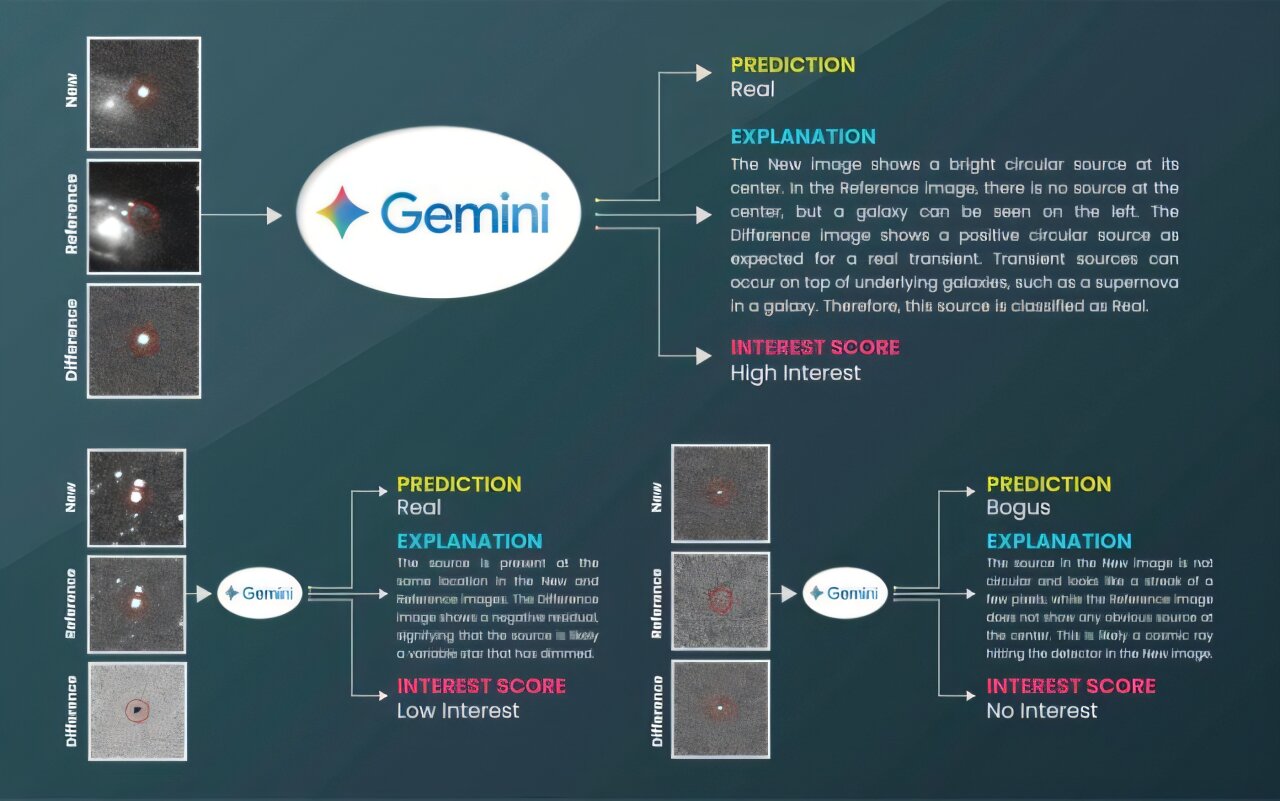
Using the Gemini neural network to classify exploding stars
How can artificial intelligence (AI) help astronomers identify celestial objects in the night sky? This is the question addressed by a recent study published in Nature Astronomy, in which an international team of scientists explored the potential of using AI to conduct astrophysical research on celestial phenomena, including black holes absorbing stars, or even exploding stars. This research could help astronomers use AI to improve their field by reducing the time and resources traditionally spent scanning the night sky.
For the study, scientists tested Google’s large language model (LLM), Gemini, on three datasets about the night sky: Panoramic Survey Telescope and Rapid Response System (Pan-STARRS), MeerLICHT (Dutch for “more light”), and Asteroid Terrestrial-impact Last Alert System (ATLAS). The goal was to determine whether LLMs could achieve the same level of accuracy and efficiency as the above datasets when presented with Gemini’s three image sets.
Researchers used special prompts for Gemini to analyze 15 examples with instructions to classify them as “No interest,” “Low interest,” and “High interest” for celestial artifacts, variable stars, and explosive events, respectively, with the complete repository of examples, prompts, and instructions uploaded to GitHub. The researchers then conducted a reanalysis six months after Gemini was updated with new algorithms. Finally, the researchers found that Gemini achieved accuracies for ATLAS, MeerLICHT, and Pan-STARRS of 91.9%, 93.4%, and 94.1%, respectively.
Accuracy of neural networks
Astronomers believe that neural networks will help them solve the problem of separating real events from false signals when processing data.
“We have spent years training machine learning models, neural networks, to do image recognition. However, the LLM’s accuracy at recognizing sources with minimal guidance rather than task-specific training was remarkable. If we can engineer to scale this up, it could be a total game changer for the field, another example of AI enabling scientific discovery,” says Dr. Stephen Smartt, a professor of astrophysics at the University of Oxford and co-author of the study.
Examples of AI use in astronomy
This study comes at a time when artificial intelligence is rapidly advancing in astronomy and planetary science thanks to a variety of applications, including the detection of exoplanets, analysis of planetary surfaces and astronomical datasets, identification of supernovae, fast radio bursts, gamma-ray bursts, and gravitational waves, citizen science, theoretical modeling, and telescope operations.
An example of the use of artificial intelligence in astronomy is the discovery of Kepler-90i, which is located approximately 2,767 light-years from Earth and is the eighth planet discovered in this system. Although Kepler-90i is defined as a super-Earth with a mass approximately 2.3 times that of Earth, the temperature of its rocky surface is too high to support life as we know it. Furthermore, all planets in the Kepler-90 system orbit within the inner edge of their star’s habitable zone, meaning that they likely all have surfaces or atmospheres that are too hot for life as we know it to exist. An example of the use of AI in planetary science is the study of Martian quakes and how seismic waves propagate inside Mars in a way that is very different from previously thought.
Future applications of AI in astronomy and planetary science include space weather forecasting, the use of autonomous robots on the Moon and Mars, and the use of AI in future manned missions to help astronauts make more informed decisions. Thus, this recent study not only demonstrates the growing application of AI in astronomy and planetary science, but also shows how non-scientists can use free online instruments such as Gemini to achieve breakthroughs in science.
According to phys.org

