

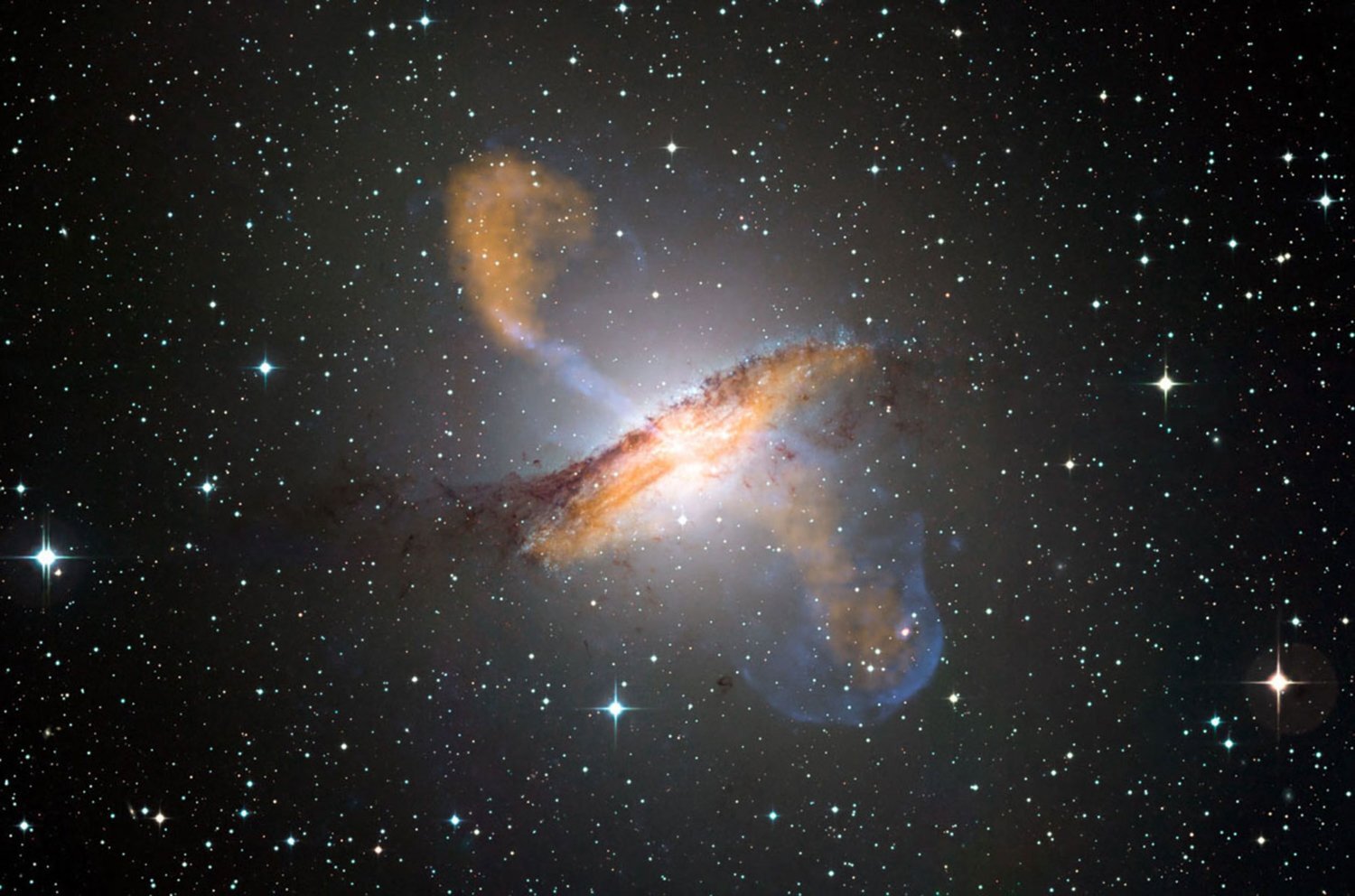
Some galaxies are very active in the radio range. There are dozens of perfectly natural reasons for this. However, scientists have recently suggested that it is worth searching for signals from intelligent beings among these powerful radio waves.
Signals from space
In January 2016, the Breakthrough Listen initiative was launched—the latest iteration of the SETI program to search for extraterrestrial life. It involves listening to the radio spectrum using antennas at the Green Banks and Parks observatories, as well as visual observations using the Automated Planet Finder (APF) system.
So far, Breakthrough Listen has not found any traces of extraterrestrial civilizations. However, scientists who study this field have made numerous observations and drawn conclusions about where in space to look for extraterrestrials and where not to.
The latest series of articles, “Artificial Broadcasts as Galactic Populations,” authored by Brian C. Lacki, explores the possibility that galaxies that shine brightly in the radio spectrum (so-called “radio- bright” galaxies) may be a sign that such galaxies could be inhabited by advanced civilizations.
The latest scientific paper examines how future SETI research could detect radio transmissions individually or collectively, and establishes the boundaries of the population of artificial radio galaxies using both methodologies. Brian C. Lacki is a theoretical astronomer in the Breakthrough Listen Initiative and a Jansky Fellow at the National Radio Astronomy Observatory (NRAO).
This article is the third in a series that examines the technosignatures of the entire population of extraterrestrial intelligences (ETIs), rather than individual civilizations orbiting stars. As Lacki explained, the series was partly motivated by the idea that ETIs might rely on self-replicating systems (Von Neumann’s samples) to explore and colonize territories beyond their star systems.
Radio galaxies and the Fermi paradox
This theory is fundamental to the “Fermi Paradox,” which suggests that this method is the most likely way that advanced civilizations will become interstellar and (possibly) galactic. The first article provides the theory and mathematical basis for the calculations performed in the second and third articles. In the second article, Lacki explores what happens when there are multiple civilizations broadcasting in a single galaxy, and applies this understanding to the Milky Way, Andromeda (M31), and Messier 59 (NGC 4621). The last article discusses potential signals that populations of advanced civilizations could generate in galaxies throughout the universe.
It is known that galaxies produce radio waves as part of their natural emissions. This includes Sagittarius A*, a supermassive black hole (SMBH) at the center of our galaxy.
In the 1970s, scientists discovered that the bright radio emissions at the center of our galaxy were caused by a very compact object located inside a larger radio source. Since then, astronomers have established that supermassive black holes (SMBHs) are located at the center of every massive galaxy and are responsible for active galactic nuclei (AGNs) — a phenomenon in which the central region of a galaxy temporarily outshines all the stars in the galactic disk.
“Collective bound” of radio emissions
However, artificial radio emissions would be indistinguishable from natural sources at the initial stage, and a galaxy containing several civilizations relying on radio technology would naturally appear brighter. Furthermore, many sending civilizations could overlap, making it very difficult to identify a single source. However, it would also be possible to identify the collective radiance of these combined transmissions. Lacki argues that it is impossible to determine whether the radio emissions from galaxies are natural or artificial based solely on their brightness. For an individual galaxy, all that can be done is to set an upper limit based on the total radio emission, which he calls the “collective bound.”
To set limits on the number of possible extraterrestrial intelligent civilizations (ETIs) in radio galaxies, Lacki used a small group of models that tested the influence of various basic assumptions. Each model considered the nature of the “metacommunity” (broad or “galactic hub”) and the societies within it (scattered or discrete), the evolution of their transmissions, the distribution of their luminescence, and established the boundaries of the radio frequencies used and the broad law of degree. These models were combined with a baseline set describing a scenario in which each galaxy has one metasociety, transmissions do not evolve, and all have the same luminosity.
Calculating the number of civilizations
Based on these models, Lacki determined that the prevalence of civilizations spanning galaxies (Kardashev type III) that transmit radio signals is less than one in 1017 stars and one in a million large galaxies. As he explained: “Of course, it’s possible that every galaxy has artificial radio transmitters at some level. We don’t even know if the Milky Way has radio-broadcasting ETIs, which is why we do SETI surveys in our own galaxy. We can make statements about how much power ETIs could be putting into radio, and for that, it can be helpful to use the Kardashev scale: a Type I society uses the power available to a planet; a Type II society uses the power available to a star; a Type III society uses the power available to a galaxy. Kardashev originally proposed that it be used to measure the amount of power going into broadcasts”.
Lacki’s work shows that Type III in their initial meaning — extraterrestrial civilizations (ETI) emitting the luminosity of an entire galaxy with radio waves — are very rare. Less than 1 in 100,000 galaxies the size of the Milky Way may host such a civilization, and this seems to be a solid result regardless of whether the power is concentrated in a single transmitter or distributed among a billion. And at most about 1 in 100 large galaxies may hide a Kardashev Type 2.75 civilization, in which ETIs emit approximately 1/300 of the galaxy’s luminosity in radio waves. In this sense, Lacki compares the search for civilizations in radio-luminous galaxies with GHAT surveys and other searches for Dyson spheres. These searches look for sources of excess infrared radiation, which (theoretically) could be caused by heat radiated into space by a Dyson sphere. Similarly, astronomers could search for galaxies with “too much” infrared emission, although this would create similar problems. How could SETI surveys distinguish artificial sources of infrared radiation from natural ones?
Search for artificial radio signals in radio galaxies
According to Lacki , there is a collective method, which he described, while another involves searching for individual radio transmissions that could stand out in the galaxy’s radio spectrum: “Over the past few years, various researchers have established upper limits for radio transmissions in other galaxies, searching for those that happen to be close to the stars we observe as part of SETI and that could be detected by chance. This is still an important strategy, and what you want to do is observe as much of the sky as possible, as deeply as possible, at as many frequencies as possible.
You can also target nearby galaxies directly, and this has been done more and more in recent years. For this collective method, using radio surveys to limit the fraction of “artificial radio galaxies,” we already know in principle how many galaxies exist at each brightness in the radio band (“source counting”). What can be done is to apply this method to other frequencies and set limits on the number of civilizations transmitting signals at these frequencies.
In recent years, SETI researchers have attempted to expand the list of potential technosignatures that future research could focus on. As Lacki noted, these same surveys could also search for technosignatures outside the radio frequency range, such as X-rays, gamma rays, and other non-radio, non-optical transmissions. In fact, he recommends that these surveys could be a good starting point for new SETI research beyond the radio spectrum.
According to phys.org

