

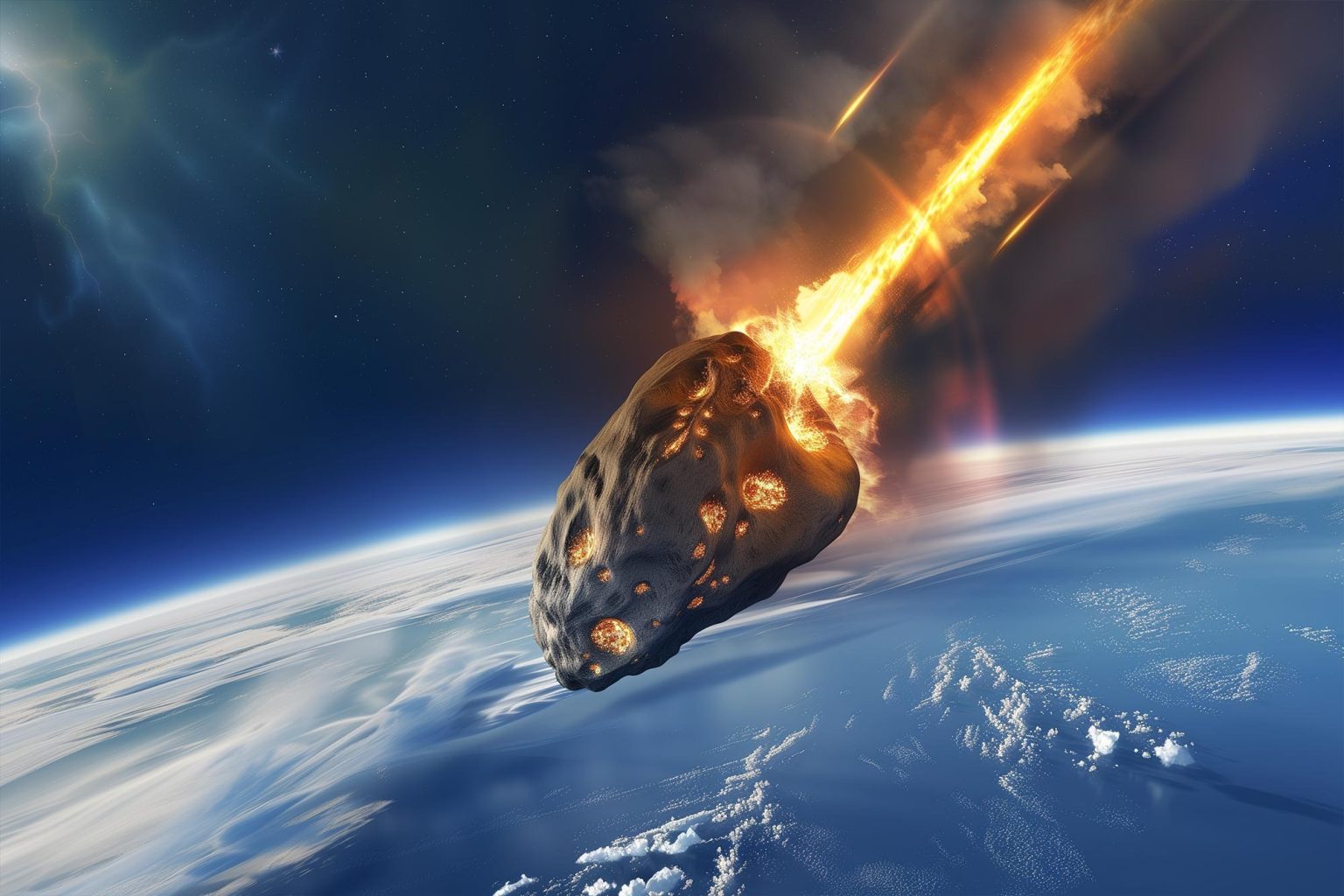
Approximately 35 million years ago, the eastern coast of present-day North America suffered a devastating blow from space. An asteroid about 5 kilometers in diameter, traveling at an incredible speed of over 64,000 km/h, crashed into Earth in the area of what is now Chesapeake Bay. This collision left behind one of the largest and best-preserved impact craters on the planet, now buried 500 meters below the ocean floor. But the consequences of the event extended far beyond the crater itself.
Illustrative photo: SciTechDaily
A new study published in the journal Southeastern Geology highlights the true scale of the disaster. A group of geologists studying fossils in Moore County, North Carolina, discovered unique rock layers 386 km from the epicenter of the impact. This previously overlooked finding provided irrefutable evidence of the impact and the powerful tsunami that followed.
Geological archive of the catastrophe
In a layer of rock nearly a meter thick, scientists discovered four distinct layers, each telling its own part of the story of that fateful day. The bottom layer, 43 cm thick, is rich in sandy clay, carbon glass, and rock fragments. The discovery of iridium, an element that is extremely rare on Earth but often found in meteorites, provided critical evidence of the cosmic origin of the catastrophe. Its concentration here reached 18 parts per billion.
The next layer, only 9 cm thick, contained silt and loosely bound masses of quartz and carbon with a smaller amount of iridium. The third layer, 6 cm thick, was a mixture of soil and fragments of the seabed, and the fourth, upper layer, 15 cm thick, consisted of coarse sand left behind by a powerful tsunami wave.
From the blow to the flood
Geologists were able to reconstruct the chronology of events. First, there was a direct impact, which created a hypersonic shock wave. It instantly destroyed all life within hundreds of kilometers and ejected a colossal amount of molten rock into the atmosphere, which fell as rain from Massachusetts to Barbados. The first layer of rock is evidence of this ejection, which settled in the first minutes after the impact.
The second layer formed when the cloud of smaller particles began to disperse. Then, when water began to fill the crater, a massive landslide occurred, forming the third layer – a mixture of soil and marine sediments. The final chord was a powerful tsunami that brought with it a mass of sand and gravel, forming the fourth, upper layer.
This discovery not only provides insight into an ancient catastrophe but also serves as a reminder of how cosmic events could have shaped the landscape and even influenced the development of life on our planet millions of years ago.
We previously reported on how the death of the dinosaurs was caused by a double Armageddon.
Provided by: scitechdaily.com

