

Japanese engineers have found a way to overcome the challenges of transmitting large amounts of data from small CubeSat satellites. To do this, they developed an origami antenna designed to take up very little space when folded.
Problem with the antenna on CubeSats
Researchers at the Tokyo Institute of Technology have developed a new antenna based on the principle of paper origami—complex three-dimensional paper figures. They reported this in an article recently published in the journal IEEE Transactions on Antennas and Propagation.
This problem has existed for several years, ever since the concept of CubeSats made its way into orbit. Indeed, modern electronics make it possible to pack a wide range of features into a space measuring 10 x 10 x 10 cm. And if one such cube isn’t enough, you can always connect two, three, or six of them. Even then, it will still be smaller than any 20th-century satellite.
It’s no surprise that CubeSats have become a popular choice for small teams conducting independent research. However, data transmission volumes are constantly increasing, and this has become a real challenge for these small satellites.
Effective transmission of large data volumes requires a powerful amplifier. The laws of physics make it impossible to build such an amplifier without a large antenna, and large antennas do not fit into the design of any CubeSat, thereby negating all of its advantages.
Origami antenna
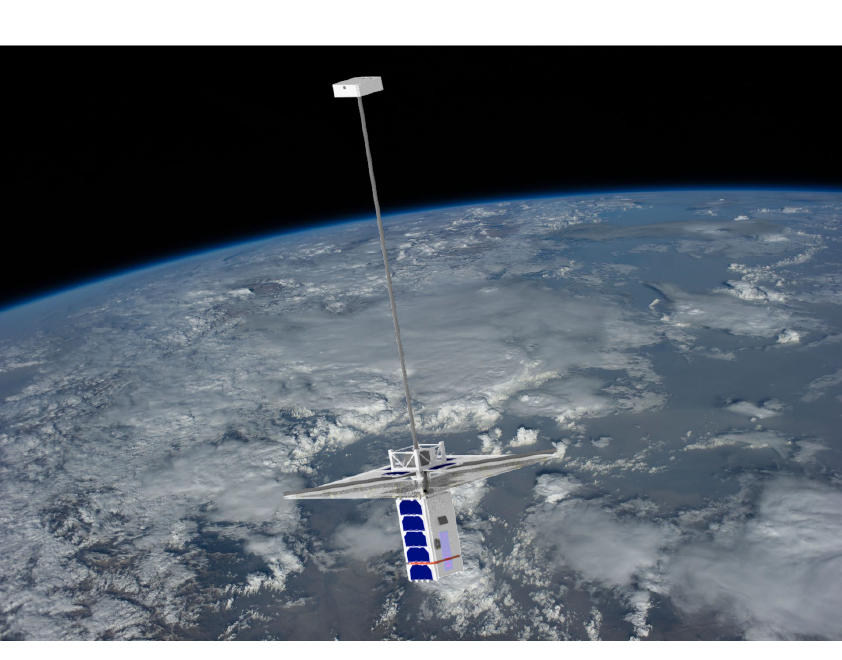
And here comes a new origami antenna from Japanese developers. It consists of a transparent membrane made up of a conductive layer and an insulating layer. Inside it are flexible electronic components in the form of small U-shaped structures connected to elements capable of reflecting waves.
This film is stretched over folding booms made of shape-memory material. This suggests that they don’t need any additional reason to turn around. When folded, the entire structure weighs 65 grams and measures 10 × 10 × 6 cm, allowing it to fit inside the satellite made up of these three CubeSat modules.
When fully extended, it increases in size by a factor of 2.6 and can operate at a frequency of 5.8 Hz. Meanwhile, the antenna has been tested on Earth in a special vacuum chamber designed to simulate outer space. In the future, it is planned to be deployed aboard the OrigamiSat-2 satellite.
According to phys.org

