

Once upon a time, there may have been another ice giant in the Solar System, and its disappearance likely triggered a chain reaction that destabilized the orbits of the giant planets. New research suggests that this hypothetical planet may have triggered an era of gravitational chaos billions of years ago. At that time, the orbits of Jupiter, Saturn, Uranus, and Neptune shifted, and their moons were put at risk of collision.
Chaos after the formation of the planets
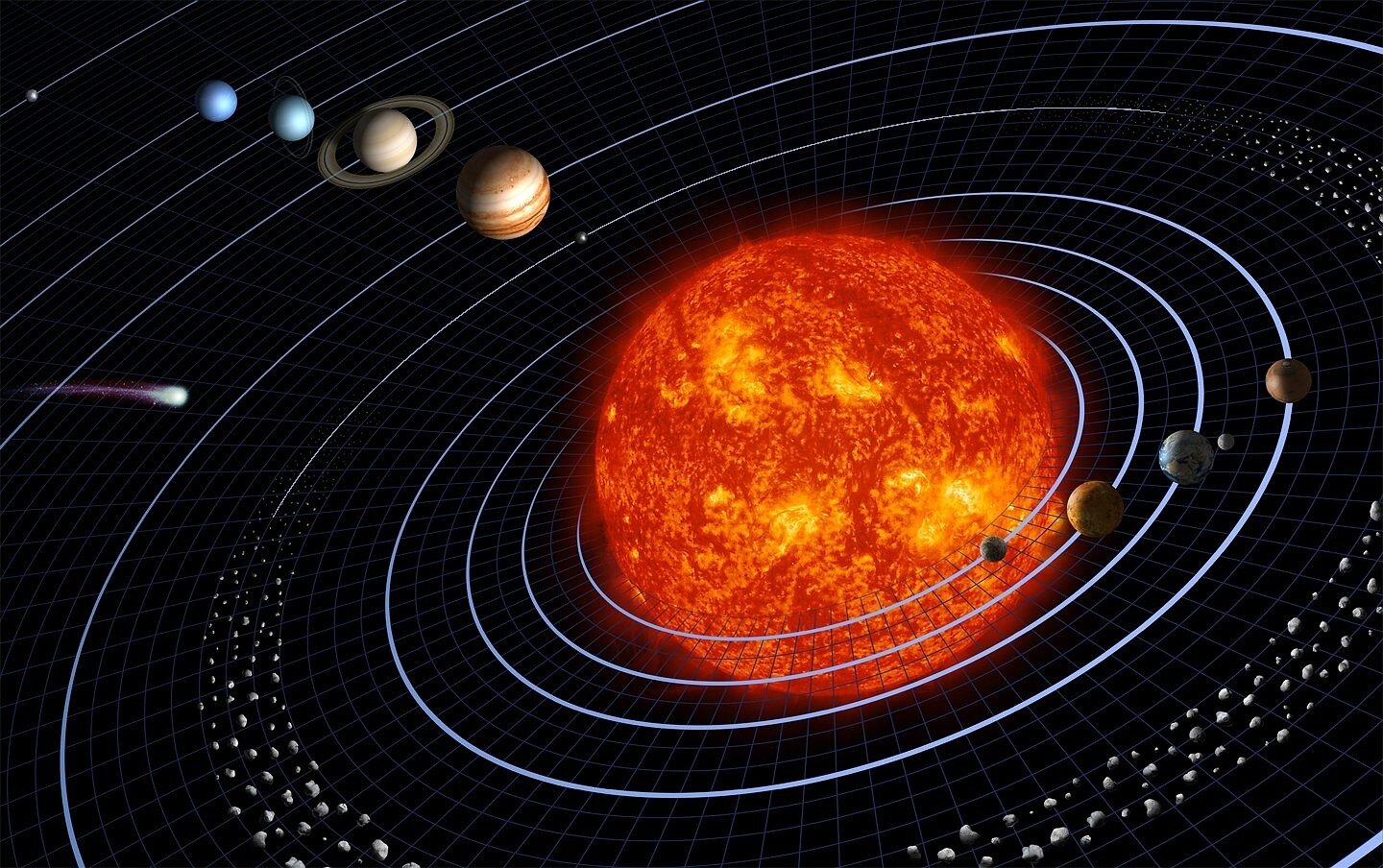
Between 4 and 4.5 billion years ago, the outer Solar System underwent a period of extreme instability. The orbits of Jupiter, Saturn, Uranus, and Neptune became sharply destabilized; the planets came extremely close to each other, attracted to each other by powerful gravitational forces, and eventually dispersed along their current trajectories.
This era of instability is described by the Nice Model, one of the key theories of the formation of the Solar System. It remained unclear how the giant planets’ regular moons managed to survive at all under such extreme conditions.
Over a hundred scenarios
Scientists reviewed thousands of computer simulations of the early Solar System and selected 122 that most accurately reproduce the key features of its current state.
The software tracked complex gravitational interactions between the planets, moons, the Sun, and asteroids over millions of simulated years. The team tested scenarios involving five and six giant planets, since the current Nice Model suggests that one or two of them were eventually ejected from the Solar System.
Uranus’s moons under attack
According to the simulations, the probability of Jupiter’s and Uranus’s moon systems surviving was less than 15% in both cases. Of all the scenarios, only one preserved both the original moons and the planets at the same time.
When other giant planets came too close to Uranus, their gravity virtually guaranteed the destruction of its moons. Instead of scattering into space, the moons collided with each other at high speeds. This created massive fields of icy debris, which eventually coalesced into new objects. According to the researchers, this is exactly how Uranus’s moon Miranda could have formed.
Double disaster
Simulation results indicate that Uranus’s moons have undergone at least two catastrophic disturbances. The first is linked to an impact that tilted the planet on its side, as Uranus still rotates nearly “lying down” relative to the plane of its orbit. The second occurred during the period of instability among the gas giants.
The authors of the study, published in the journal Icarus, acknowledge that the simulations do not capture every detail and that new calculations will be needed to understand the fate of individual moons. However, even the available data is sufficient to confirm that the early Solar System was an environment of constant catastrophic collisions.
According to phys.org

