

The quasar SDSS J0005+2007 exhibits strange long-period variability in the X-ray range. No such variations are observed in other parts of the spectrum. This points to mysterious processes taking place in its vicinity.
Quasar SDSS J0005+2007
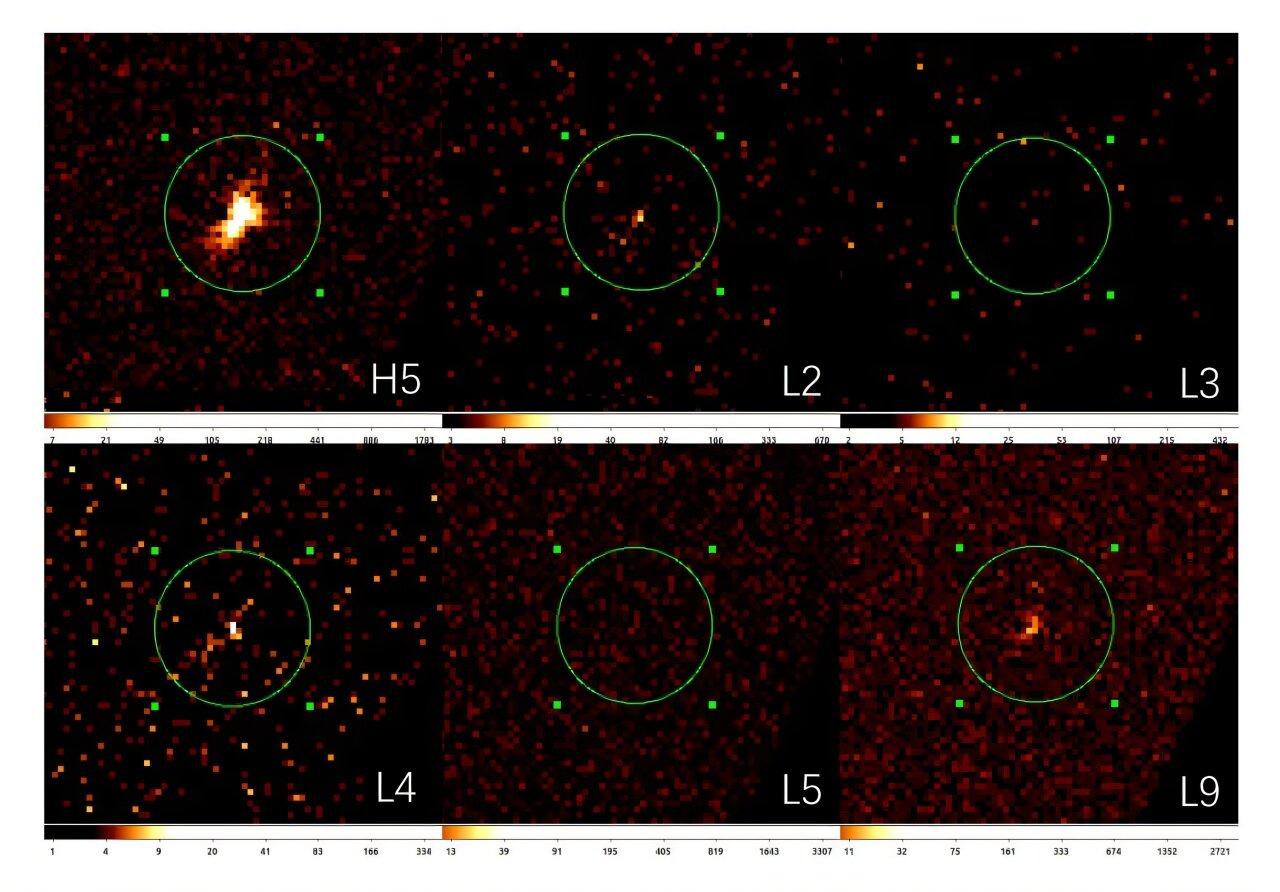
Given that still very little is known about the properties and behavior of SDSS J0005+2007, a team of astronomers led by Xiao-Hui Yang of Shenzhen Technology University in China decided to take a closer look at this quasar. For this purpose, they combed through the data from space telescopes such as XMM-Newton or Swift.
Generally speaking, a quasar refers to the phenomenon of a jet of extremely powerful radiation emanating from the center of a galaxy. Specifically, its source is a supermassive black hole that actively devours matter. And it emits most of its energy in the X-ray spectrum.
Observations of SDSS J0005+2007 at these specific wavelengths have shown that over the past five years, this black hole – estimated to have a mass of 30 million solar masses – has changed its state. During this time, the energy flux in this range has decreased by an order of magnitude.
What is behind this?
A distinctive feature of this transition is that, even in its more active state, the quasar’s X-ray spectrum remained relatively soft. However, as it transitioned to a more quiescent state, the spectrum simultaneously became significantly harder.
Another interesting feature is that in the ultraviolet region, which is close to the X-ray spectrum, the changes were not as dramatic. And in the visible and infrared regions, they are not visible at all. This suggests that the changes are not caused by processes occurring in the accretion disk around the black hole.
Instead, scientists believe that something is happening in the near-polar regions of the black hole along our line of sight – some kind of movement of pure gas without dust. However, only further research will help us understand what this is.
Provided by: phys.org

