

Blue Origin has completed another round of tests on its unmanned lunar lander and is moving the craft closer to the launch pad. The company hopes to carry out its first unmanned lunar landing later this year.
What is Endurance?
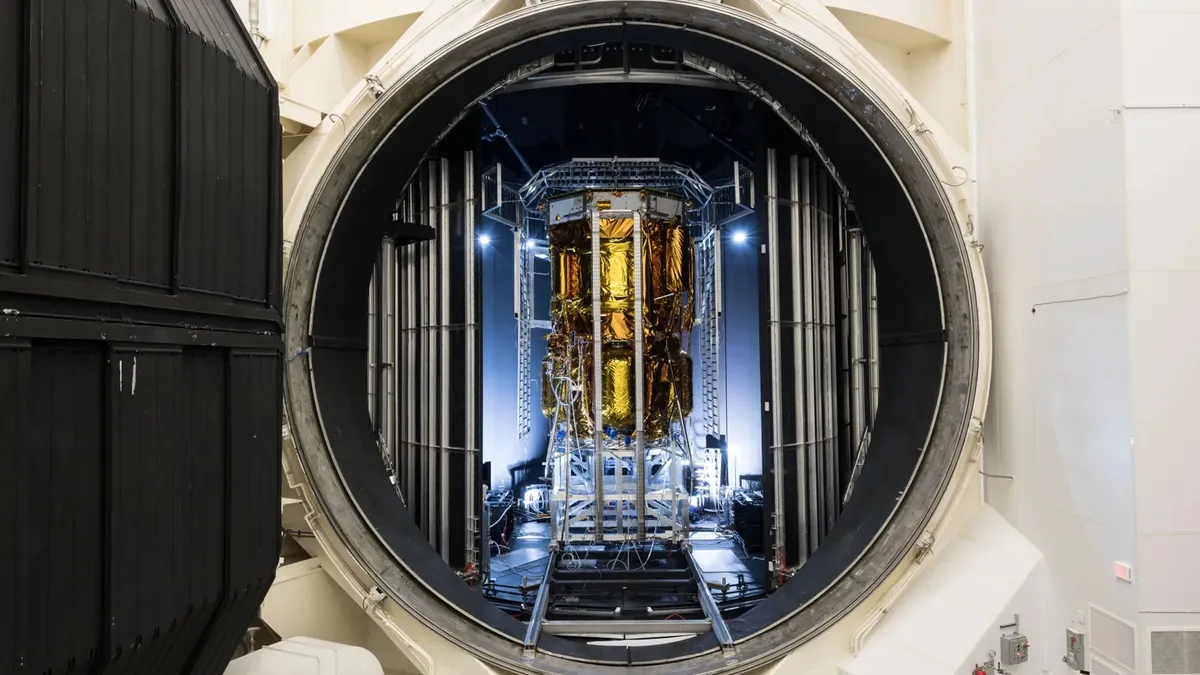
Blue Origin is building two landing modules. The first, Blue Moon MK1, is designed for uncrewed flights and technology testing and has been named Endurance. It recently underwent testing in a vacuum chamber at the Johnson Space Center and was transported to the Blue Origin facility near the Kennedy Space Center in Florida.
The second one, the MK2, will be capable of transporting astronauts directly to the Moon’s surface. NASA is considering this spacecraft as one of the two official landing modules for the Artemis program—the other is being developed by SpaceX.
What they’re checking right now
At its new location, Endurance is being prepared for radio frequency compatibility testing—engineers are ensuring that the spacecraft’s onboard communication systems will not interfere with one another during an actual flight. Once this phase is successfully completed, the spacecraft will proceed to launch.
To obtain NASA approval for crewed missions, the Blue Moon MK1 has to land on the Moon under its own power, demonstrate autonomous navigation and cryogenic refueling, and then take off back into orbit.
In parallel with SpaceX
Blue Origin is sharing a NASA contract with SpaceX, whose Starship is also being developed to transport astronauts to the Moon. Both spacecraft must undergo the same set of mandatory qualification tests.
NASA has stated that it is targeting 2028 for the first crewed landing as part of the Artemis 4 mission, and prior to the Artemis 3 crewed flight, scheduled for late 2027, the crew will practice docking in Earth orbit with one or both spacecraft.
Will the spacecraft make it this year?
Another source of uncertainty is the New Glenn launch vehicle, which remains grounded pending an investigation by the Federal Aviation Administration following a second-stage failure during its most recent launch. The launch of Endurance to the Moon will depend on how the spacecraft performs in the remaining tests and when the rocket resumes flight operations.
On its maiden flight, Endurance will deliver two scientific instruments to the Moon for NASA’s CLPS (Commercial Lunar Payload Services) program.
According to space.com

