

In 1971, astronaut David Scott conducted a simple but elegant experiment on the surface of the Moon. He simultaneously dropped a geological hammer and a feather. Without air resistance, they fell to the surface simultaneously, clearly demonstrating the principle that Galileo Galilei had proven centuries earlier: in a gravitational field, all bodies fall with the same acceleration, regardless of their mass. This was an illustration of the weak equivalence principle — the foundation of Einstein’s theory of relativity. But does it work for the most mysterious substance in the Universe — antimatter?

The birth of antimatter
To understand the importance of this issue, it is worth remembering how antimatter came into being. In the 1920s, physicist Paul Dirac combined quantum mechanics with the theory of relativity. His equation had an unusual property: it assumed the existence of “doubles” of all particles, but with opposite electric charges. Thus, mathematics gave rise to the idea of antimatter — the first prediction of its kind in the history of science. Later experiments confirmed the existence of antiparticles.
The perfect test subject for gravity
Why is antimatter so interesting for studying gravity? It is a pure product of quantum mechanics, whereas gravity is best described by Einstein’s theory. These two fundamental theories of modern physics are not yet compatible. By studying how antimatter reacts to gravity, scientists hope to find a bridge between them.
However, experiments with antimatter are a real challenge: it annihilates upon contact with ordinary matter, making it incredibly difficult to obtain and even more difficult to contain.
The decisive moment in the ALPHA-g laboratory
Finally, scientists from the ALPHA-g collaboration at CERN found a way. They created neutral antihydrogen atoms by combining antiprotons and positrons (antielectrons), and then cooled them with lasers to almost absolute zero. The antiatoms were held in a special magnetic trap. The key stage came when the magnetic field strength began to be slowly reduced.
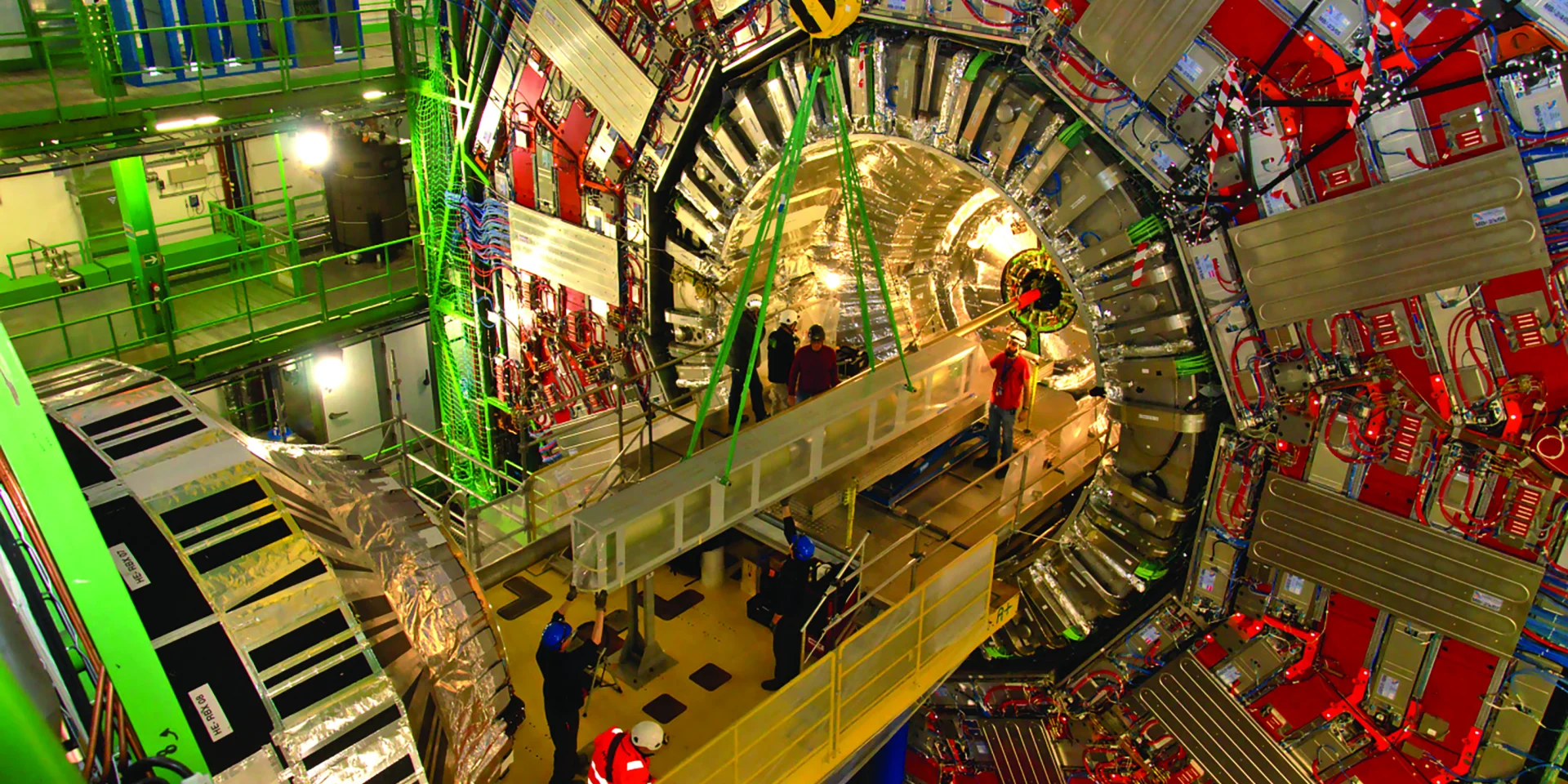
If antimatter “fell upward” or behaved differently, the atoms would have escaped from the top. If the weak equivalence principle works, they should have fallen downward under the influence of Earth’s gravity. The detectors waited for annihilation flashes when they hit the walls of the container. The result was decisive: about 80% of the antiatoms were released at the bottom.
Open questions
The experiment confirmed that antimatter obeys gravity in the same way as ordinary matter. A hammer, a feather, and an antihydrogen atom fall with the same acceleration. This is a triumph for the weak equivalence principle and Einstein’s theory. However, the story does not end there.
Physicists are now trying to determine whether this acceleration is exactly the same. Even a tiny difference of 1% between the fall of matter and antimatter would shift the foundations of physics and open up a new understanding of the nature of the Universe. For now, our world remains a place where the laws of gravity are universal for everything — from a hammer to an antiatom.
Earlier, we reported on another attempt to solve the mystery of “global asymmetry.”
According to Space

