

Scientists believe that Trojan planets may exist in binary systems consisting of a neutron star and a normal star. They developed two methods to find them.
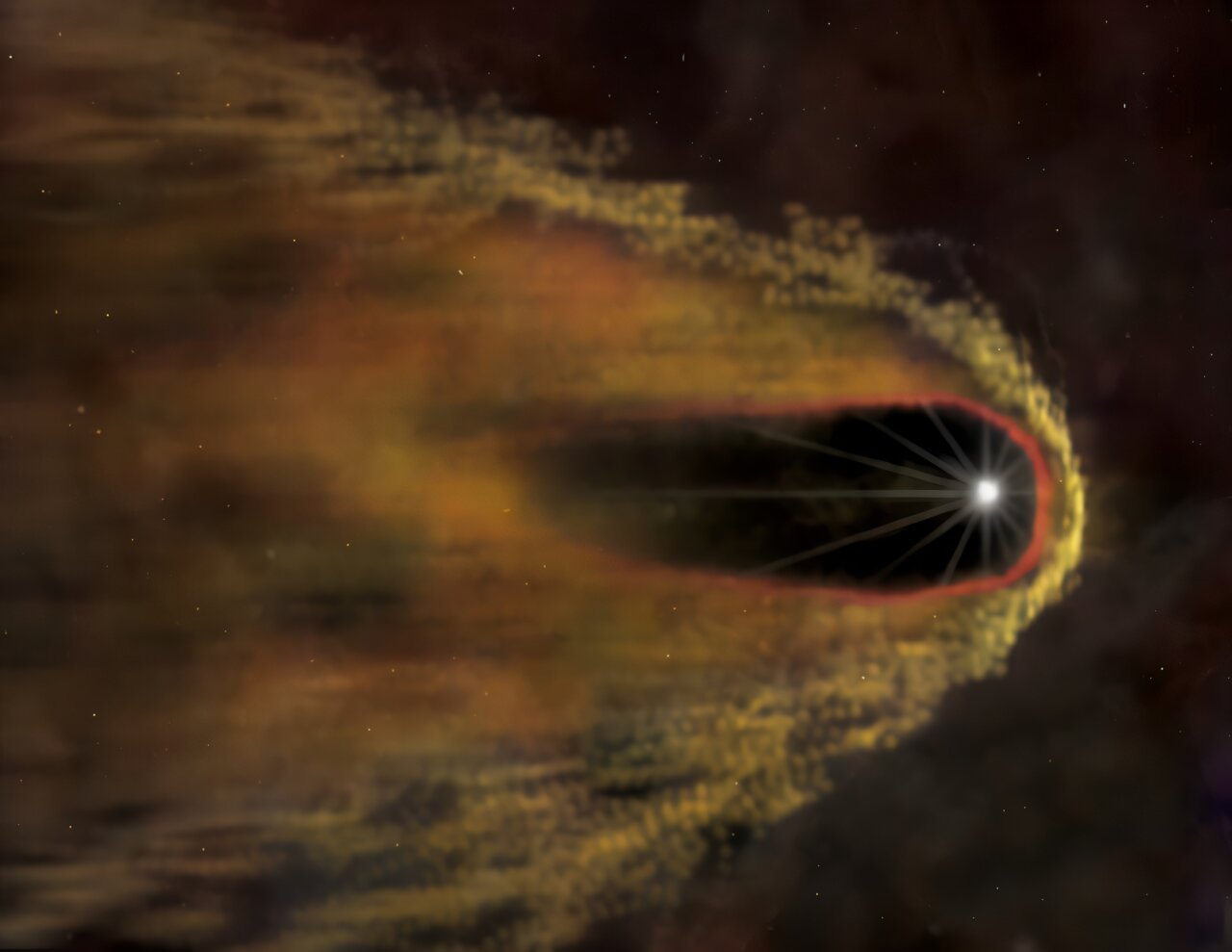
Trojan planets
A group of astrophysicists from the TROY project recently published a study in The Astrophysical Journal on the possibility of the existence and detection of Trojan exoplanets. Moreover, the suggestion is to look for them not just anywhere, but in pulsar systems.
Generally, in astronomy, the term “Trojan asteroids” refers to asteroids located at the L4 and L5 Lagrange points. In these regions, the gravitational forces of all the bodies in the system are in equilibrium, and relatively small objects can exist there. These points are located 60° ahead of and 60° behind the giant planet in its orbit.
However, over time it became clear that Jupiter was not the only planet with such a feature; other planets have it as well. And then scientists realized that an entire planet could be located at one of the Trojan points of a given system.
Pulsar systems
However, in a new study, the researchers went even further. They hypothesized that Trojan planets might exist directly in the orbit of one of the stars in binary systems. These luminaries usually revolve around a common center of mass, so there is nothing surprising about this.
However, scientists suggest looking for Trojan planets not just in binary systems, but around “black widows.” This is the name given to a specific type of pulsar. The neutron star is so close to its companion that its gravity pulls some of the companion’s matter toward it, causing the object to begin spinning very rapidly.
It would seem that the orbit of a star—where a neutron star devours its mate like a female spider devours her male—is the worst possible place for a planet to exist. However, researchers say that in this particular case, the orbit is so stable that Trojan planets can remain there indefinitely.
Planet detection
However, it is extremely difficult to detect such a Trojan planet. Standard methods, such as transit and radial velocity measurements, do not work here because it has almost no effect on the star’s motion and never passes between the star and us.
However, the researchers discovered two ways to do this. For one of them, applied to a binary system known as PSR J1641+8049, they compared the optical light curves with the radio data.
They knew that optical light peaks when the heated side of the companion star faces Earth, whereas radio pulses track the orbital center of mass of the entire system (which may consist of three or more bodies). If there were a discrepancy between the two measurements, this would indicate the presence of a third body (i.e., a Trojan asteroid) interfering with the radio pulses.
The second method, which scientists applied to eight different black widow binary systems, uses a 15-year dataset from NANOGrav that tracks a parameter known as time of arrival (TOA). If the system contains a Trojan asteroid, it will “librate” (or oscillate) around its stable point, causing the system’s center of mass to oscillate at the same frequency. This change can be detected through slight variations in the timing of radio signals reaching Earth—hence their “time of arrival”—which indicates that a third object, causing instability, is inducing changes in the timing of the radio pulses.
Despite using two different methods on nine different systems, the researchers were unable to definitively confirm that they had detected any Trojans. According to the authors, two systems in the NANOGrav dataset exhibited false-positive signals, most likely caused by random noise from the host pulsar or limitations in transit tracking at Arecibo, one of the observatories used to collect the data.
In addition, they were able to state unequivocally that there were no objects around the remaining seven binary pulsar systems—not even one with the mass of Earth—with the exception of the system tested using optical and comparative methods, which could limit the size of the Trojan planet to no more than 8 times the radius of Jupiter.
According to phys.org

