

Scientists studied Polana, a fairly large asteroid in the Main Belt, using a spectroscope installed on the James Webb Space Telescope. It turned out to be very similar to Bennu and Ryugu, which had previously been explored by spacecraft.
Asteroid Polana
An article on the spectroscopy of Polana (142) was recently published in the Planetary Science Journal. Its authors claim that it has a common origin and forms a family with well-known objects such as Bennu and Ryugu.
The diameter of Polana is about 55 km. It was discovered back in the 19th century and has not been particularly noteworthy until now. Instead, Ryugu and Bennu were explored by spacecraft at close range, and material from the former was even brought back to Earth.
Spectral analysis of asteroids and their samples
A team of scientists led by Dr. Anicia Arredondo believes that in the early stages of the Solar System’s formation, large asteroids collided and broke into pieces to form a “family of asteroids,” the largest of which was Polana. Theories suggest that the remnants of this collision not only created Polana, but also Bennu and Ryugu. To test this theory, scientists began studying the spectra of all three bodies and comparing them with each other.
Arredondo and her team have applied for time on the James Webb Space Telescope to observe Polana using two different spectral instruments that focus on the near-infrared and mid-infrared spectra. Next, they compared this data with spectral data from physical samples of Ryugu and Bennu collected by two different space missions. The Japanese Aerospace Exploration Agency’s Hayabusa2 spacecraft encountered Ryugu in 2018 and collected samples that returned to Earth at the end of 2020. NASA’s OSIRIS-REx spacecraft encountered Bennu in 2020 and collected samples that returned to Earth in late 2023.
Asteroid sizes
Bennu and Ryugu are considered asteroids on Earth because they orbit the Sun inside the orbit of Mars; however, they are not considered dangerous to Earth, with closest approaches of approximately 1.9 and 1 million miles, respectively.
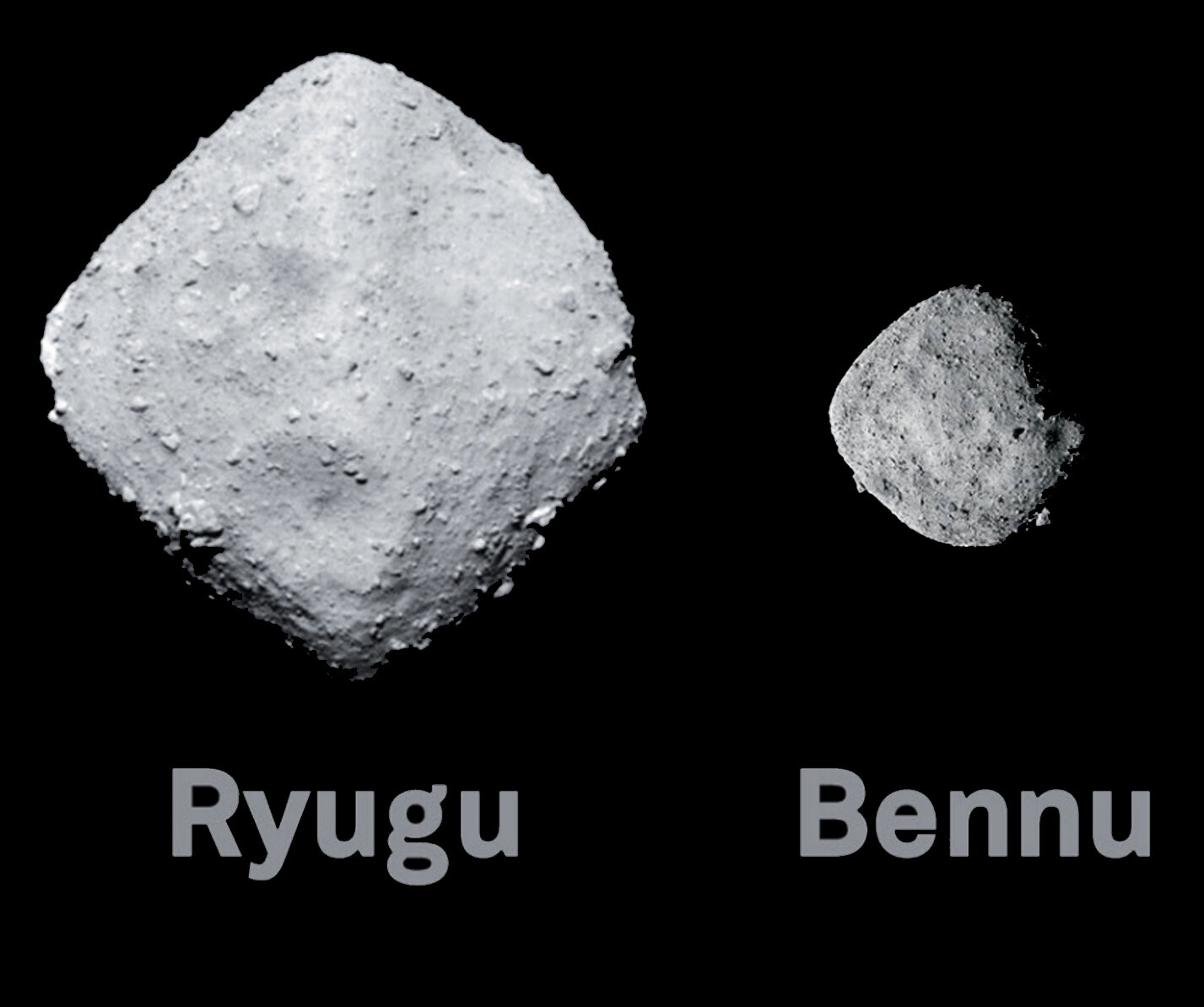
Both Bennu and Ryugu are relatively small compared to Polana. Bennu’s diameter is approximately one-third of a mile, or roughly the same as that of the Empire State Building. Ryugu is twice as large, but Polana overshadows them both, being approximately 33 miles wide. Scientists believe that Jupiter’s gravity pushed Bennu and Ryugu out of their orbits near Polana.
According to phys.org

