

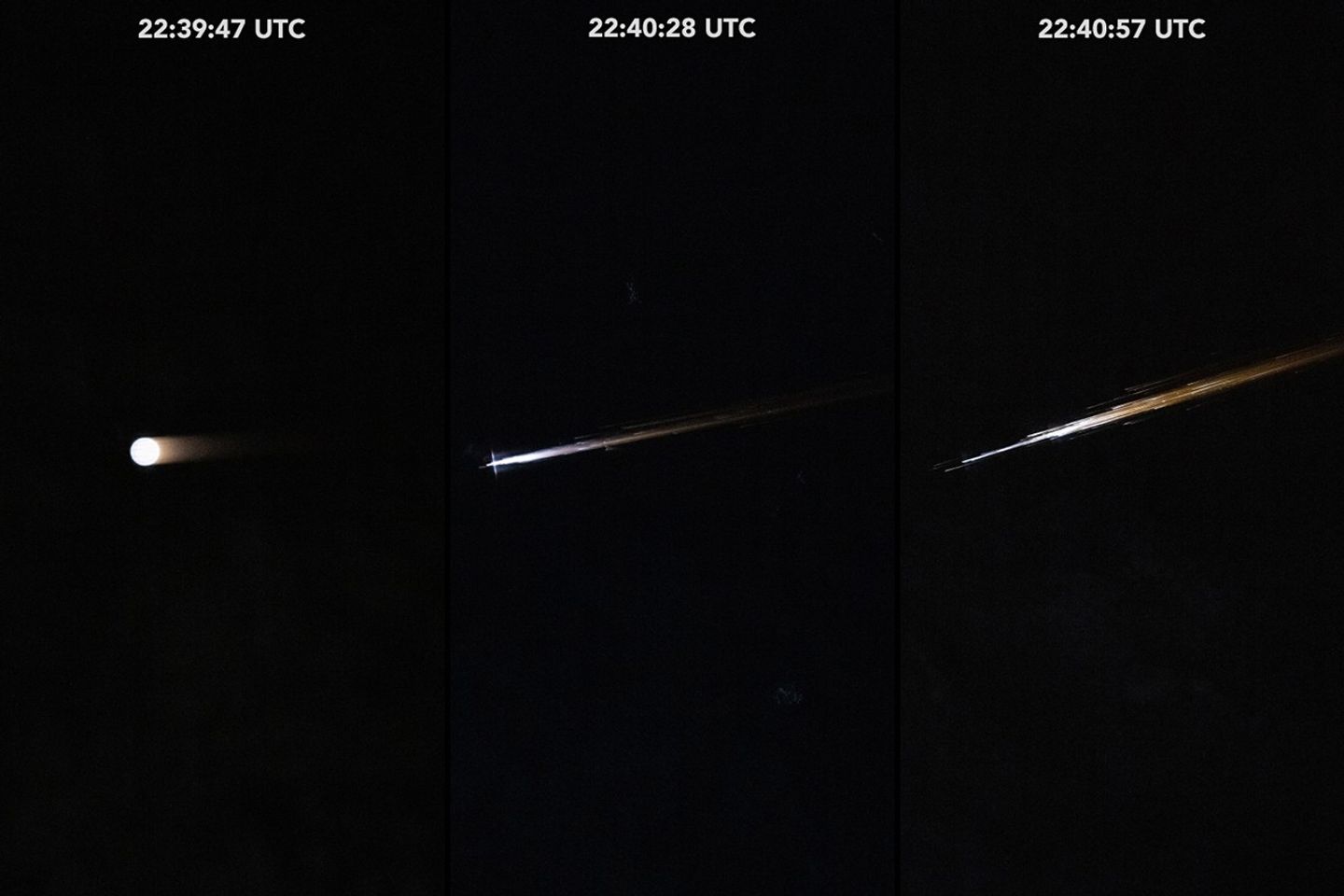
An astronaut aboard the International Space Station was scanning the darkness in search of a cargo spacecraft—when he suddenly saw something completely different. An unidentified object burst into flames in the atmosphere and broke apart into dozens of fragments.
Instead of a spacecraft, there was a flash
It happened on April 27, 2026, as the ISS was flying over West Africa. The astronaut was watching through the dome-shaped Cupola window, waiting for the cargo spacecraft heading toward the station to appear. But right below him, something flashed brightly.
“I saw the tail grow, and then break apart into a bunch of smaller pieces,” the astronaut wrote on social media. Progress 95 (also known as Progress MS-34) docked with the station as scheduled that same day, so it was not involved in the incident.
What could it have been?
It has not yet been possible to pinpoint the source. According to a scientist from NASA’s Crew Earth Observations office, it is difficult to identify the object without data on the camera’s exact orientation.
It could have been a stage from the Progress 95 launch vehicle, another piece of space debris, or even meteoric material. Three consecutive images, taken at 30–40-second intervals, captured the entire process: first a point of light, then a long tail with a white trail of debris, and finally a stretched-out orange trail of disintegration.
How the atmosphere destroys space debris
The upper layers of the atmosphere—the thermosphere and exosphere—are truly bustling places. Tens of thousands of tracked objects orbit there: satellites, spent rocket stages, and spacecraft debris. Every day, tens of tons of meteoric material pass through the atmosphere—most of it burns up in the mesosphere before reaching the surface.
Objects at altitudes below 600 kilometers re-enter Earth’s atmosphere within a few years. Those above 1,000 kilometers can remain in orbit for millennia. As debris descends into denser layers of the atmosphere, friction and compression heat it to extreme temperatures—causing it to disintegrate or burn up completely.
According to NASA Earth Observatory

