

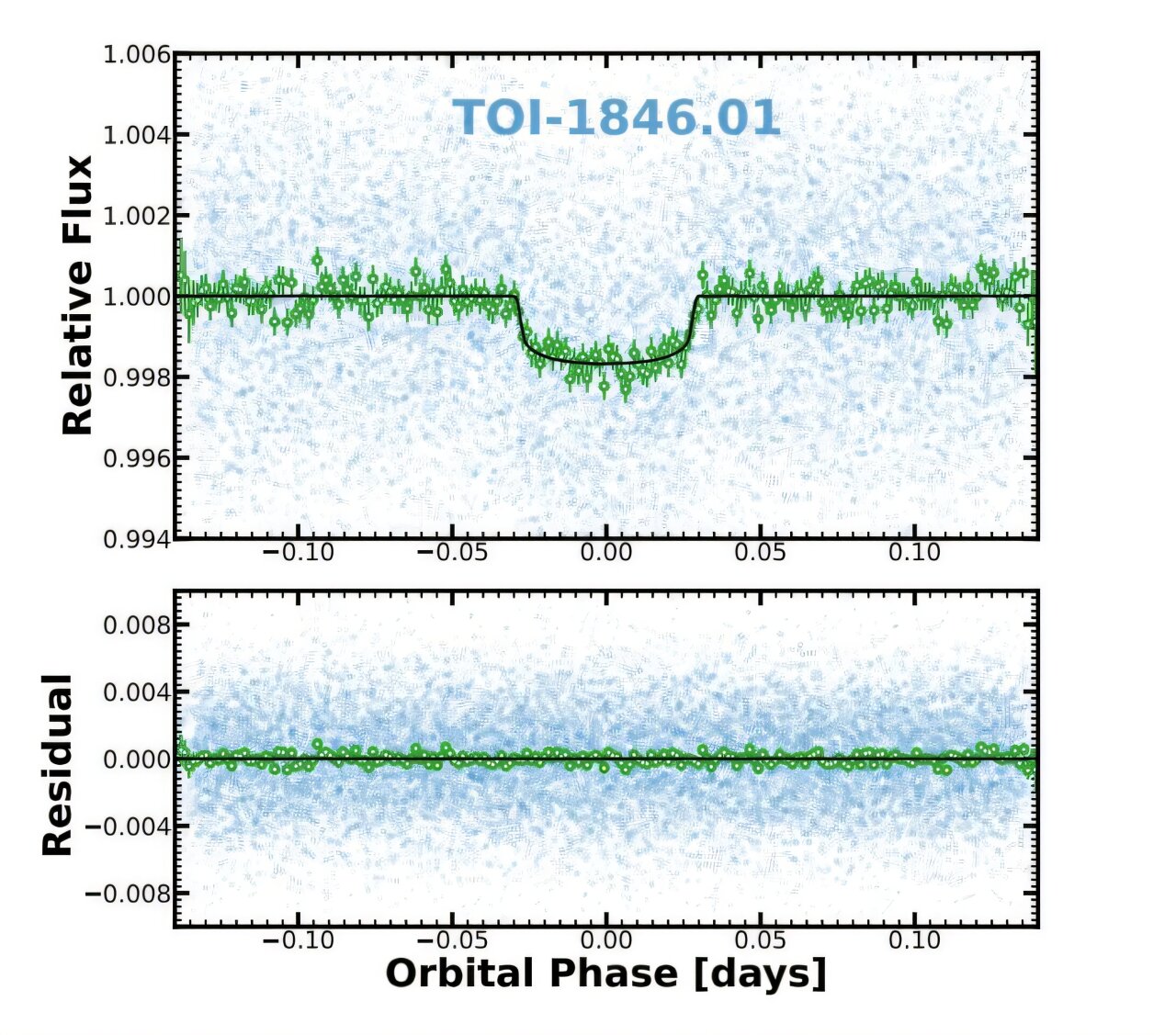
An international team of astronomers has discovered a new distant planet orbiting a neighboring star. It is called TOI-1846 b and belongs to the “super-Earth” type: these are planets larger than Earth but smaller than gas giants such as Neptune. Its discovery was made possible by data from NASA’s TESS (Transiting Exoplanet Survey Satellite), which searches for planets beyond our Solar System.
TOI-1846 b is located approximately 154 light-years from Earth. It is 1.8 times larger and 4.4 times more massive than our planet. The temperature on its surface can reach 568 degrees Kelvin; this is hot, but not excessively for planets that orbit close to their stars. The newly discovered “super-Earth” completes one orbit around its star in just 3.93 days.
A distinctive feature of this planet is that it is likely to be rich in water. TOI-1846 b also falls within the so-called “radius valley” — an area where planets of this size are relatively rare. This may mean that it lies on the border between rocky planets such as Earth and gas giants such as Neptune. These types of planets are precisely the transitional types that can reveal the secrets of planetary evolution and their atmospheres.
The “super-Earth” TOI-1846 orbits the star TOI-1846 (or TIC 198385543). It is a red dwarf, smaller and cooler than the Sun. Its mass is only 42% of the Sun’s mass, and its surface temperature is approximately 3568 Kelvin. The star’s age is estimated at 7.2 billion years (much older than our Sun).
TESS, which has been operating since 2018, has already discovered more than 7,600 planet candidates, among which more than 630 have already been confirmed. It detects planets using the transit method — observing how the brightness of a star decreases slightly when a planet passes in front of it.
Exactly such a signal was recorded by the team led by Abderahmane Soubkiou from the observatory in Morocco. The scientists were then able to confirm its origin using ground-based telescopes, spectroscopy, and high-resolution images.
TOI-1846 b is not just another planet. Studying it could help answer important questions:
- How exactly are different types of planets formed?
- Why do some planets lose their gas envelopes?
- Can life exist on other worlds?
Although some characteristics of this planet still need to be clarified, such as its exact chemical composition, researchers are already planning new observations. In particular, they want to measure the so-called radial velocity of TOI-1846 b to better understand its mass.
In conclusion, TOI-1846 b is further evidence that “super-Earths” may be one of the most common types of planets in the galaxy. And although it is located hundreds of light years away, each such discovery brings us closer to answering the eternal questions of space: are we alone in the Universe? Is life possible on other planets?

