

An international team of astronomers has discovered one of the most vivid manifestations of activity from an “awakened” black hole. They figuratively compared it to the eruption of a “cosmic volcano.”
Black hole under pressure
Most galaxies contain supermassive black holes, but only some of them produce huge jets of radio-emitting magnetic plasma. Among them is the black hole at the center of the radio galaxy J1007+3540. Researchers first noticed it when studying images taken with the Low Frequency Array (LOFAR) in the Netherlands and India’s Giant Metrewave Radio Telescope (uGMRT). The images revealed a unique structure indicating multiple “activations” of the black hole, followed by periods of calm.
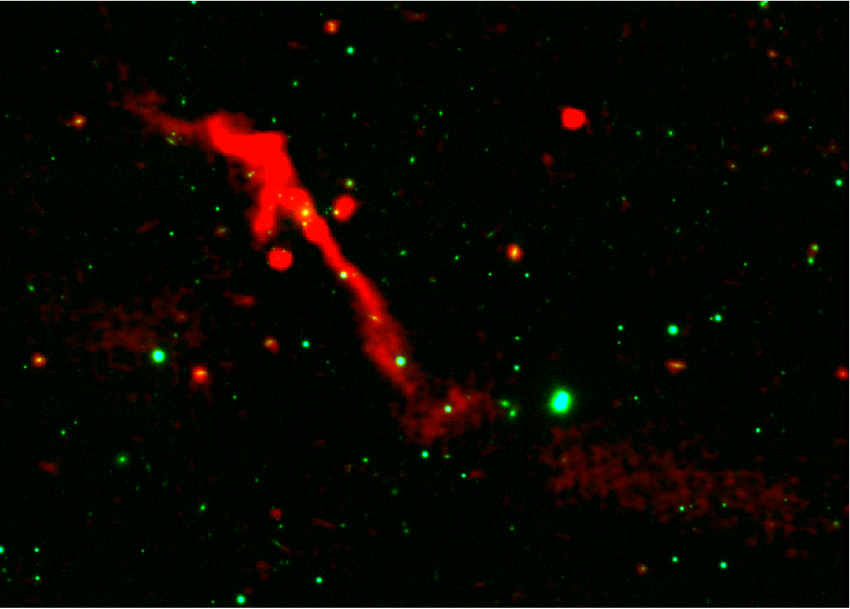
J1007+3540 is located inside a massive galaxy cluster filled with extremely hot gas. This environment creates enormous external pressure — much higher than that experienced by most radio galaxies. When the plasma jets created by the black hole’s activity are pushed outward, they bend, compress, and deform under the influence of the dense environment.
Eruption of a “cosmic volcano”
Radio images show a compact, bright internal jet stream, which is an unmistakable sign of the recent (by astronomical standards) awakening of a black hole. It happened 100 million years ago. Immediately behind it is a cocoon of older, faded plasma — remnants of past black hole eruptions, deformed and compressed by the hostile environment.
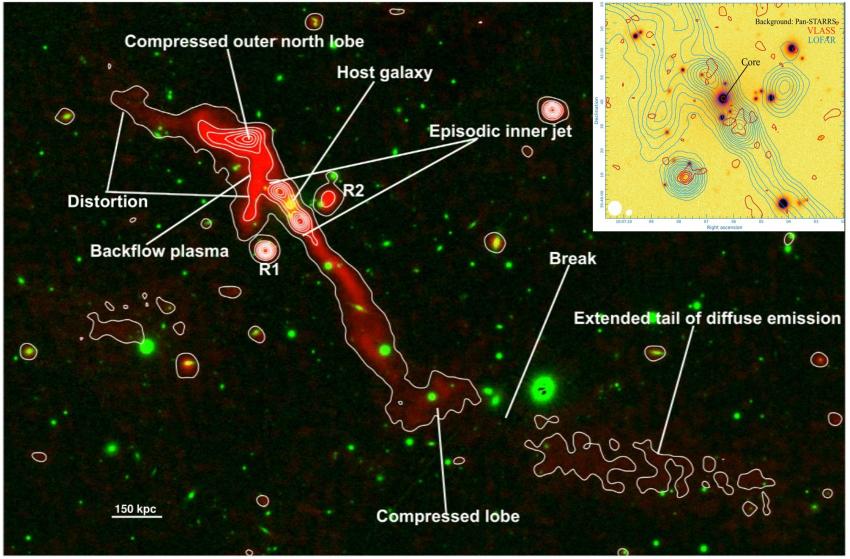
“It’s like watching a cosmic volcano erupt again after ages of calm – except this one is big enough to carve out structures stretching nearly a million light-years across space”, said lead researcher Shobha Kumari.
The LOFAR image shows that the northern part is compressed and severely distorted, revealing a curved plasma jet that appears to be pushed sideways by the surrounding gas. The uGMRT image also shows that this compressed region has an ultra-steep radio spectrum, meaning that the particles there are extremely old and have lost most of their energy — another sign of the cluster’s influence.
The long, faint tail of diffuse radiation stretching southwest tells an equally dramatic story. Magnetized plasma stretches across the cluster, leaving behind a thin trail that is millions of years old. This indicates that the powerful environment directly affects J1007+3540.
Why J1007+3540 is important to science
Systems such as J1007+3540 are extremely valuable to astronomers. They show how black holes turn on and off, how jets evolve over millions of years, and how the cluster environment can change the entire morphological structure of a radio galaxy.
The combination of renewed activity, enormous scale, and intense environmental pressure makes J1007+3540 a useful example of galaxy evolution. According to scientists, the discovery shows that galaxy growth is not peaceful or gradual, but rather a struggle between the explosive power of black holes and the crushing pressure of their environment. They now plan to conduct more sensitive, high-resolution observations to look even deeper into the core of J1007+3540 and track how plasma jets propagate in this turbulent environment.
Understanding systems such as J1007+3540 will help us better understand how galaxies grow, fade, and reawaken. They also clearly demonstrate how vast cosmic environments can shape, bend, distort, and even smother the jets of matter ejected by black holes.
According to Royal Astronomical Society

