

An international group of astronomers studied one of the brightest fast radio bursts in history and determined its location. It is located in a neighboring galaxy.
Fast radio bursts (FRBs) are intense bursts of radio waves lasting only a few milliseconds, during which energy equivalent to that emitted by the Sun over several days is released. To date, the physical nature of this mysterious phenomenon remains unknown, but astronomers are considering various explanations, ranging from radiation from young magnetars in supernova remnants to cosmic strings. Radio bursts are very difficult to study because they disappear in the blink of an eye.
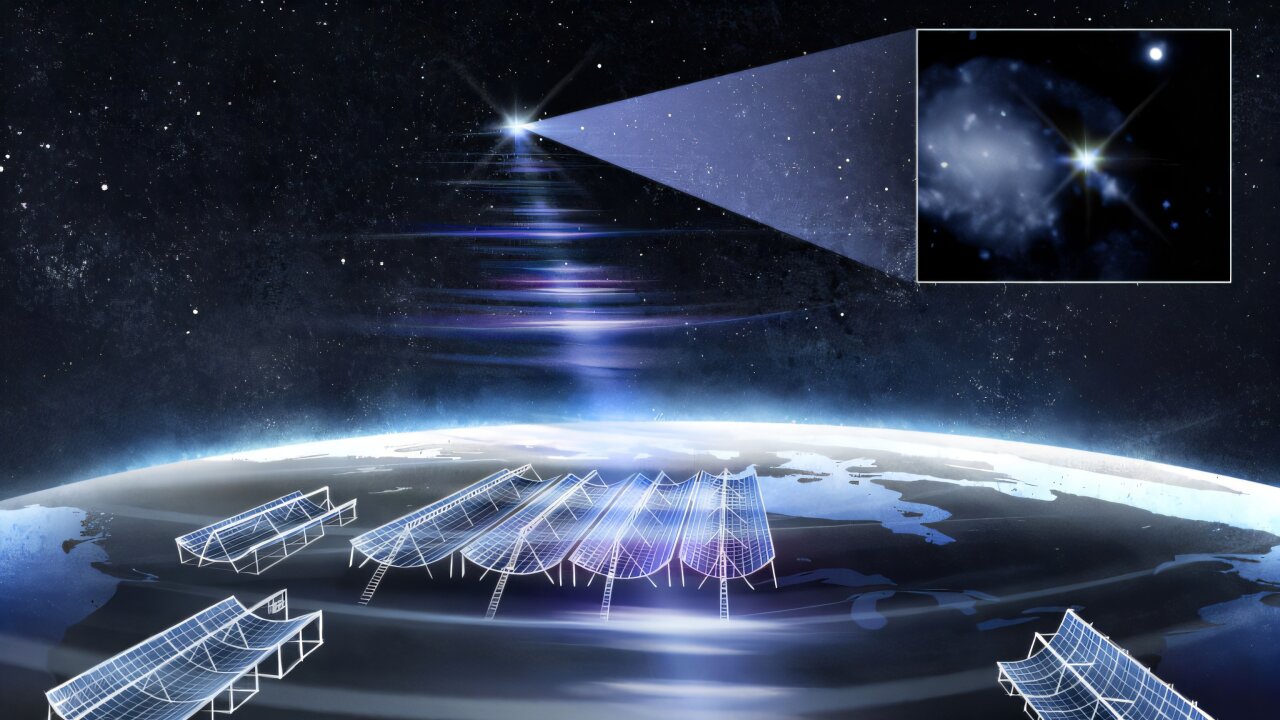
On March 16, 2025, the Canadian Hydrogen Intensity Mapping Experiment (CHIME) radio telescope network recorded an extragalactic fast radio burst with the highest signal-to-noise ratio in the history of observations. It was designated FRB 20250316A and given the unofficial nickname RBFLOAT, which stands for “Radio Brightest FLash Of All Time.”
Astronomers quickly realized that the exceptional brightness of the radio burst was due not to its strength, but to the relative proximity of the source. To determine its position, they analyzed data collected by all CHIME network telescopes, as well as the James Webb Space Observatory.
The search was successful. Researchers were able to triangulate the position of the radio burst with extremely high spatial resolution, corresponding to approximately 45 light years. It came from the spiral galaxy NGC 4141, located 133 million light-years from Earth. According to researchers’ estimates, the source of the radio burst is located about 615 light-years from the center of the nearest star-forming region.
According to scientists, FRB 20250316A marks the beginning of an era of locating one-time radio bursts, which will enable large-scale studies of their local environment. Previously, scientists could only determine repeating radio bursts with similar accuracy, which account for only 2–3% of the total number of bursts.
According to Phys.org

