

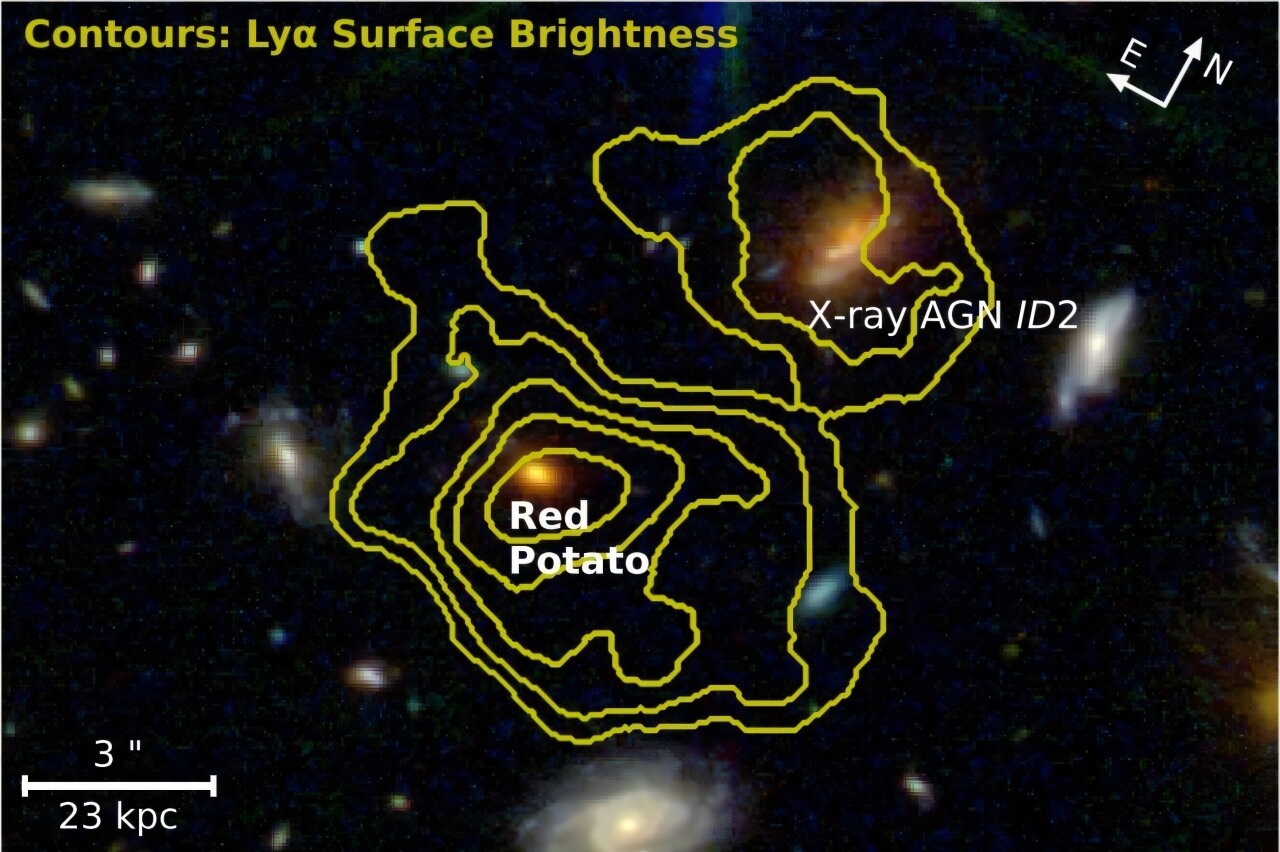
Using the James Webb Space Telescope, an international team of astronomers has discovered a new massive and quiet red galaxy, which they have named “Red Potato.”
“Potato” in a cosmic cluster
A team of astronomers led by Weichen Wang of the University of Milan (Italy) recently observed a gas-rich cosmic web node with a redshift of approximately 3.25, designated MQN01. It is known that such cosmic web nodes and protoclusters with high redshifts contain rich reserves of cold and molecular gas. Therefore, it is expected that these structures are sites of very efficient formation of massive galaxies through gas accretion.
While studying MQN01 with the James Webb Space Telescope’s Near-Infrared Camera (NIRCam) and Near-Infrared Spectrograph (NIRSpec), Wang’s team accidentally discovered a new massive red galaxy. Due to its morphology and color, it was named “Red Potato.”
Massive and calm galaxy
“Red Potato,” or MQN01 J004131.9-493704, has a half-light radius of about 3,260 light-years and a stellar mass of 110 billion solar masses. The mass of the galaxy’s molecular gas was calculated to be less than 7 billion solar masses, giving a molecular gas fraction of less than 0.06.
The absence of detected carbon monoxide and sodium D lines indicates that the “Red Potato” galaxy is poor in molecular and neutral gas. Moreover, no gas leaks have been recorded from it. Overall, considering the kinematics of ionized gas, “Red Potato” appears to be a system dominated by dispersion.
The study showed that Red Potato has a star formation rate (SFR) of 4.0 solar masses per year, which is at least one dex below the star-forming main sequence (SFMS). This is a relatively low star formation rate, considering that the galaxy is located in the center of a large reservoir of cold circumgalactic medium (CGM).
X-ray jet causing gas turbulence
The velocity dispersion of stars in the Red Potato galaxy is 268 km/s, indicating an elevated level of gas turbulence in the CGM. In addition, deep X-ray data indicate the presence of an extended X-ray jet, which most likely originates from a neighboring bright X-ray active galactic nucleus (AGN), suggesting a certain form of feedback in the jet mode acting on the circumgalactic environment of the “Red Potato.”
The authors of the study conclude that jet feedback could have led to increased turbulence in the environment around “Red Potato” and thus reduced gas accumulation in the galaxy, as evidenced by the high gas velocity dispersion measured from the Lyα and Hα line profiles.
According to phys.org

