

At a distance of 6 billion light years, astronomers witnessed a unique cosmic event: the birth of a supermassive black hole, which began to form just a thousand years ago, which is a moment in cosmic terms. This young “cosmic monster” is located in the heart of the distant galaxy cluster CHIPS 1911+4455.
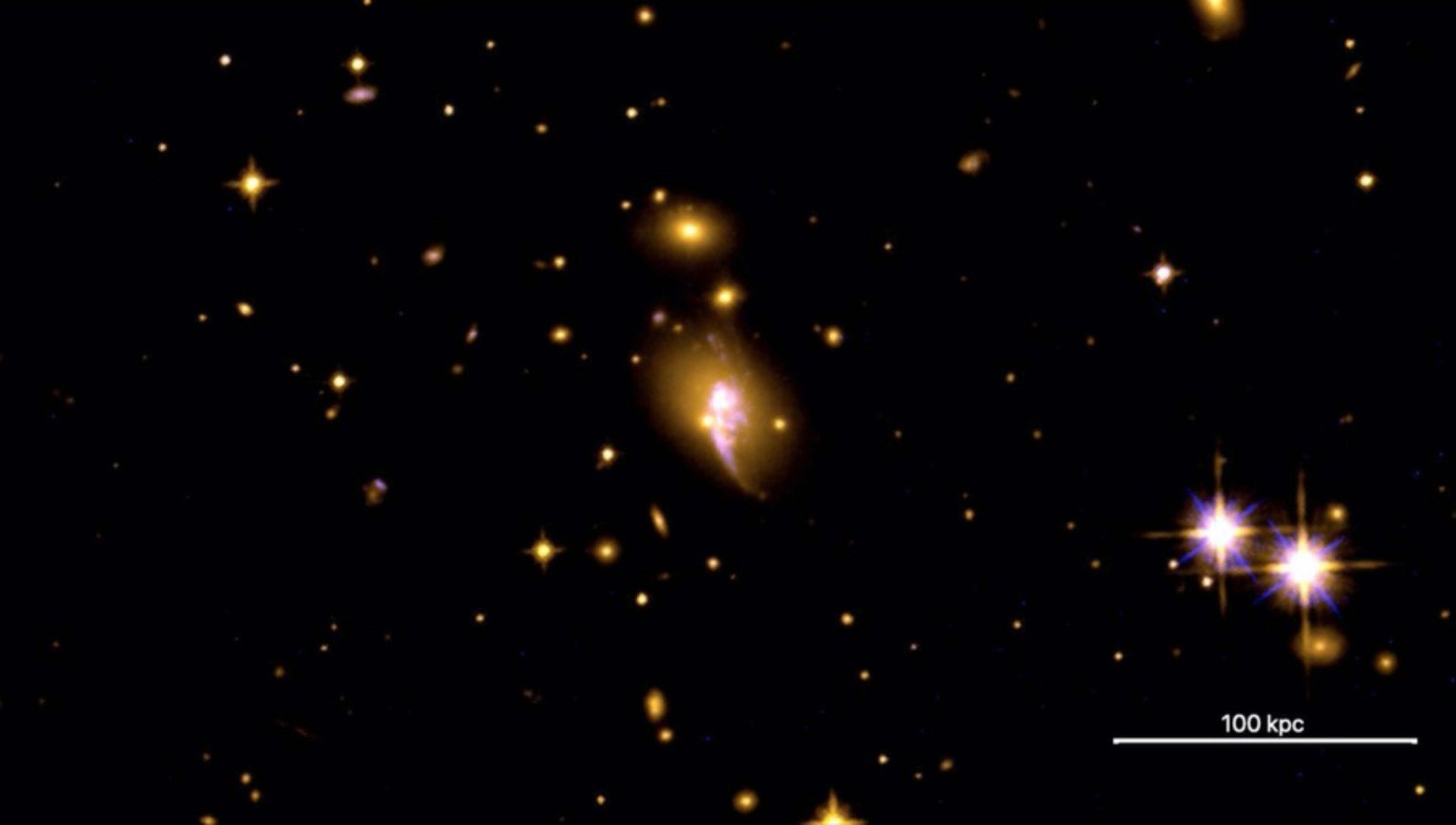
Researchers led by Francesco Ubertosi of the University of Bologna describe the discovery as observing “the awakening of a sleeping giant.” Using the powerful Very Long Baseline Array and Very Large Array radio telescopes, which provide extreme accuracy, the team discovered that this cosmic monster became active practically “yesterday.”
A baby among black holes
A key indicator of youthful activity is the size of the jets of matter ejected from the poles of a black hole. They extend only 100 light-years. Although this is an incredibly large distance for us, for supermassive black holes it is a tiny figure. Mature similar objects form jets tens of thousands of light years long. Most of the black holes studied have been active for millions of years, so observing the very beginning of their impact on their surroundings is extremely rare. It’s like the first frame of a movie about the life of a giant.
Crazy Galaxy
While the black hole is just waking up, the galaxy around it is demonstrating frenzied activity. It creates new stars at an astonishing rate: every year, the mass of stars increases by an amount equivalent to 140-190 Suns. For contrast: our Milky Way adds stars equivalent to only one Sun’s mass each year.
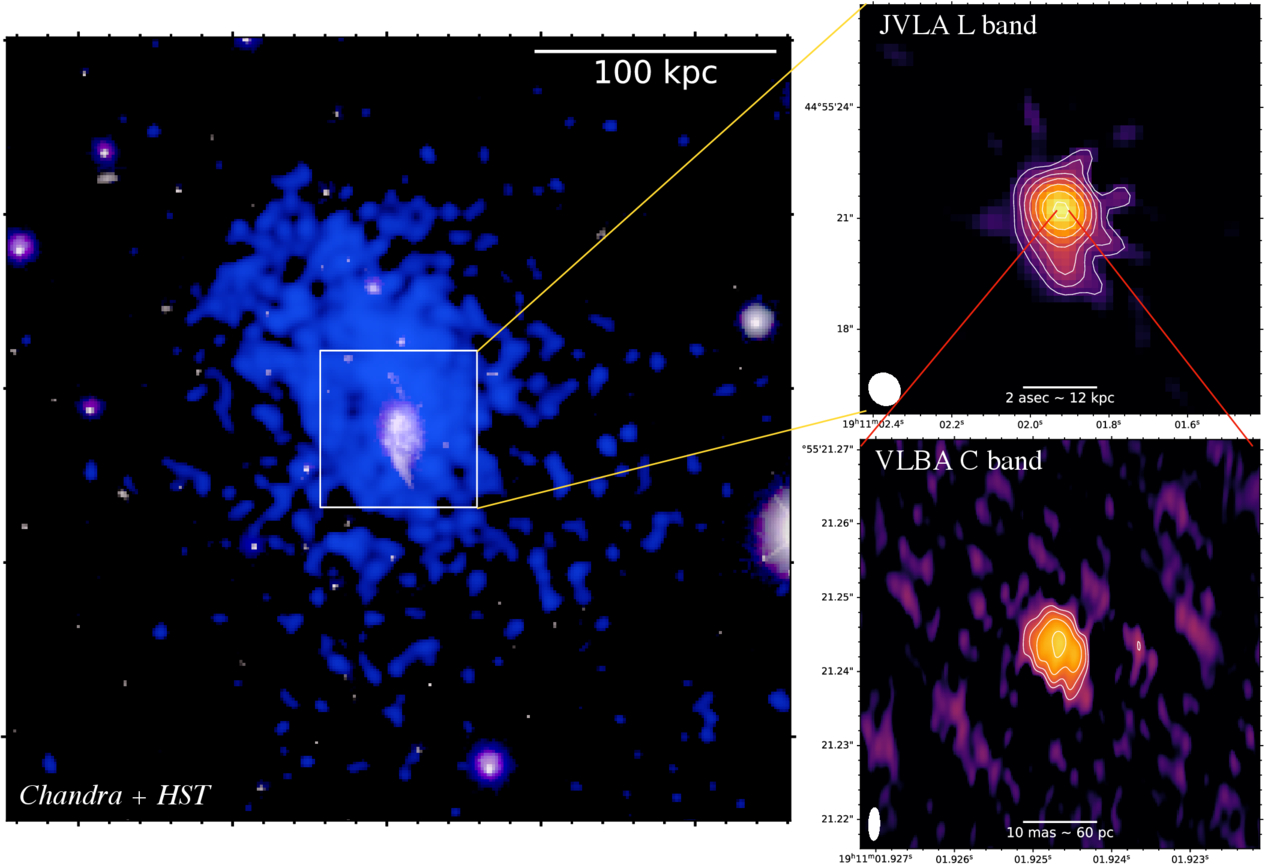
Researchers believe that the hot gas surrounding the black hole cools extremely efficiently. This cooling can deliver the gas necessary for star formation directly to the black hole, triggering its awakening and activating violent star formation in the galaxy.
Key to cosmic evolution
The discovery is of fundamental importance. Supermassive black holes are not just exotic objects; they play a crucial role in the formation of galaxies and the largest structures in the Universe by regulating star formation. Understanding how they awaken and begin to influence their surroundings is the key to unraveling the evolution of galaxies. By recording this process at the very beginning, scientists finally had the opportunity to study it in real time in space dynamics, rather than just reconstructing it after completion.
The team now plans to continue observing CHIPS 1911+4455 to track how the young black hole’s activity develops and to find more similar systems. This could completely change our understanding of how the most powerful objects in the Universe “turn on” and begin to shape the cosmos around them.
Earlier, we reported on how a supermassive black hole in a neighboring galaxy “eats” very neatly.
According to universetoday.com

