

Scientists studied the red giant SDSS J0715-7334 and found that it contained very few elements heavier than helium. Astronomers call such stars “pristine.” They are believed to represent the first generations of stars.
Heavy elements in stars
Not all stars are created identically. Astronomers believe that the first stars formed after the Big Bang consisted mainly of hydrogen and helium with small amounts of lithium, since heavier elements were formed later as a result of nuclear fusion inside stars. When these objects exploded as supernovae, heavier elements spread throughout space and formed new stars. Each subsequent generation contained more heavy elements, and these elements also gradually became heavier.
Although most stars still contain mainly hydrogen and helium, they also contain many heavy elements, especially as they get older. These elements appear in spectrographic data when astronomers collect light from these distant stars. Stars are considered “pristine” when data shows no heavy elements — this means they are likely very rare, old stars from previous generations. And now a group of astronomers led by Alexander Ji from the University of Chicago believes they have found the most pristine star known today.
Record low metallicity of the star SDSS J0715-7334
The star, named SDSS J0715-7334, is a red giant that is claimed to have the lowest metallicity, or content of heavy elements, ever detected. Detailed spectral and chemical analysis by the team shows that SDSS J0715-7334 has a total metallicity of less than 7.8 x 10⁻⁷. For comparison, the next lowest metal-rich star known today is in the Milky Way and has a total metallicity of about 1.4 × 10⁻⁶. “This is about two times more metal-poor than the previous record holder, J1029+1729 (Z < 1.4×10⁻⁶). It is over ten times more metal-poor than the most iron-poor star known, SMSS J0313-6708,” the authors of the study note.
But the problem of lack of this element does not only concern iron. The star SDSS J0715-7334 also has a surprisingly low carbon content. Even other stars recorded with very low iron levels contained noticeable amounts of carbon, which makes the newly discovered star even rarer. A group of scientists notes that the chemical composition of SDSS J0715-7334 indicates its formation from gas produced by a supernova star with a mass of 30 solar masses belonging to Population III — stars that were the first to form after the Big Bang.
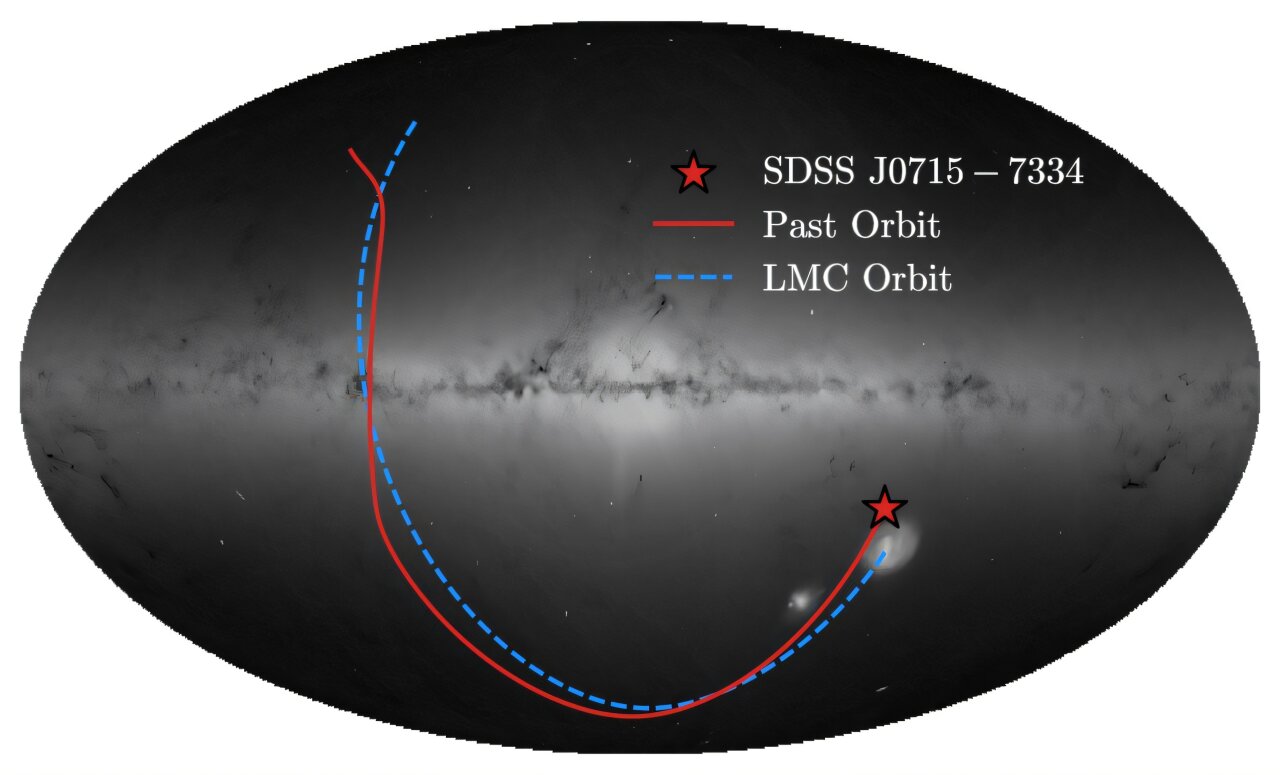
Researchers used kinematic analysis to trace the star’s origin in the Large Magellanic Cloud (LMC) based on Gaia data and orbit modeling. Analysis showed that it was initially part of this galaxy and later migrated to the Milky Way.
Cooling vision with cosmic dust
Although this discovery allows us to see the oldest stars in the Universe and the origin of heavier elements, data on J0715-7334 also provides certain answers about how stars cool down. The team notes that J0715-7334 is now the second star below the so-called “fine-structure cooling threshold,” which describes how some gas clouds cool more rapidly with the help of heavier elements that emit more energy. According to the team, this work shows that cooling by cosmic dust is necessary for gas clouds to cool sufficiently to form low-metal stars at this threshold, and also shows that this occurs in galaxies outside the Milky Way.
According to phys.org

