

Using the James Webb Space Telescope, an international team of astronomers observed an elliptical galaxy known as NGC 4486B. The results of the observations, published on December 16, provide important information about the properties of this galaxy’s double nucleus.
Why does NGC 4486B have a double nucleus?
NGC 4486B (also known as VCC1279) is a compact elliptical galaxy at the center of the Virgo Cluster. It has a small effective radius of about 620 light-years, an absolute magnitude of 17.6 mag, and its total stellar mass is estimated to be approximately 6 billion solar masses.
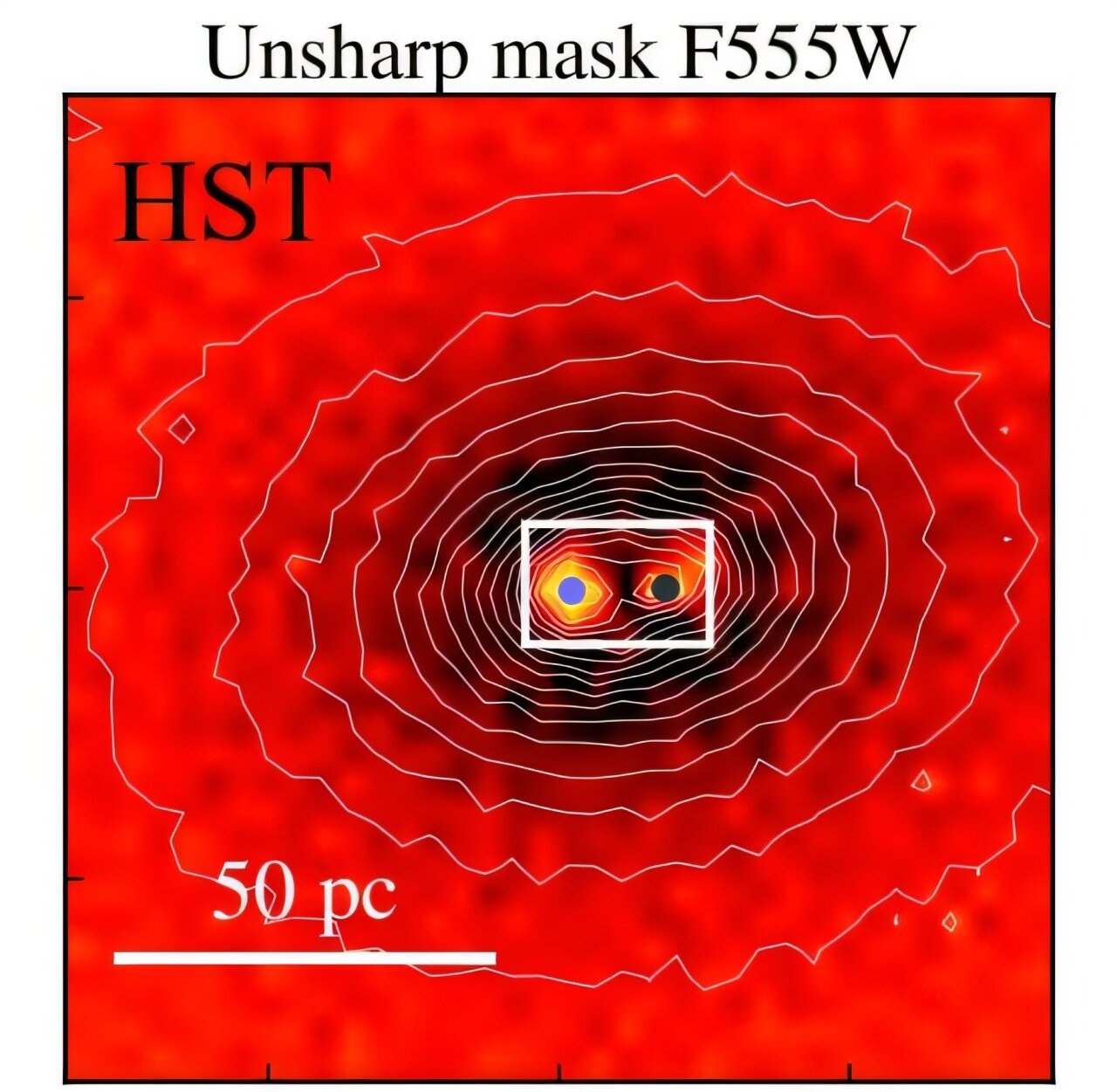
Hubble Space Telescope observations of NGC 4486B have revealed that it hosts a double nucleus, as does the Andromeda galaxy. The two nuclei (the brighter and the fainter peak) are separated by about 39 light-years. However, the origin of such a double nucleus in this galaxy is still uncertain. One of the possible explanations is that it is due to the presence of an eccentric, apsidally aligned stellar disk orbiting a central supermassive black hole (SMBH).
Саме тому група астрономів під керівництвом Бехзада Тахмасебзаде з Мічиганського університету вирішила дослідити NGC 4486B за допомогою спектрографа ближнього інфрачервоного діапазону (NIRSpec) JWST, зосередившись на з’ясуванні походження її ядра. Їхнє дослідження було доповнено даними з Hubble.
Black hole shift indicates eccentric nuclear disk
First of all, the JWST observations found that NGC 4486B has a flat core with a radius of about 65.2 light-years. The SMBH was identified approximately 19.5 light-years from the center and possibly has a velocity offset of about 16 km/s relative to stars on the opposite side of the galaxy.
In general, the observations suggest that the double nucleus of NGC 4486B is due to an eccentric nuclear disk (END) similar to that in the Andromeda galaxy. In this scenario, it is assumed that a gravitational wave recoil kick can naturally transform a circular stellar disk bound to an SMBH into an eccentric, apsidally aligned lopsided one.
The astronomers noted that previous studies of surface brightness and kinematic distributions of simulated ENDs match many properties of the observed double nucleus in NGC 4486B. For instance, the fainter peak and the velocity dispersion peak coincide, which is consistent with predictions for nearly edge-on ENDs.
Space laboratory for studying black holes
Based on the observed properties of the double nucleus of NGC 4486B and black hole mass, the researchers estimated that the SMBH experienced a recoil kick of about 340 km/s. They predict that with such a kick, the SMBH should return to the center of the galaxy within about 30 million years.
“Thus, although NGC 4486B is an old, relaxed galaxy near the Virgo cluster center, its SMBH appears to have merged only recently, making its nucleus a rare nearby laboratory for studying post-merger SMBH dynamics,” the authors of the paper concluded.
Provided by: phys.org

