

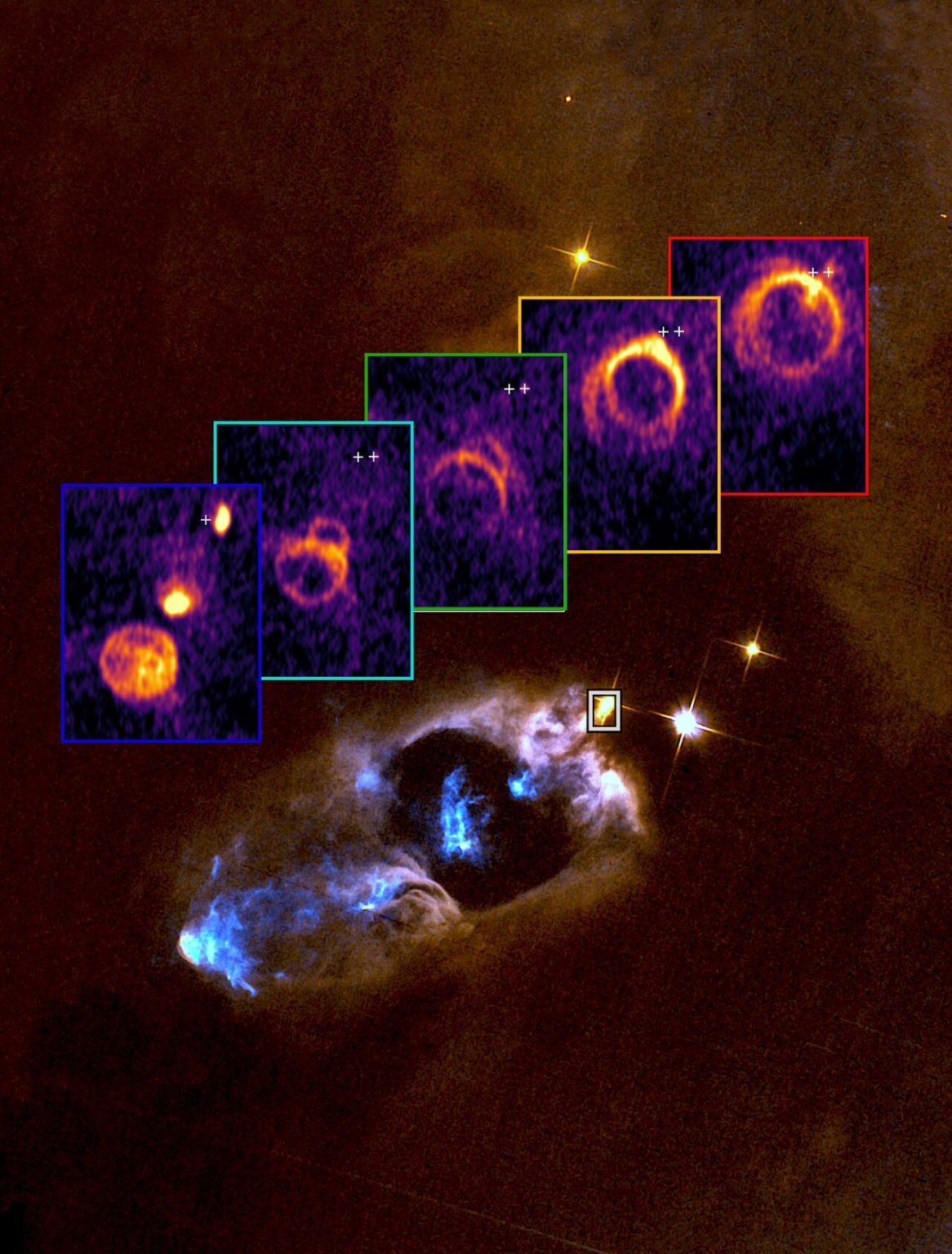
The European Southern Observatory has published an image compiled from data collected by the Hubble Space Telescope and the ALMA radio observatory. It shows how a newborn star is inflating giant gas bubbles.
The childhood of young stars is quite turbulent. They grow by absorbing matter from the gas and dust disk surrounding them. At the same time, stars can also experience bursts of activity, during which some of the matter is ejected through polar jets. They interact with their environment, forming various structures within it.
This is precisely the process captured in this image taken by the Hubble Space Telescope. It shows the young star SVS 13, located in the star-forming region NGC 1333, about 1,000 light-years from Earth.
SVS 13 ejects gas in clusters known as “molecular bullets.” Images of these clusters are shown in the insets, made using the ALMA telescope. Each frame shows gas moving at different speeds, from 35 km/s (red) to 97 km/s (blue).
This series of images resembles medical tomography and allows astronomers to reconstruct the three-dimensional shape of the rings and gas bubbles created by the jet as it interacts with its surroundings. “Thanks to the exceptional sensitivity achieved in our study with ALMA, we were able to obtain such a high level of detail for the first time,” said Guillermo Blázquez-Calero, lead author of the study recently published in the journal Nature Astronomy. This will help astronomers better understand not only the infancy of stars, but also how planets form around them.
Provided by ESO

