

The European Southern Observatory has published an image of the galaxy NGC 1386. It has attracted the attention of astronomers with its unusual way of forming new stars.
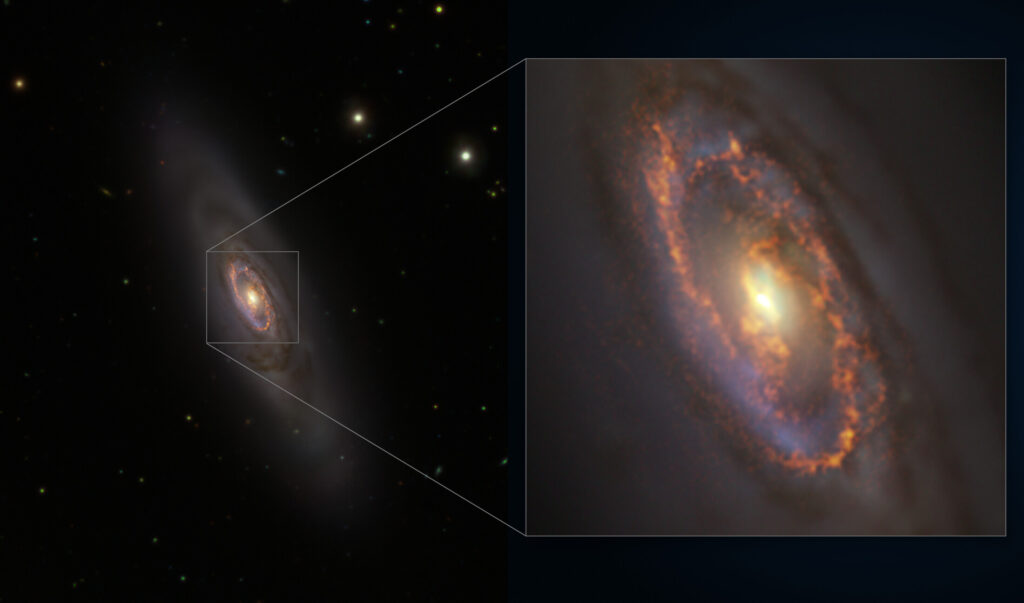
NGC 1386 is a spiral galaxy located 53 million light-years from Earth toward the constellation Eridanus. It possesses an active core that hides a supermassive black hole resembling the one at the center of our Milky Way. The hole absorbs matter from the surrounding accretion disk, which is accompanied by gas ejections and powerful radiation.
But NGC 1386 attracted scientists because of its other activity. The fact that its center is surrounded by a ring full of star clusters full of young stars. To study it in detail, astronomers have engaged ESO’s Very Large Telescope, the Hubble Observatory, and ALMA.
The data obtained during the observation show that all these star clusters formed 4 million years ago almost simultaneously. This is the first time that synchronous star formation has been observed in a galaxy containing mostly old stars.
In addition, ALMA also managed to detect many clouds of gas ready to form a second batch of young stars. However, we will have to be patient to see their birth. Astronomers estimate that it will begin in about 5 million years.
Earlier we reported on how the Subaru telescope photographed a unique galaxy with a polar ring.
Provided by ESO

