

Astronomers have witnessed the birth of a magnetar — a highly magnetized, rotating neutron star — for the first time and confirmed that it is the source of energy for some of the brightest explosive stars in the cosmos. This discovery confirms a theory proposed by a physicist at the University of California, Berkeley, 16 years ago and establishes a new phenomenon in exploding stars: supernovae with a “chirp” in their light curve caused by general relativity.
Mystery of superluminous supernovae and the theory explaining it
Superluminous supernovae — which can be 10 or more times brighter than normal supernovae — have puzzled astronomers since their discovery in the early 2000s. It was believed that they were formed as a result of the explosion of very massive stars, possibly 25 times more massive than our Sun, but they remained bright much longer than expected when the iron core of the star collapses and its outer layers are ejected outward.
In 2010, scientists proposed that the long-lasting glow of these supernovae was caused by a magnetar.
A theory has been proposed that when a massive star collapses at the end of its life, it compresses most of its mass into a very compact neutron star. If the star initially had a very strong magnetic field, it intensified during the formation of the magnetar, creating a field 100–1,000 times stronger than that of ordinary rotating neutron stars, known as pulsars. Pulsars and their highly magnetized larger counterparts, magnetars, are only about 10 miles in diameter, but in their youth can rotate more than 1,000 times per second.
When the magnetar rotates, the rotating magnetic field can accelerate charged particles, which collide with debris left over from the expanding supernova, increasing its brightness. It is also believed that magnetars are the source of fast radio bursts.
Explaining the connection through the theory of relativity
Joseph Farah, a graduate student at the University of California, Santa Barbara, and Las Cumbres Observatory (LCO) has confirmed the link between magnetars and Type I supernovae of super-luminous supernovae (SLSNe-I) after analyzing data from the 2024 supernova, named SN 2024afav. In an article in Nature magazine, Farah and his colleagues proposed a general relativistic explanation for the unusual peaks in the light curve of this supernova — what they call a “chirp” — which clearly links it to a magnetar.
“What’s really exciting is that this is definitive evidence for a magnetar forming as the result of a superluminous supernova core collapse,” said Alex Filippenko, professor emeritus of astronomy at the University of California, Berkeley, co-author of the article, and one of Farah’s future mentors. “The basis of Dan Kasen and Stan Woosley’s model is that all you need is the energy of the magnetar deep within and a good fraction of it will get absorbed, and that’ll explain why the thing is superluminous. What had not been demonstrated was that a magnetar did, in fact, form in the middle of the supernova, and that’s what Joseph’s paper shows.”
Fluctuations in supernova brightness
After SN 2024afav was discovered in December 2024, Las Cumbre Observatory — a network of 27 telescopes around the world — observed it and measured its brightness for more than 200 days. The exploding star was located approximately one billion light-years from Earth.
Working with UCSB astronomer Andy Howell, Farah noticed that after the brightness peaked about 50 days after the explosion, it did not gradually fade away like normal supernovae. Instead, its brightness slowly fluctuated downward, with the period of fluctuation gradually shortening, creating a series of four “bumps.” He compared it to a sound that gradually increases in frequency, reminiscent of birdsong.
It was previously known that super-bright supernovae had several “bumps” in their fading luminosity curve, which some interpreted as the collision of the supernova shock wave with layers of gas accumulated around the star, temporarily illuminating it. But before that, no one had ever seen four “bumps.”
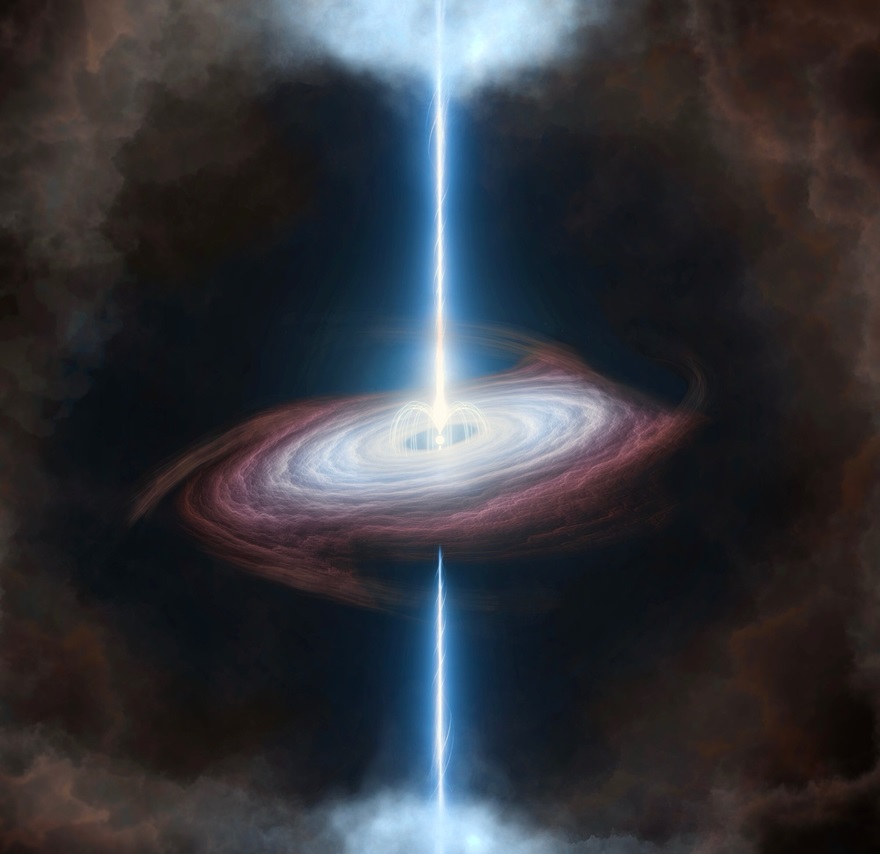
According to Farah’s model, some of the material from the SN 2024afav explosion fell back toward the magnetar, forming a disk of matter called an accretion disk. Since the material around the magnetar is probably not symmetrical, the accretion disk would also not be symmetrical relative to the rotating neutron star, leading to a mismatch between the magnetar’s axis of rotation and the accretion disk’s axis of rotation.
Since general relativity states that a rotating body drags space-time along with it, a rotating magnetar would create an effect known as Lense-Thirring precession, meaning it would cause the unbalanced disk to wobble.
The oscillating disk could periodically block and reflect light from the magnetar, turning the entire system into a flickering cosmic beacon. The time required to repeat this phenomenon decreases as the radius of the disk decreases, so when the disk moves inward toward the magnetar, it oscillates faster, causing the light to oscillate faster as it fades, creating the “chirp” observed by telescopes on Earth.
“We tested several ideas, including purely Newtonian effects and precession driven by the magnetar’s magnetic fields, but only Lense-Thirring precession matched the timing perfectly,” Farah said. “It is the first time general relativity has been needed to describe the mechanics of a supernova.”
Need for further verification of the theory
Astronomers also used observational data to estimate the neutron star’s rotation period — 4.2 milliseconds — and magnetic field: approximately 300 trillion times stronger than Earth’s. Both indicators are characteristic features of a magnetar.
Filippenko cautioned that Farah’s conclusion does not mean that all super-bright supernovae are powered by magnetars. There is also an alternative theory: the shock wave from an exploding star strikes the surrounding material, slightly increasing its brightness. Furthermore, Kasen has suggested that if the collapse of a star’s core leads to the formation of a black hole, this could also fuel a brighter supernova and, if it had an offset accretion disk, create bumps in the light curve.
“We don’t know what fraction of Type I superluminous supernovae might be powered by circumstellar material, but it’s definitely a smaller fraction than we previously thought, because this discovery clearly accounts for some of them,” Filippenko said.
Farrah expects to find dozens more of these “chirping” supernovae when the Vera C. Rubin Observatory gets ready to launch and starts the most comprehensive survey of the night sky to date.
According to phys.org

