

Astronomers used very long baseline interferometry (VLBI) to observe a gamma-ray loud blazar known as TXS 2013+370. The observations revealed an extraordinary gamma-ray flare from this object.
What are blazars?
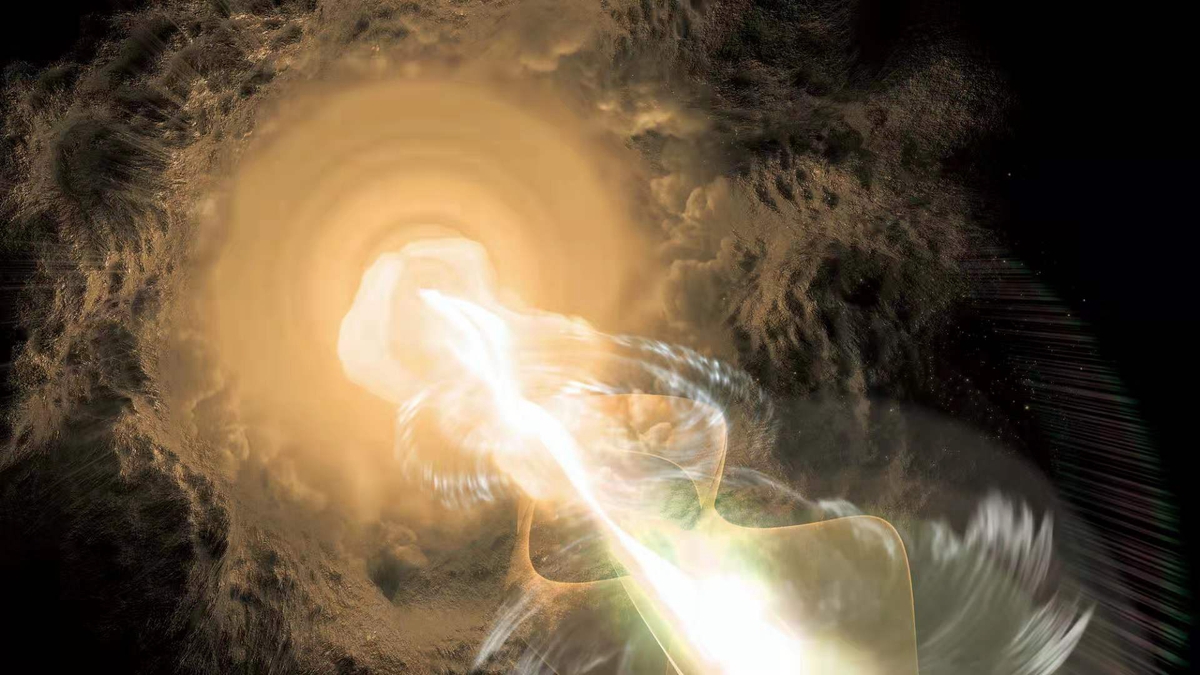
Blazars are very compact quasi-stellar objects (quasars) associated with supermassive black holes at the centers of active giant elliptical galaxies. They belong to a larger group of active galaxies containing active galactic nuclei and are the most common sources of gamma radiation outside our galaxy. A characteristic feature of blazars is relativistic jets directed almost exactly at Earth.
Blazars can be divided into two classes based on their optical emission properties: flat-spectrum radio quasars (FSRQs), which have prominent and broad optical emission lines, and BL Lacertae objects, which do not.
Detection of a gamma-ray flare
TXS 2013+370 is a powerful gamma-ray-emitting blazar with a redshift of approximately 0.86, located near the galactic plane. It contains a supermassive black hole with an estimated mass of about 400 million solar masses.
On December 6, 2020, TXS 2013+370 began emitting increased amounts of gamma radiation, which escalated into a burst of activity. A team of astronomers led by Giorgos Michailidis of Aristotle University in Thessaloniki, Greece, decided to begin VLBI observations of this blazar using the Very Long Baseline Array (VLBA), which allowed them to record the gamma-ray flare in unprecedented detail.
“In this work, we conducted polarimetric VLBI observations of TXS 2013+370 at frequencies of 22, 43, and 86 GHz during an exceptional GEV outburst on February 11, 2021, achieving an angular resolution of up to ~0.1 mas. This is the first multi-frequency polarimetric VLBI study of this source,” the scientists write.
Revealing the structure of the jet
First of all, observations of flares showed that TXS 2013+370 is a compact source dominated by a core, with a curved jet structure extending southwest of the bright core region. The images show that the blazar consists of a dominant core and several separate jet components, with the overall jet structure becoming increasingly clear at higher hours.
Observations have revealed that the curved jet of TXS 2013+370 contains a newly formed component designated N2. This component is located approximately 60 microseconds from the blazar’s nucleus and is associated with enhanced activity in several wavelength ranges.
Location of the gamma-ray flare
It turned out that the source of gamma emission TXS 2013+370 is located outside or at the edge of the broad line region (BLR). This makes the blazar’s dust torus the main reservoir of photons, with infrared photons being intercepted by the jet and scattered to gamma rays also by means of external Compton (EC) emission. A strong correlation and time lag between gamma-ray emission and variability at 15 GHz was also detected, indicating that high-energy activity precedes radio emission by approximately 102 days.
Comparing the 2021 gamma-ray flare with the previous one that occurred in 2009, the authors of the article concluded that both flares localize gamma radiation in the same subparsec/parsec region. This indicates that the changes in delay reflect a change in opacity conditions rather than a shift in the scattering location.
According to phys.org

