

Researchers have uncovered the mystery behind the mysterious blue flash observed in 2024. It was caused by a black hole tearing apart a companion star.
Mysterious flash
In 2014, astronomers observed for the first time a phenomenon called a luminous fast blue optical transient (LFBOT). It is an extremely bright flash of blue and ultraviolet light that gradually fades over several days, leaving behind faint X-ray and radio emissions.
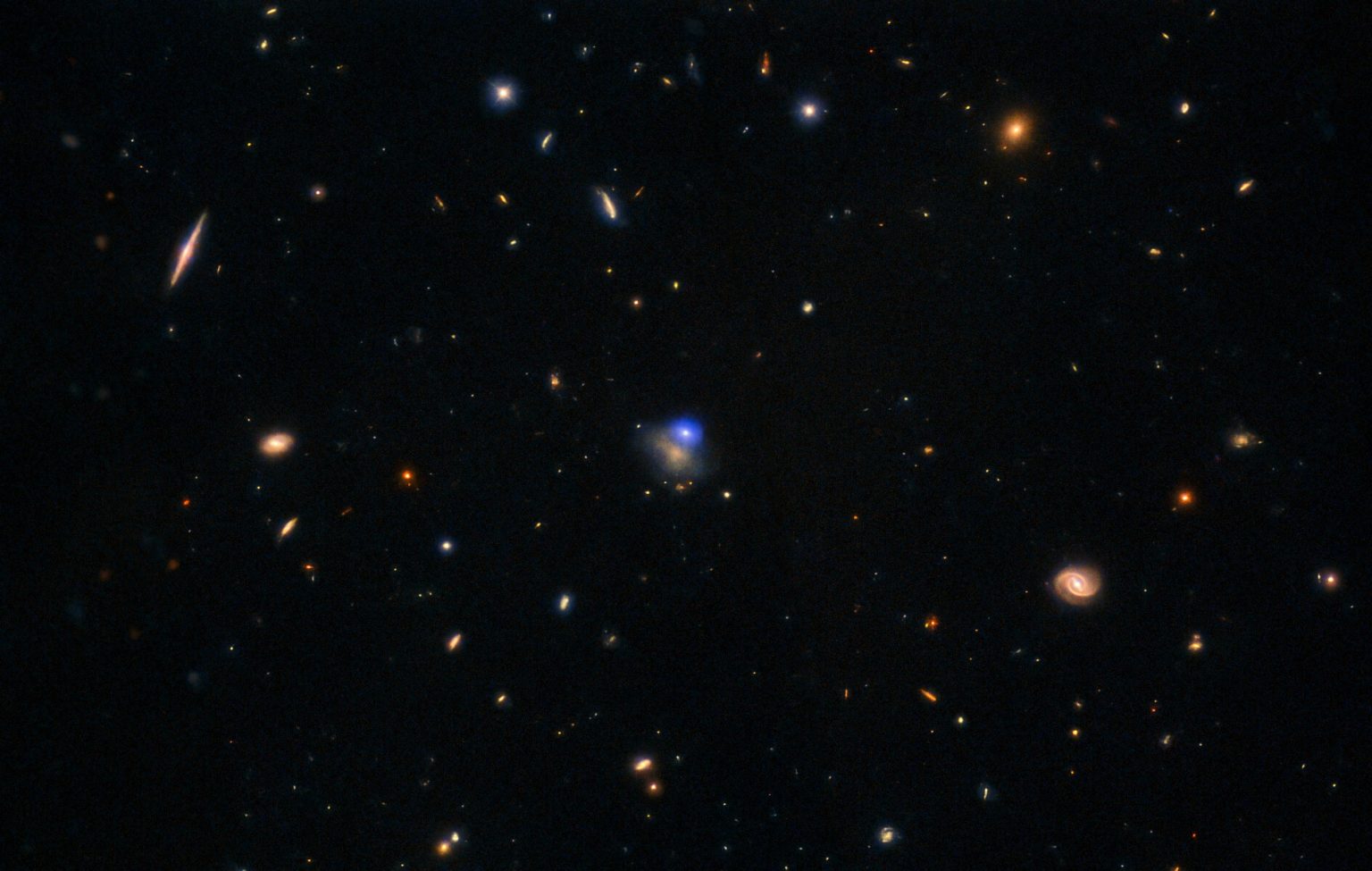
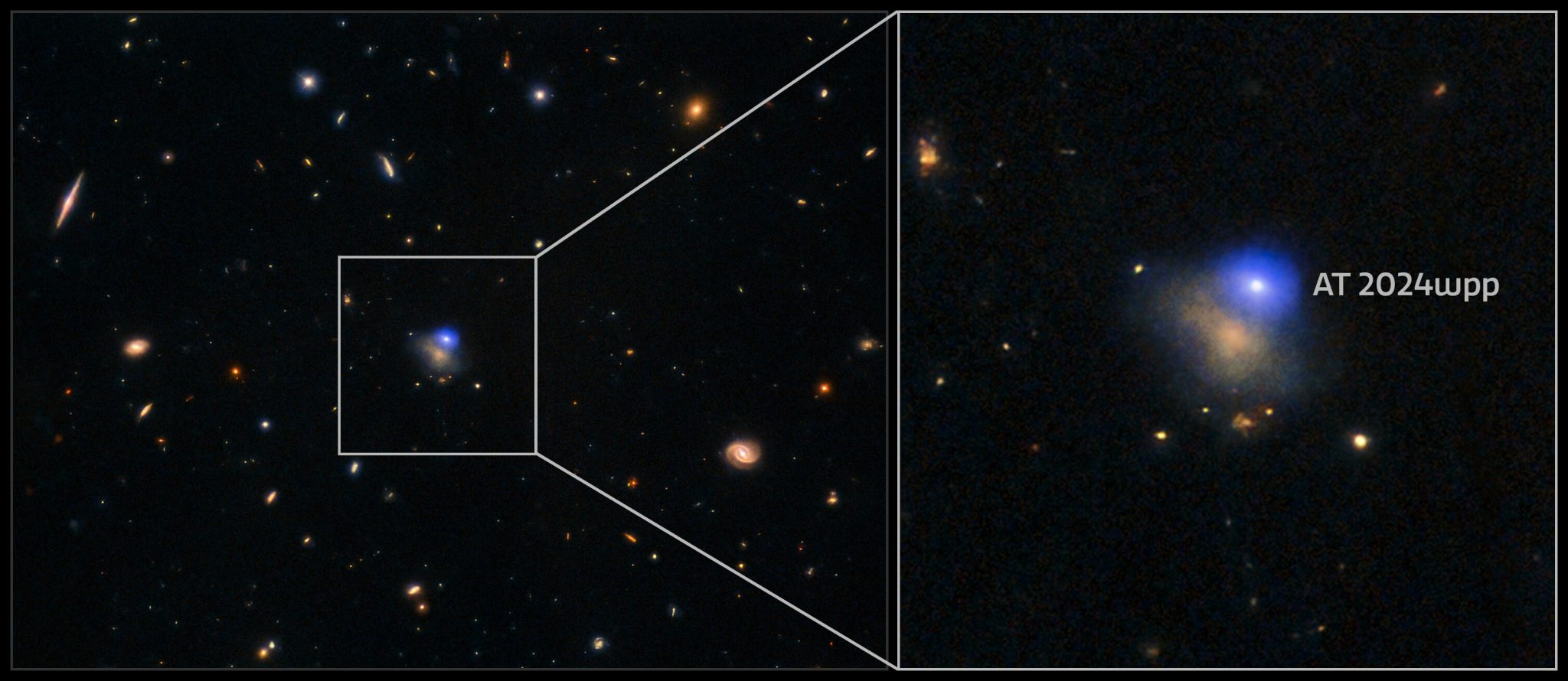
Since then, astronomers have recorded just over a dozen such phenomena. Until recently, it was believed that they were the result of an unusual type of supernova. However, the results of the analysis of the brightest LFBOT, which was recorded in 2024 (the event was designated AT 2024wpp), cast doubt on this hypothesis. A team of scientists led by researchers from the University of California, Berkeley, concluded that the flash was caused by extreme tidal disruption, in which a black hole 100 times the mass of our Sun completely tore apart a massive companion star in a matter of days.
Story of a black hole and a doomed star
The AT 2024wpp team’s analysis was presented in two papers recently accepted for publication in The Astrophysical Journal Letters. In their study, they used data from ground-based telescopes that measured different wavelengths of light emitted by the flash.
The realization that AT 2024wpp could not have been a supernova came after researchers calculated its energy. It turned out to be 100 times greater than the energy that would be released by a normal supernova. To emit this energy, it would have required converting about 10% of the Sun’s mass into energy in a very short period of time — a few weeks.
In addition, Gemini South observations revealed an excess of near-infrared radiation emitted by AT 2024wpp, which also contradicts the supernova hypothesis. According to the researchers, the amount of energy emitted by these bursts is so great that they cannot be explained by core collapse or any other type of stellar explosion.
According to scientists, the flash was actually caused by the tidal disruption of a star orbiting a black hole whose mass exceeded that of the Sun by about 100 times. For a long time, it sucked matter from its companion, surrounding itself with an accretion disk. At the same time, it was too far from the black hole for it to be swallowed up.
Then, when the star finally got too close to the black hole and was torn apart, its remains fell into the accretion disk and collided with its material, generating X-ray, ultraviolet, and blue radiation. Most of the gas from the dead star was then ejected in the form of jets of hot plasma. The team calculated that these jets were traveling at about 40% of the speed of light and generated radio waves when they collided with the surrounding gas.
The estimated mass of the torn star exceeded the mass of the Sun by more than 10 times. It may have been a so-called Wolf-Rayet star, i.e., a very hot and evolved star that had already consumed most of its hydrogen and had begun to shed its shell. This explains the weak hydrogen emission from AT 2024wpp.
According to NOIRLab

