

Using NASA’s Chandra and ESA’s XMM-Newton space observatories, Indian astronomers studied the population of ultraluminous X-ray sources in the galaxy NGC 5813, which led to the discovery of a new source of this type.
What is an ultraluminous X-ray source?
Ultraluminous X-ray sources (ULX) are extragalactic point sources that are extremely bright in X-rays — they emit more radiation than one million suns across all spectra. Although it has been suggested that they may contain neutron stars or stellar-mass black holes, their true nature remains unclear.
NGC 5813 is a giant elliptical galaxy with a regular morphology, located at a distance of about 105 million light-years. It is a member of the NGC 5846 galaxy group in the Virgo supercluster.
A lot of ULXs in the galaxy NGC 5813
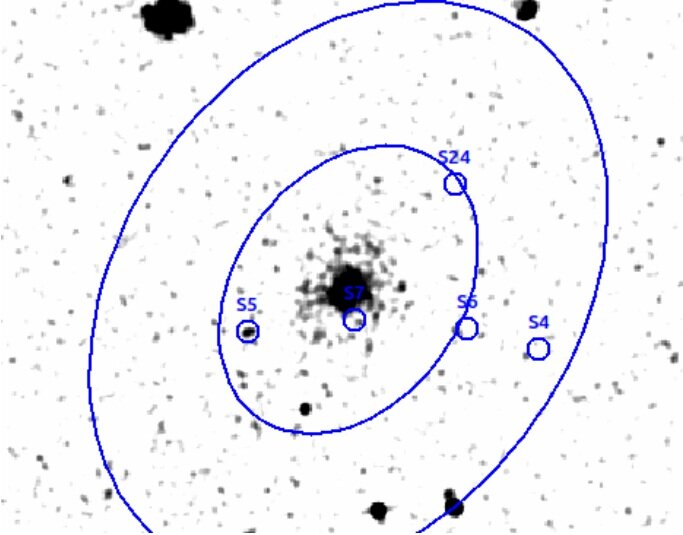
Previous observations have shown that NGC 5813 contains a supermassive black hole with a mass of approximately 280 million solar masses and an associated active galactic nucleus (AGN), which is a known radio source. It has a kinematically distinct core and contains both red and white populations of globular clusters. NGC 5813 is believed to have an unusually large number of ULXs, and eight such sources have been identified in this galaxy to date. The ULX population in this galaxy was recently studied by a team of astronomers led by T. R. Rajalakshmi from Mahatma Gandhi University in Kerala, India.
X-ray space telescopes such as Chandra and XMM-Newton enabled Rajalakshmi’s team to reidentify four known ULXs in NGC 5813 and discover that two previously reported ULXs are eclipsing binaries and background sources. Most importantly, these observations led to the discovery of a new ULX in this galaxy, designated CXOJ150101.11+014119.80 (S4). According to the study, CXOJ150101.11+014119.80 (S4) was detected approximately 2.65 arcminutes from the center of NGC 5813. Newly identified ultraluminous X-ray sources were found at distances ranging from 0.43 to 1.
The brightest ULX of the five discovered in this study was one of those previously recorded, designated CXOJ150116.555+014133.97 (S5), with an average luminosity of 14.5 duodecillion erg/s. The remaining four have average luminosities ranging from 1.5 to 3.82 duodecillion erg/s.
Variability of point sources
Observations have shown that none of the ULXs in NGC 5813 exhibit intra-observational variability. However, CXOJ150116.555+014133.97 (S5) exhibits an inter-observational fractional variability of approximately 15.1%. The researchers noted that there was no clear evidence of long-term (over years) variability for the ULXs studied.
The study also showed that one of the verified ultraluminous X-ray sources in NGC 5813, known as CXOJ150104.927+014136.02 (S6), has an average photon count of less than 1.0. This indicates that there may be a neutron star there; therefore, the authors of the article classified this source as a possible candidate for the role of an ULX pulsar.
According to phys.org

