

GRB 250702B is one of the most amazing explosions ever observed by astronomers. It is not only very powerful, but also very long. And now, by observing the galaxy in which it took place, scientists have finally understood its nature.
Extreme gamma-ray burst
An astrophysicist from Rutgers University is helping to solve a cosmic mystery that has stumped astronomers. The mystery involves a powerful explosion in space that lasted much longer than any other they have seen before.
Scientists used the James Webb Space Telescope to study GRB 250702B, a long gamma-ray burst, one of the brightest and most energetic phenomena in the Universe. Long gamma-ray bursts usually occur when a massive star collapses into a black hole, creating a rapid, intense burst of high-energy gamma radiation. This burst did not follow the rules.
“This object shows extreme properties that are difficult to explain,” said Huei Sears, a doctoral student in the Department of Physics and Astronomy at Rutgers University’s School of Arts and Sciences, who is studying the explosion.
“Usually, these bursts are over in less than a minute, but GRB 250702B lasted for hours and even showed signs of X-ray activity a day prior.”
She noted that observatories around the world are studying data collected on this object. Among them are scientists from the Chinese Einstein Probe project and the National Science Foundation’s Very Large Array, known to the general public thanks to the science fiction film Contact.
Explanation of the nature of the burst
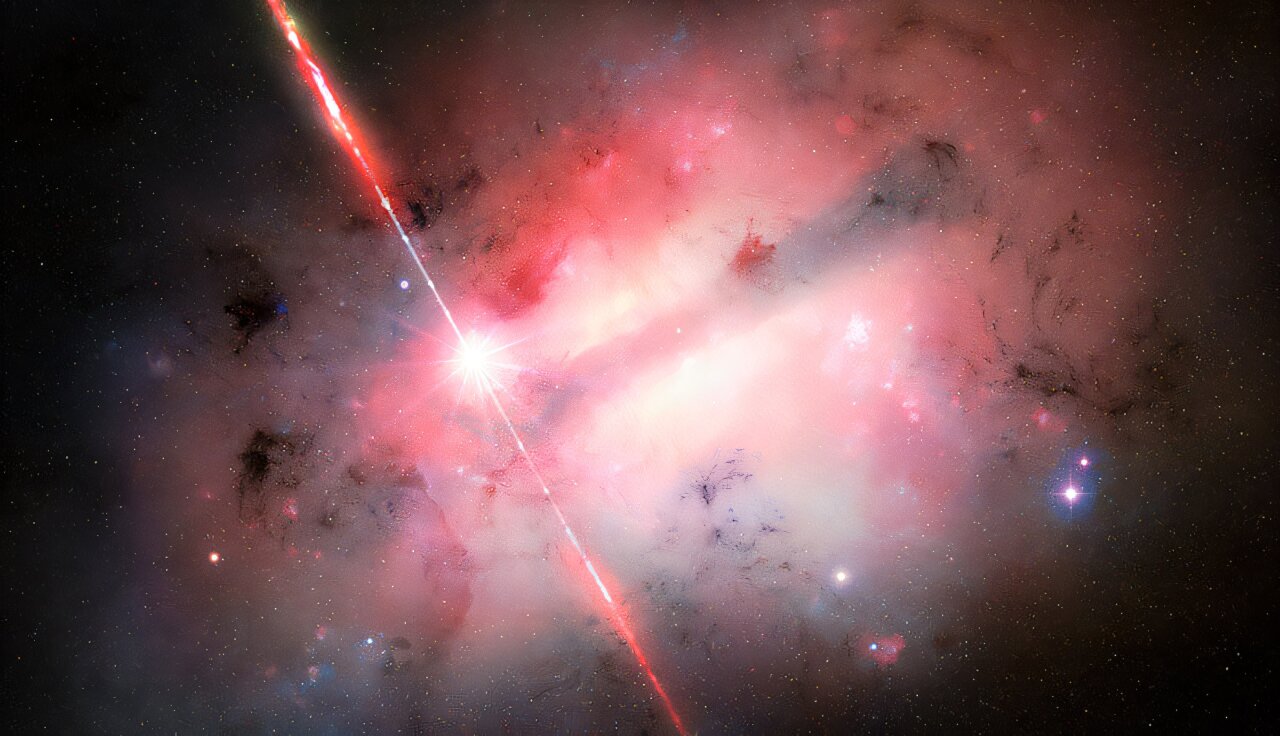
The gamma-ray burst lasted at least seven hours, which is almost twice as long as the previous record. NASA has released a video animation illustrating one possible explanation for the origin of GRB 250702B, showing a black hole about three times the mass of the Sun, with an event horizon only 18 kilometers in diameter, orbiting and merging with a companion star.
Scientists believe that the best explanation is that it is an extraordinary gamma-ray burst or an extraordinary tidal disruption event, when a medium-mass black hole, thousands of times heavier than the Sun, tore apart a star that came too close. Another, more exotic explanation is that the smaller black hole merged with a stripped star called a helium star, swallowing it from the inside.
In any case, the black hole didn’t just take a bite: it feasted, feeding on the jets of energy scattered throughout space.
NASA’s Fermi Gamma-ray Space Telescope first detected the phenomenon on July 2, and other observatories quickly joined in. The burst was so powerful that no single instrument could capture all of its details. Telescopes on Earth and in space worked together, collecting gamma rays, X-rays, infrared light, and radio waves. The phenomenon was not detected in visible light.
Distant galaxy at the site of the explosion
Photos from the Hubble Space Telescope showed a strange galaxy at the site of the explosion. It was unclear whether these were two merging galaxies or just one galaxy with a dark band of dust that seemed to divide the center into two parts. Later, images of the galaxy taken with the James Webb Telescope showed that it was located about 8 billion light-years away. This means that the explosion occurred long before Earth even existed.
To help unravel the mystery of the galaxy’s identity, Sears conducted observations using NIRCam, the James Webb Telescope’s primary near-infrared imaging instrument, several months after the explosion.
“In such vibrant and unprecedented detail, we see just one very large galaxy with a dust lane,” Sears said. “The galaxy has such a complex structure that it’s not 100% clear if there’s anything left to see of the explosion, but if there is, it’s really faint.”
Mystery of the gamma-ray burst
This clue supports the hypothesis that GRB 250702B was a gamma-ray burst rather than a tidal disruption event. But the mystery remains unsolved.
Astronomers have only seen a few similar cases of destruction caused by tidal forces, so they do not know exactly how they should develop. Many studies of this explosion offer different and sometimes contradictory explanations. Therefore, scientists do not yet fully understand what happened.
Whatever it is, scientists agree that it is a rare and important phenomenon, providing a unique opportunity to study the extreme conditions of the evolution of stars and black holes.
According to phys.org

