

Ballistics, the science of projectile propulsion, is at the heart of both ancient artillery and modern missile technology. Since the Second World War, the emergence of ballistic missiles, such as the German V-2, has demonstrated that a projectile launched along a steep trajectory can travel vast distances and hit targets beyond the horizon. Nowadays, ballistic missiles have become a strategic weapon: intercontinental ballistic missiles are capable of carrying warheads across the planet in a matter of minutes. At the same time, anti-missile systems designed to intercept such missiles are being developed. Today, the battlefield is expanding even further into space, where a new frontier of military technology is unfolding. In this article, we will examine three related aspects: the fundamentals of ballistics, state-of-the-art anti-ballistic missile systems (using the example of the US THAAD system and its counterparts), and potential scenarios for warfare in orbit.

Ballistics: from projectile trajectory to intercontinental missile
A ballistic trajectory is the path a projectile or missile takes under the influence of gravity and inertia after active acceleration is completed. Ballistic missiles are initially accelerated with the help of engines, and for most of their flight, they fly without engines in an arc trajectory, similar to an artillery shell. Unlike cruise missiles, which fly in the atmosphere with the help of wings and an engine, ballistic missiles are not aerodynamically controlled for most of the flight and follow a predetermined ballistic curve. To cover long distances, such rockets go into suborbital space flight, actually outside the atmosphere. For example, intercontinental missiles can ascend 4,500 kilometers above the Earth, meaning they pass through outer space before entering the atmosphere above their target. The flight of a ballistic missile is divided into three phases:
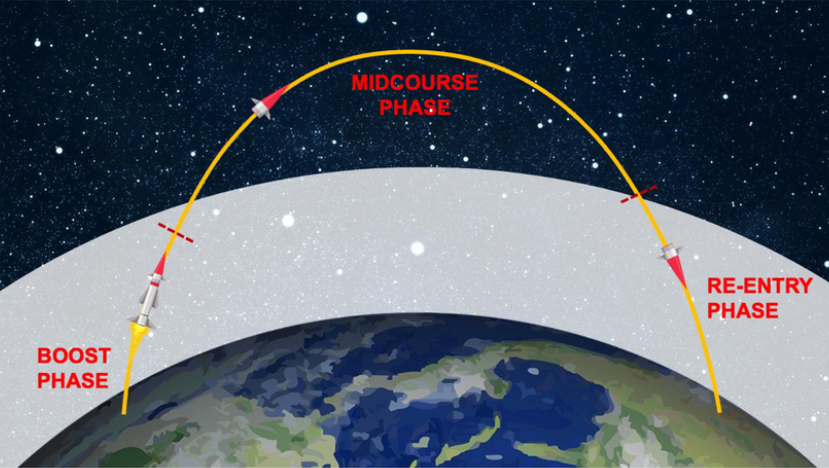
Boost phase (acceleration): engine operation immediately after launch. It lasts for several minutes until the rocket launches the warhead onto the trajectory.
Midcourse (space) phase: The rocket flies by inertia in the vacuum of space. During this phase, the warhead can reach maximum altitudes and speeds of up to 7-10 km/s (about 25,000-36,000 km/h). On long-range trajectories, the warhead can even enter a temporary orbit.
Re-entry phase: The warhead re-enters the atmosphere and falls on the target. At this stage, the speed remains extremely high, approximately 6-8 km/s (about 22,000-29,000 km/h). Due to friction with the atmosphere, the warhead heats up, but a special heat-shielding shell allows it to withstand this thermal load.
Such enormous speeds and altitudes make intercepting ballistic missiles technically extremely challenging. A missile launched from thousands of kilometers away can reach its target in 15-30 minutes, and for most of that time, it flies in space. It can carry not only one warhead, but also several (such as the MIRV system), as well as decoys to complicate interception. Modern ballistic missiles vary in range from tactical (less than 300 km) to intercontinental (over 5,500 km), but they all use the principle of ballistic flight to carry a warhead.

A clear example of the destructive potential of such missiles is demonstrated by test launches and combat use in recent years. For example, in October 2024, the most massive ballistic missile strike in history was recorded: about 200 missiles were fired in about 15 minutes at targets at a distance of 1500 km. This demonstrates how quickly ballistic weapons can strike at a great distance. That is why there is a need for special missile defense systems capable of detecting and shooting down a warhead flying from space.
State-of-the-art ballistic missile defense systems: THAAD and analogs
One of the most advanced missile defense systems is the American THAAD (Terminal High Altitude Area Defense) system. THAAD is designed to intercept short- and intermediate-range ballistic missiles at the final stage of their trajectory, i.e., when the warhead is already descending to the target. THAAD is unique in that it intercepts the target with a hit-to-kill: its interceptor does not have an explosive warhead, but destroys the warhead with a direct hit at high speed (“hit-to-kill”). This is similar to hitting a bullet into a bullet – an extremely difficult task given the space velocities of the targets.

THAAD is a mobile system: the launchers are mounted on trucks, which allows the system to be deployed in the desired region. The battery includes a powerful AN/TPY-2 radar, a control center, and up to 6 launchers (each with 8 missiles). The radar is capable of detecting missile launches and tracking warheads at long range (up to 1000 km in independent operation and up to ~3000 km in integrated mode). When the target is captured, the interceptor is launched, which in a few seconds gains a speed of more than Mach 8 (about 2.8 km/s) and rises to an altitude of 150 km, i.e., actually outside the atmosphere. At this altitude, in thin air or space vacuum, it collides with an enemy warhead. A successful direct hit means that the warhead is destroyed or deflected from the target.

The U.S. THAAD system has successfully demonstrated its effectiveness in tests and is deployed in a number of regions of the world. It complements the lower echelons of missile defense, such as the Patriot PAC-3 systems, which intercept missiles at lower altitudes and ranges. However, THAAD is not the only development of this class. Other countries also seek to have the means to counter ballistic threats. Let’s look at some well-known analogs and projects:
China – HQ-9 and HQ-19 systems. China has created its multi-layered missile defense system, partly based on technologies of Soviet origin. The HQ-9 long-range multifunctional air defense system is an analog of the S-300 family and is capable of hitting aerodynamic and some ballistic targets at long distances. Based on the HQ-9, China has developed the HQ-19, a modern strategic missile defense system. HQ-19 was first demonstrated publicly in 2024; it is often compared to THAAD. According to available data, HQ-19 is designed to intercept medium-range missiles (about 3000 km range) in the middle and terminal phases, meaning it can shoot down warheads both in space and during reentry. Its capabilities are impressive: the declared intercept range is up to 3000 km, the target altitude is over 200 km, and the intercept speed is up to 36,000 km/h. The HQ-19 can even neutralize hypersonic targets, which is a cause for concern in US military circles. In addition, due to its long range, the HQ-19 is theoretically capable of hitting objects in low Earth orbit, such as reconnaissance satellites. However, it should be noted that, unlike THAAD, the American system is already on combat duty, while China’s HQ-19 has not yet entered the stage of full deployment. Nevertheless, China is actively testing anti-missile technologies and has made several successful test interceptions of ballistic targets in space.

Source: scmp
Other countries. Other countries are also developing their missile defense programs. For example, India is working on a multilayer BMD (Ballistic Missile Defense) system and has already tested PDV interceptors to intercept ballistic targets. Israel, together with the United States, has created the Arrow-3 system capable of shooting down missiles at altitudes outside the atmosphere (sold to Germany for the development of the European missile defense system). South Korea is developing the L-SAM system, designed to complement Patriot and eventually have characteristics similar to THAAD. Thus, space-based interception technologies are no longer a fantasy; they are gradually becoming a reality in different countries.

Ukraine. Although Ukraine has historically not had its own developed long-range missile defense system, steps are being taken in this direction in response to missile threats. In 2023, it was officially announced that the development of a Ukrainian long-range air defense system, a strategic level of air defense capable of destroying targets at a distance of more than 100 km, would begin. In addition, the Ukrainian defense industry has been tasked with creating its analog of the Patriot system, and this project has been given the highest priority after 2022. Details are kept secret, but Ukraine offers European partners to co-finance and co-develop such a system. This is likely to be a system capable of intercepting ballistic targets at high altitudes, effectively filling the niche occupied by THAAD, SM-3, or Israel’s Arrow-3. Thus, even countries without traditional missile defense programs are now forced to invest in such technologies, as the realities of war have shown the importance of protection against missile attacks.

Options for warfare in orbit
Until recently, battles in space were the stuff of science fiction movies, but in the 21st century, this is becoming a very realistic scenario. Space has already turned into a critical space for military needs, with communication, navigation (GPS and similar), reconnaissance, and battlefield surveillance satellites in orbit. Control over spacecraft means information superiority, uninterrupted communications, and precision weaponry. Therefore, it is not surprising that the world’s leading powers have created separate space commands and space forces. Cheaper and smaller space technologies (e.g., the emergence of affordable nanosatellites) allow even relatively small countries to launch vehicles into orbit. The military, on the other hand, is seeking to use space for its purposes, hence the ideas of placing sensors, interceptors, and even weapons in outer space.
What could a war in orbit look like? There are several scenarios and methods of confrontation in space that have already been tested or are being considered:
Kinetic destruction of satellites (ASAT). Back in the 1980s, the United States and the Soviet Union conducted the first tests of weapons against satellites. For example, in 1985, an American ASM-135 missile launched from an airplane shot down a satellite in orbit. In 2007, China demonstrated a similar technology by destroying the old Fengyun-1C weather satellite with an interceptor missile. The effect of such actions was twofold. On the one hand, the ability to physically destroy an enemy vehicle was confirmed. On the other hand, it created a pile of debris in orbit. After China’s test in 2007, more than 100,000 fragments of space debris appeared in near-Earth space. This debris can damage other satellites at high speeds, leading to a chain reaction known as “Kessler syndrome”. In this scenario, the debris from one destroyed object shoots down other satellites, generating even more debris, and so on, until the entire orbital space becomes unusable. Thus, direct downing of satellites is an extreme step that can harm all parties to a conflict by littering a “valuable” orbit.

“Soft” disabling (non-kinetic methods). Recognizing the danger of debris, the military is developing means of non-kinetic impact on spacecraft. These can include cyberattacks and electronic warfare, such as hacking into the satellite’s software, jamming its communication signals, and blinding its sensors. All of this can disable a satellite without physical destruction. A promising area is also the use of laser weapons or microwave pulses to “blind” satellite sensors or burn out electronics on board. A laser beam directed from the ground or another spacecraft can damage the optics of a reconnaissance satellite or overheat its elements without causing fragments. Such methods are already preferable to blowing up spacecraft.

Space interceptors and “hunters”. Another option for warfare in orbit is special interceptor satellites that can approach a target and disable it. These can be either “kamikazes” (vehicles that ram an enemy satellite or explode nearby) or “hunter satellites” equipped with manipulators or suppression devices. Conceptually, similar systems were considered as early as the US SOI: the Brilliant Pebbles project envisioned the deployment of thousands of miniature interceptor satellites weighing ~14 kg, capable of independently targeting missile warheads and destroying them with a kinetic impact at speeds of 10-15 km/s. Today, technologies have become more mature for the realization of such swarms of low-cost space drones. For example, microsatellite inspectors are already being tested that can maneuver near other people’s vehicles, take pictures of them, or potentially interfere with their operations. Soon, we may see the emergence of “security satellites” that protect other valuable vehicles by blocking attacks or taking the hit for themselves. All of this is not fiction, but the direction in which military space technology is heading.

Defense against missiles from space. War in orbit is not only about satellites, but also about a new dimension of missile defense. As mentioned earlier, the deployment of interceptors in space allows ballistic missiles to be shot down in the middle of their path before they reach their target. Modern threats include hypersonic maneuvering warheads, against which traditional missile defense systems are ineffective due to their unpredictable trajectory and low altitude. In this context, a number of experts believe that the only real defense against hypersonic missiles is space-based. In particular, it is proposed to deploy satellite interceptor groups in low orbits that can massively destroy hypersonic units or other missiles flying in the upper atmosphere. The United States is already creating a new generation of satellites to detect launches and trajectories of hypersonic objects, and the issue of orbital missile defense is increasingly being raised at the highest level.
In general, the militarization of space is gaining momentum. It is believed that real hostilities in space, if they do occur, will be mostly covert and fleeting – a “cold” or “hybrid” war in orbit. A direct collision, such as the destruction of satellites by missiles, will be a last resort, as it harms the shared space environment. Instead, states will try to quietly weaken the enemy’s space capabilities: jamming communications, stealing data, and blinding sensors. Space is turning into a springboard for the deployment of numerous systems, from reconnaissance to strike, that will be used in future conflicts. Their impact on the course of wars may be no less than the deployment of nuclear missiles. Already today, several states have announced the creation of space weapons, and tests such as the destruction of satellites have become loud signals of a new stage in the arms race.
Conclusions
The development of ballistics and space technology is fundamentally changing the nature of warfare in the 21st century. Humanity has gone from throwing stones along a hinged trajectory to launching missiles that can cross continents in minutes along suborbital trajectories. In response to the ballistic missile threat, high-tech interceptor systems such as THAAD have emerged, which are a marvel of engineering in themselves, hitting “bullet to bullet” at an altitude of hundreds of kilometers. Other countries are developing similar systems, and a new competition is emerging: whose missile defense umbrella is more reliable? At the same time, combat operations are gradually moving beyond the atmosphere. Outer space can no longer be considered a neutral territory; it is becoming an arena for competition for superiority. Over the next decade, further progress in this area can be predicted: more advanced radars and interceptors, the potential use of laser missile defense, the deployment of orbital surveillance networks, and testing of new ways to neutralize enemy satellites.

Importantly, all of this race is taking place against the backdrop of attempts to maintain strategic stability. International agreements, such as the Outer Space Treaty of 1967, prohibit the deployment of weapons of mass destruction in space, but do not cover many modern weapons. Therefore, humanity is facing a challenge: how to introduce these new technologies without turning near-Earth space into a zone of chaos and destruction. Military technology has always been a double-edged sword – it can protect, but it also creates risks of escalation. In the case of ballistic missiles and space weapons, this balance is particularly delicate.
Ballistics, anti-missile systems, and warfare in orbit are three links in the same chain of technological progress in military affairs. The knowledge of the laws of projectile motion allowed us to create long-range missile weapons; the development of sensors and interceptors allowed us to defend against these weapons; and space exploration opened a new front where offensive and defensive systems meet. In the coming years, we will likely see breakthroughs and new challenges for humanity on this frontier of atmosphere and space. The task of the international community is to ensure that technologies serve to deter and protect, rather than to resolve destructive conflicts.


_interceptors_is_launched_during_a_successful_intercept_test_-_US_Army.jpg)
_missile_during_a_test.jpeg)
