

Astrophysicists from Northwestern University have made a sensational discovery that makes us rethink modern models of star evolution. The supernova they studied, named SN2021yfj, turned out to be a previously unseen type of explosion, allowing them to peer into the deep inner layers of a massive star just before its demise for the first time in the history of observations.
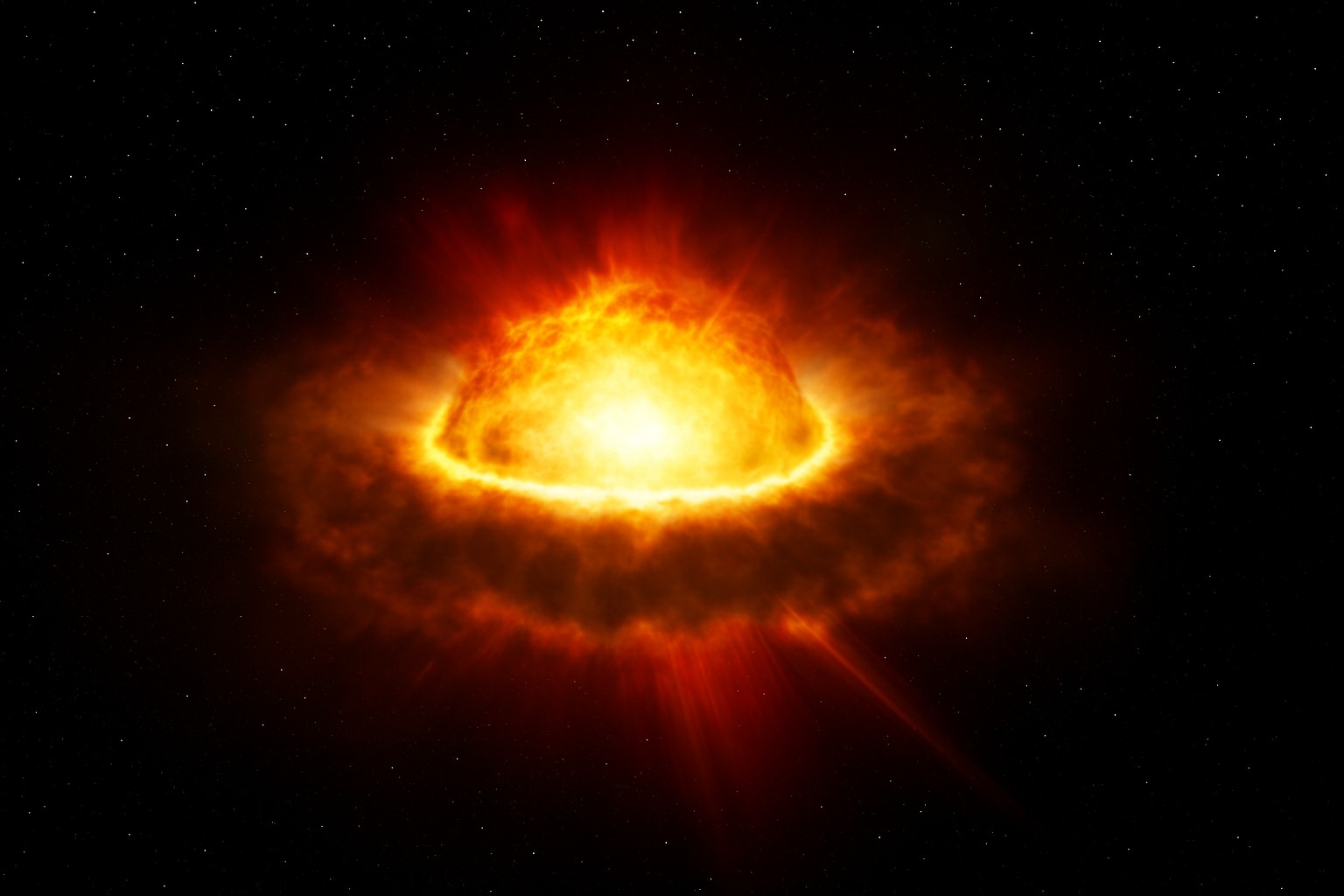
Typically, explosions of massive stars, known as supernovae, are characterized by a predominance of light elements — hydrogen and helium — in their spectrum. However, spectral analysis of SN2021yfj revealed a radically different picture. It revealed an extremely high content of heavy elements such as silicon, sulfur, and argon. These elements are usually formed and remain deep within the core of the star, never becoming visible to observers.
Steve Schulze, head of research, explained the significance of this phenomenon: “This is the first time we have seen a star that was essentially stripped to the bone. It shows us how stars are structured and proves that stars can lose a lot of material before they explode.”
Onion Theory
This discovery provided the first direct evidence for a long-standing theory about the onion-like structure of massive stars. Scientists assumed that such stars were composed of concentric layers, with the lightest elements on the outside and the densest and heaviest ones in the core. SN2021yfj seems to have removed the outer layers, demonstrating this structure in practice.
Adam Miller, senior author of the study published in Nature, emphasized the revolutionary nature of the discovery. “This event is literally unlike anything anyone has ever seen before. It tells us that our ideas and theories about the evolution of stars are too narrow.”
The team discovered the supernova in September 2021 using the Zwicky Transient Facility observatory in California. The observed object is located 2.2 billion light-years away in an area of active star formation. The acquisition of spectral data, without which the discovery would have been impossible, nearly failed: several large telescopes around the world were unavailable due to cloud cover or technical maintenance.
The situation was saved by a colleague from the University of California, Berkeley, who provided access to the powerful W.M. Keck telescope in Hawaii. “Without this spectrum, we might never have understood that it was a strange and unusual explosion,” Miller noted.
What caused such a catastrophe?
Analysis showed that an extremely powerful event probably completely stripped away the outer layers of the star. Researchers are considering several hypotheses, including interaction with a companion star or extremely powerful stellar winds. However, the most likely mechanism is considered to be a phenomenon known as pair instability. In this case, the massive star undergoes a series of powerful energy bursts that gradually strip away its outer layers, exposing the core.
“This star lost most of the material it had created during its lifetime,” explained Schulze. “Therefore, we could only see the material that had formed in the months immediately before its explosion.”
This discovery opens up new horizons for studying the final moments of stars’ lives and highlights the importance of searching for such rare phenomena to understand how the Universe creates and destroys its most massive objects.
Earlier, we reported on how astronomers studied the evolution of Type Ia supernovae.
According to northwestern.edu

